What Defines Authentic Mil-Spec American Made Body Armor
When lives are on the line, trust in your equipment is non-negotiable. For body armor, this trust often begins with its origin. In October 2026, the phrase “American-made” carries significant weight. It signifies a commitment to stringent quality control, robust manufacturing processes, and adherence to specific compliance standards. This isn’t just about supporting local industry; it’s about ensuring the ballistic protection you rely on meets the highest possible benchmarks.
This comprehensive guide will demystify what it means for body armor to be genuinely American-made. We will explore the critical definitions, advanced materials like ceramic, steel, and composites, and the essential NIJ certification processes that govern these products. We’ll also examine how these standards translate into real-world performance for various users. Understanding these factors is key to making an informed decision, ensuring your gear provides the uncompromising protection you expect from Mil-spec American made body armor.
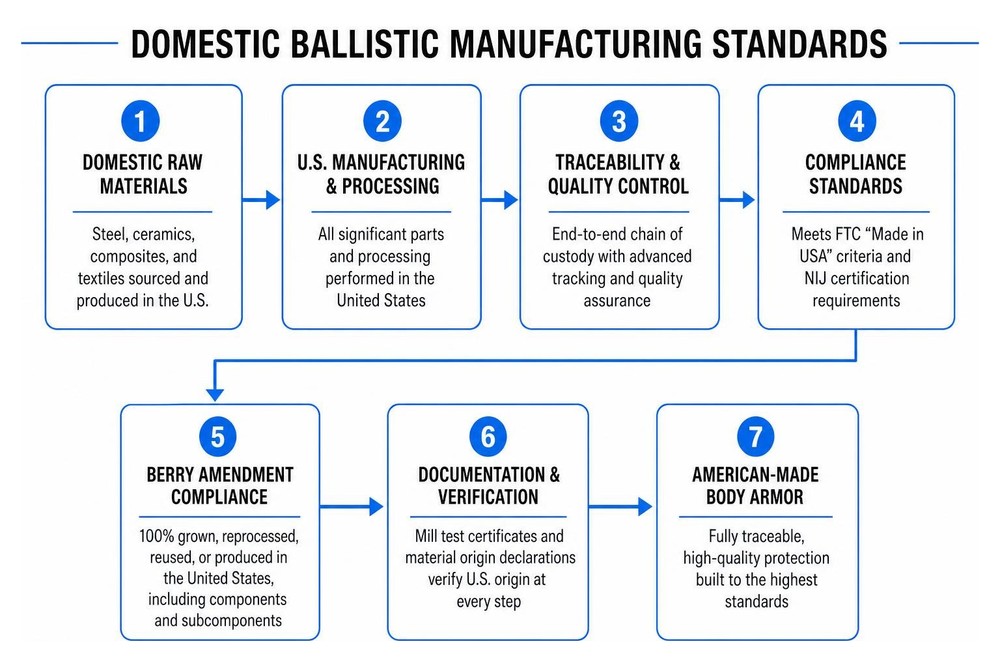
The designation “American-made” for body armor extends far beyond mere assembly within U.S. borders. It encompasses a rigorous adherence to domestic raw material sourcing, from the steel melt origins to the synthesis of technical ceramics. This commitment ensures a fully traceable supply chain, a critical factor in maintaining quality and mitigating the risks associated with counterfeit or substandard imported armor. The Federal Trade Commission (FTC) sets stringent “Made in USA” standards, requiring that “all or virtually all” of a product be made in the U.S. This typically means that all significant parts and processing that go into the product must be of U.S. origin, and the final assembly and processing must take place in the U.S. For body armor, this translates into every component, from ballistic plates to carrier materials, meeting these domestic criteria.
The importance of this domestic focus is multifaceted. It bolsters the U.S. defense industrial base, ensuring that critical life-saving equipment can be produced reliably and securely, independent of foreign supply chain disruptions. It also directly impacts the ballistic protection integrity of the product. When manufacturers control the entire process, from raw material to finished good, they can implement advanced tracking systems and quality assurance protocols, ensuring superior performance from the steel mill to the end user. This level of oversight is paramount for equipment designed to withstand life-threatening ballistic threats.
Understanding Berry Amendment Compliance and Traceability
For body armor intended for military and certain federal agency use, “American-made” often implies compliance with the Berry Amendment (10 U.S.C. 2533a). This legislation mandates that the Department of Defense (DoD) and other federal agencies procure certain items, including body armor, that are 100% grown, reprocessed, reused, or produced in the United States. This means not only the final product but also its components and subcomponents must originate domestically.
Meeting Berry Amendment requirements necessitates an unparalleled level of supply chain traceability. Manufacturers must provide comprehensive documentation, such as mill test certificates for steel alloys or raw material origin declarations for ceramic precursors and polyethylene fibers. This creates an end-to-end chain of custody, allowing for verification of every step in the manufacturing process. This stringent oversight helps to prevent the infiltration of non-compliant materials and ensures that the protective gear delivered to service members meets the highest standards of quality and reliability. In October 2026, with global supply chains still facing various challenges, this domestic sourcing and traceability remain a cornerstone of national security and equipment integrity.
NIJ Standards vs Military Specifications in US Manufacturing
While Berry Amendment compliance addresses origin, the effectiveness of body armor is primarily measured by its ability to stop ballistic threats. Here, two key sets of standards come into play: the National Institute of Justice (NIJ) standards for civilian and law enforcement body armor, and military specifications (Mil-Spec) for defense applications.
The NIJ-STD-0101.06, and its successor, the NIJ-STD-0101.07 (introduced in 2024), are the benchmarks for ballistic resistance in the United States. These standards define protection levels (e.g., Level IIA, II, IIIA for soft armor; Level III, IV for hard armor) based on the types of projectiles they can defeat. Testing involves firing specific ammunition at armor samples under controlled conditions. Key metrics include the V-50 ballistic limit, which is the velocity at which a projectile has a 50% chance of penetrating the armor, and backface deformation thresholds, which measure the indentation created on the clay backing behind the armor, indicating the amount of blunt force trauma transferred to the wearer. American manufacturers rigorously test their products to these standards, often exceeding the minimum requirements. For example, Caliber Armor AR550 Body Armor is NIJ-STD-0101.06 Level III Certified and Special Threat tested, demonstrating a commitment to validated performance.
Military specifications, while often overlapping with NIJ standards, typically involve additional, more rigorous requirements tailored to combat environments. These can include multi-hit defeat capability against military-grade ammunition (such as M80A1 or M2 AP rounds), performance across extreme temperature conditioning, resistance to environmental factors like salt spray and sand, and specific plate geometries (e.g., SAPI and ESAPI plates). For instance, Armored Republic’s A4 Level III++ Alloy Body Armor plates are manufactured in the United States and are designed to stop M80A1 at 2,800 FPS and M193 at 3,250 FPS, showcasing performance beyond typical NIJ Level III. American manufacturers like RMA Armament specialize in producing 100% American-made body armor that utilizes ultra-light and ultra-strong technologies, often developed to meet these exacting military specifications before becoming available to the broader market. The constant evolution of these standards ensures that American-made body armor remains at the forefront of protective technology.
Material Breakdown: Ceramic, Steel, and Advanced Composites
The choice of ballistic material is fundamental to body armor performance, influencing weight, protection level, and durability. American manufacturers excel in developing and producing advanced ceramic, steel, and composite solutions, each with distinct characteristics tailored to specific operational needs.
| Feature | Ceramic Armor | Steel Armor | Composite Armor |
|---|---|---|---|
| Primary Material | Boron Carbide, Silicon Carbide, Alumina | AR500, AR550 Ballistic Steel Alloys | UHMWPE (Ultra-High-Molecular-Weight Polyethylene) |
| Weight | Moderate to Light (depending on composition) | Heavy | Very Light |
| Protection Level | High (often Level IV capable) | Moderate to High (Level III, III+) | Moderate to High (Level III, III+) |
| Multi-Hit Cap. | Good (can degrade with multiple hits in same area) | Excellent (especially with spall liner) | Good (fibers absorb energy) |
| Durability | Brittle (can crack from drops/impacts) | Extremely Durable (resistant to drops/impacts) | Excellent (resistant to drops/impacts) |
| Shelf Life | Typically 5-10 years (resin degradation) | 20+ years | 10-15 years (UV/environmental factors) |
| Cost | High | Moderate | High |
| Threats | Rifle threats, AP rounds | Rifle threats (FMJ, M193, M80A1 with rating) | Rifle threats (FMJ, M193, M80A1 with rating) |
This table highlights the trade-offs inherent in each material type. Ceramic offers high protection at a reasonable weight but can be fragile. Steel provides robust durability and multi-hit capability at a lower cost but with significant weight. Composites, particularly those made from UHMWPE, deliver exceptional lightness and good multi-hit performance but come at a higher price point and can be sensitive to extreme heat. American innovation continues to push the boundaries of these materials, optimizing their weight-to-protection ratio and enhancing their multi-threat stopping power.
Ceramic and Composite Engineering in Mil-Spec American Made Body Armor
American engineering in ceramic and composite body armor represents the pinnacle of lightweight ballistic protection. These plates are typically constructed from advanced ceramic strike faces bonded to a composite backing. Boron carbide ceramics and silicon carbide matrices are favored for their extreme hardness and low density, making them highly effective at shattering incoming projectiles. The ceramic layer absorbs the initial impact, fragmenting the bullet, while the composite backing, often made from ultra-high-molecular-weight polyethylene (UHMWPE), catches the fragments and dissipates the remaining energy.
The development of Enhanced Small Arms Protective Inserts (ESAPI) and Small Arms Protective Inserts (SAPI) plates for the U.S. military showcased the effectiveness of this technology. ESAPI plates, for instance, are designed to stop armor-piercing (AP) rounds, a capability typically achieved through sophisticated ceramic compositions. American manufacturers continually refine these designs, focusing on multi-curve geometries for improved ergonomics and reduced thickness without compromising ballistic integrity. The goal is to produce lightweight ceramic multi-curve plates that offer superior protection while minimizing the burden on the wearer. This focus on advanced materials and precision engineering ensures that American-made ceramic and composite armor remains a preferred choice for military, law enforcement, and civilian users seeking high-level, lightweight protection.
Ballistic Steel Alloys and Spall Containment
While ceramic and composite materials dominate the lightweight, high-end market, ballistic steel alloys remain a vital component of American-made body armor, particularly for their durability, cost-effectiveness, and excellent multi-hit capability. High-hardness AR500 steel and more advanced AR550 ballistic alloys are the industry standards. These steels are specifically treated and hardened to resist penetration from various rifle threats. Every piece of AR500 and AR550 steel is proudly manufactured in the United States, with advanced tracking systems ensuring superior quality assurance from steel mill to end user. This domestic production ensures consistent quality and performance.
A critical aspect of steel body armor is spall containment. When a bullet strikes a steel plate, fragments of the projectile and the plate material itself (known as spall) can be ejected, posing a secondary threat to the wearer. American manufacturers address this through specialized coatings and wraps. Polyurea anti-fragmentation coatings are commonly applied to the strike face of steel plates. These coatings encapsulate the spall, preventing it from injuring the wearer. Similarly, spall containment wraps, often made from durable fabrics or specialized composites, encase the plate edges. This comprehensive approach ensures that while the steel provides the primary ballistic stop, the spall containment measures protect against secondary fragmentation, maintaining the multi-hit structural integrity of the armor system. The 20-year shelf life often associated with these steel plates further underscores their robust and reliable nature.
Evaluating Plate Carrier Systems and Concealable Soft Armor
Beyond the ballistic plates themselves, the effectiveness of body armor relies heavily on the systems that carry and integrate them. American manufacturers apply the same rigorous standards to plate carrier systems and concealable soft armor, focusing on domestic textile fabrication, ergonomic design, and tactical functionality.
Structural Rigidity and Load Carriage for Mil-Spec American Made Body Armor
Plate carriers are more than just vests; they are tactical load carriage systems designed to distribute the weight of hard armor plates and mission-essential equipment efficiently. American-made plate carriers often utilize Berry-compliant materials such as 500D Cordura nylon or the even more robust 1000D ballistic nylon. These materials are chosen for their exceptional tear resistance, abrasion resistance, and durability in harsh environments. The stitching, often reinforced with bartacks and double seams, is also domestically performed to meet stringent quality standards.
Modern American plate carriers feature advanced designs for structural rigidity and optimal load distribution. Laser-cut MOLLE (Modular Lightweight Load-carrying Equipment) systems provide precise attachment points for pouches and accessories while reducing overall weight compared to traditional webbing. Quick-release buckles and structural cummerbunds allow for rapid donning and doffing, as well as improved weight distribution around the wearer’s torso. The ergonomic design ensures that the weight of hard armor plates and gear is managed effectively, reducing fatigue during extended operations. This attention to detail in material, construction, and design ensures that the carrier system is as reliable and durable as the ballistic plates it holds.
Essential plate carrier features typically include:
- Adjustable Shoulder Straps: For proper plate height and comfort.
- Cummerbund System: For weight distribution and secure fit.
- MOLLE/PALS Webbing: For attaching modular pouches and accessories.
- Plate Pockets: Designed to fit specific SAPI/ESAPI or commercial plate sizes.
- Internal Padding/Mesh: For ventilation and comfort.
- Drag Handle: For emergency extraction.
- Quick-Release Mechanism: For rapid removal in emergencies.
- Admin Pouch/Integrated Storage: For small essential items.
Soft Armor Ballistics and Fiber Innovation
Concealable soft armor, designed for discreet wear under clothing, relies on advanced fiber innovation to provide protection against handgun threats and blunt force trauma. American manufacturers are at the forefront of developing and utilizing high-performance woven aramid fibers, such as Kevlar KM2 filament, which offers superior ballistic protection at reduced weight. This material was famously used in the Interceptor Body Armor (IBA) system, providing 25% more protection for less weight than previous materials.
Soft armor panels are constructed from multiple layers of these ballistic fibers, which work by catching and deforming the bullet, spreading its energy over a larger area. Beyond ballistic stopping power, American-made soft armor also incorporates blunt trauma mitigation panels. These layers, often made from specialized foam or non-Newtonian materials, absorb and disperse the kinetic energy that passes through the ballistic layers, significantly reducing the severity of non-penetrating injuries. The architecture of concealable soft vests is carefully designed to be thin, flexible, and comfortable for extended wear, often incorporating features like deltoid and axillary coverage for enhanced protection of vital areas without compromising mobility. Premier Body Armor, for example, offers a lifetime incident guarantee, replacing any vest or panel that saves a life, underscoring the confidence in the life-saving capabilities of American-made soft armor.
Critical Factors Driving US Ballistic Demand in 2026
As of October 2026, several key factors continue to drive the demand for American-made body armor across various sectors. These factors reflect a broader understanding of security needs, technological advancements, and strategic priorities.
Firstly, supply chain security remains a paramount concern. Lessons learned from recent global events have underscored the vulnerabilities of relying on foreign sources for critical protective equipment. Domestic manufacturing ensures a stable, reliable supply, free from geopolitical disruptions, export restrictions, or quality control issues inherent in distant supply chains. This strategic independence is vital for national security and emergency preparedness.
Secondly, law enforcement modernization initiatives are leading to increased demand for advanced, lightweight, and multi-threat capable armor. Police departments across the nation are updating their equipment to address evolving threats, including the proliferation of rifle-caliber weapons. American manufacturers are uniquely positioned to provide tailored solutions that meet specific agency requirements, offering custom fits and specialized protection levels.
Thirdly, defense readiness initiatives continue to fuel the procurement of state-of-the-art ballistic protection for military personnel. The U.S. military consistently seeks to equip its forces with the best available technology, and American manufacturers are often at the forefront of developing next-generation armor systems. This includes ongoing research into lighter, more durable, and more effective materials capable of defeating increasingly sophisticated threats.
Finally, the continuous pursuit of advanced threat mitigation and domestic quality assurance testing drives demand. American manufacturers invest heavily in research and development, pushing the boundaries of ballistic science. This innovation, coupled with rigorous, independently verified testing to NIJ and military standards, provides an unparalleled level of confidence in the product’s ability to perform when it matters most. The assurance that body armor has been manufactured under strict quality controls, with traceable materials, and proven performance, is a non-negotiable requirement for users whose lives depend on it.
Frequently Asked Questions About Domestic Protective Gear
How do military SAPI and ESAPI plates differ from NIJ Level IV armor?
While both military SAPI/ESAPI plates and NIJ Level IV armor are designed to stop rifle threats, they are distinct in their specific threat matrices and testing protocols. NIJ Level IV is the highest protection level under the NIJ-STD-0101.06/07 for hard armor. It is specifically tested to defeat a single shot of a .30-06 M2 armor-piercing (AP) round. This is a very high standard, indicating robust protection against common AP threats.
Military SAPI (Small Arms Protective Inserts) and ESAPI (Enhanced Small Arms Protective Inserts) plates, on the other hand, are developed under military specifications. SAPI plates are typically designed to stop multiple hits of 7.62x51mm M80 FMJ (Full Metal Jacket) rounds. ESAPI plates are an upgrade to SAPI, specifically engineered to defeat multiple hits of .30-06 M2 AP rounds, similar to or exceeding NIJ Level IV in AP capability, but often with additional multi-hit requirements. A key difference also lies in their configuration: NIJ Level IV can be “standalone” (providing full protection by itself) or “in-conjunction” (requiring soft armor behind it). Military plates are almost always designed as standalone or as part of a specific system (like the Interceptor Body Armor, which uses SAPI/ESAPI in conjunction with a soft vest for comprehensive protection). The military also imposes stricter environmental testing (temperature, humidity, drops) that NIJ standards do not always cover to the same extent.
What indicates that body armor is genuinely manufactured in the United States?
Identifying genuinely American-made body armor requires looking beyond simple claims. Several key indicators confirm domestic origin:
- FTC Domestic Origin Rules: The Federal Trade Commission’s “Made in USA” standard requires that “all or virtually all” of a product be made in the U.S. Reputable manufacturers will explicitly state their compliance with these rules.
- Department of Defense CAGE Codes: For manufacturers supplying to the military or government, a Commercial and Government Entity (CAGE) code is assigned by the DoD. While not exclusive to American manufacturing, it indicates a registered entity capable of government contracts, often implying domestic production capabilities for sensitive items like body armor.
- Documented Raw Material Origins: True American-made armor will have verifiable documentation for its raw materials. This includes mill test certificates for ballistic steel (confirming U.S. melt and processing), and origin statements for ceramic precursors, UHMWPE fibers, and even the textiles used in plate carriers. Manufacturers should be able to provide evidence of a Berry Amendment compliant supply chain if they claim it.
- Verifiable Laboratory Test Reports: While not directly proving origin, independent NIJ certification and special threat testing conducted by accredited U.S. laboratories lend credibility to the manufacturer’s quality control processes, which are typically stronger with domestic production.
- Manufacturer Transparency: Leading American manufacturers are often transparent about their facilities, processes, and sourcing. Companies like RMA Armament proudly state their 100% American manufacturing, utilizing advanced technologies developed domestically.
How does shelf life vary across different American-made armor materials?
The shelf life of body armor is a critical factor influencing its long-term reliability and replacement cycles. It varies significantly depending on the primary ballistic material:
- Ceramic Composite Armor: Typically has a shelf life of 5 to 10 years. The primary reason for this limitation is the degradation of the resin systems used to bond the ceramic strike face to the composite backing. Over time, environmental factors like temperature fluctuations, humidity, and UV exposure can cause the resin to become brittle, compromising the structural integrity and ballistic performance of the plate.
- Polyethylene (UHMWPE) Composite Armor: Generally has a shelf life of 10 to 15 years. While UHMWPE itself is highly stable, the resins and adhesives used in its construction can degrade, similar to ceramic composites. Extreme temperatures, particularly prolonged exposure to high heat, can also affect the material’s molecular structure and ballistic properties. Proper storage conditions are crucial to maximize its lifespan.
- Ballistic Steel Alloy Armor: Offers the longest shelf life, typically 20 years or more. Steel is an inherently stable material that does not degrade significantly over time under normal storage conditions. The primary concern for steel plates is the integrity of their anti-spall coatings or wraps, which can degrade or detach over decades. However, the ballistic steel itself maintains its protective properties for a very long period, making it a highly durable option. Armored Republic’s A4 Level III++ plates, for example, are manufactured with a 20-year shelf life.
Regardless of material, all body armor should be inspected regularly for signs of wear, damage, or delamination. Adhering to manufacturer-recommended storage condition protocols, such as keeping armor in a cool, dry place away from direct sunlight and harsh chemicals, is essential for achieving its stated shelf life.
Conclusion
In October 2026, the decision to invest in American-made body armor is more than a preference; it’s a strategic choice rooted in unwavering quality, verifiable compliance, and robust reliability. From the initial sourcing of domestic raw materials to the final, rigorous ballistic testing, every stage of production within the United States is subjected to stringent oversight. This commitment ensures that the life-saving equipment delivered to law enforcement, military personnel, and civilian users meets the highest possible benchmarks for ballistic protection integrity.
The meticulous adherence to Berry Amendment requirements, the continuous innovation in materials like advanced ceramics, ballistic steel alloys, and UHMWPE composites, and the rigorous certification against NIJ and military standards collectively define the superior performance of American-made body armor. By prioritizing domestic procurement verification, buyers contribute to a resilient defense industrial base while securing equipment that offers uncompromising protection. The future of ballistic manufacturing standards will undoubtedly continue to evolve, but the foundation of quality, trust, and life-saving reliability inherent in American-made body armor will remain paramount.