Not all flat roof waterproofing products have improved at the same rate. Old technologies such as built-up roofing and modified bitumen are still being specified on large commercial projects, and traditional single-ply EPDM is still being installed, even though the adhesive seam problem was never solved. The performance gap between these systems and the advanced heat welded single-ply thermoplastics has grown so wide that it no longer makes sense to treat them as equivalent options.
Why built-up roofing was always a seam problem waiting to happen
Building up a roof using bitumen felt made perfect sense at the turn of the 20th century when it was the best material we had. Keep layering the stuff and the waterproofing performance will continue to improve. The same isn’t true of today’s materials, but that’s another story. The problem with BUR was always at the edges and seams.
Every single ply of felt in a BUR roof has a lap edge produced by mopping hot bitumen to fix it both into and over the previous layer. Bitumen in its heated liquid state is an adhesion point, mopped onto a cold edge. That makes the lap a structurally important point, using a material that is both wholly reactive and extremely temperature sensitive.
In winter it can become so cold that it is dislodged by even a slight level of building movement. On a hot August day, particularly where roofs face due south, the bitumen can re-melt and ooze out. This process will rapidly become exaggerated by heat and sunlight, since the primary mode of bitumen’s failure is oxidation caused by UV. Over time, the first point of failure on a BUR roof will always be the laps, transitions, upstands, and flashed edges. They are weaker than the body of the roof and have been designed to be so.
Modified bitumen got closer, but not close enough
Modified bitumen – torch-on SBS or APP sheets and their self-adhered cousins – provided a step change from BUR. It was more elastic, with far better low-temperature flexibility, and the elimination of several layers was a game-changer. For a couple of decades, starting in the 1980s, it was the default for commercial re-roofing.
The issues are still there, however. You still need to use an open flame when torch-applying modified bitumen, and that isn’t only risky when working on a timber substrate or retrofitting occupied buildings – it can also be a very real insurance liability risk. One insurable incident every few years is more than enough to convince underwriters to substitute your product on the spec.
Self-adhered modified bitumen won’t incur the wrath of your brokers, but on the downside, you are introducing latent failure mechanism number two: poor lap adhesion. The adhesive bond at the laps isn’t as strong as the sheet. Given enough thermal cycling – a flat roof in a northern city can go from above 60°C at the roof surface in July to well below zero in January – the sheet will expand and contract and the lap adhesion cannot keep up. The edge of the sheet will lift. Water will track back. The failure mode of a self-adhered modified bitumen roof is so well understood that a decent surveyor will know where to look first.
What specifiers should be demanding from a flat roof system
If you’re specifying flat roof waterproofing products on a commercial project, the minimum technical bar is a weldable, scrim-reinforced thermoplastic membrane backed by independent third-party certification and a long-form system guarantee – not just a material guarantee.
Independent certification matters because it provides tested performance data rather than manufacturer claims. BBA certification and equivalent European building approvals give specifiers documented evidence of expected membrane lifespan and system performance under UK and European conditions. Specifying a membrane without it is specifying against your own interest.
The guarantee structure matters too. A material only guarantee that doesn’t cover the system – insulation interface, fixing method, flashing details, drainage design – leaves liability gaps that become expensive in year 8 when a detail fails and no one accepts responsibility for the whole assembly.
The range of alwitra products includes the Evalon ECB membrane, which combines genuine weldability with bitumen compatible chemistry and is available with full system certification appropriate for commercial and public sector specification. That combination of chemical profile and welded installation is exactly what the failure analysis above points toward.
The installation method choice – mechanically fastened or fully adhered – also warrants specific attention at specification stage. Mechanically fastened systems allow differential movement between membrane and deck, which is appropriate for certain substrates and wind uplift requirements. Fully adhered systems create a tighter thermal envelope by eliminating the air movement channels that can develop under a mechanically fastened membrane. For projects targeting demanding Part L U-values with PIR insulation, fully adhered installation over rigid boards maintains the thermal continuity that makes the insulation specification worthwhile. A PIR board specification that loses 15% of its effective performance to air movement under the membrane is a U-value you’re paying for but not getting.
EPDM and the seam that outlives its usefulness
EPDM rubber membranes are extremely tough stuff. The rubber itself, in the heart of a sheet properly laid down, will be one of the longer-lasting components of this setup. The issue is the seam.
EPDM isn’t a thermoplastic. It can’t be hot-air welded. Each and every lap joint must take the chances on adhesive bonding or tape sealing, and those bonds are not molecular but mechanical. Industry seam-strength testing has been consistently replicating this result: hot-air welded thermoplastic seams reach bond strength of 90% or better of the membrane’s tensile strength – in many tests the sheet tears before the seam comes apart – and aged adhesive or tape-sealed EPDM seams drop to 60-70% of peak peel and shear strength. This is why seam failure dominates wherever EPDM roofs are being surveyed to locate leaks. The membrane did not fail. The joint did.
If the failure mechanism is in the connection method rather than the quality of the material, you cannot spec your way beyond it by ordering a better grade of EPDM. Your limit is the seam.
What heat-welded thermoplastics actually change
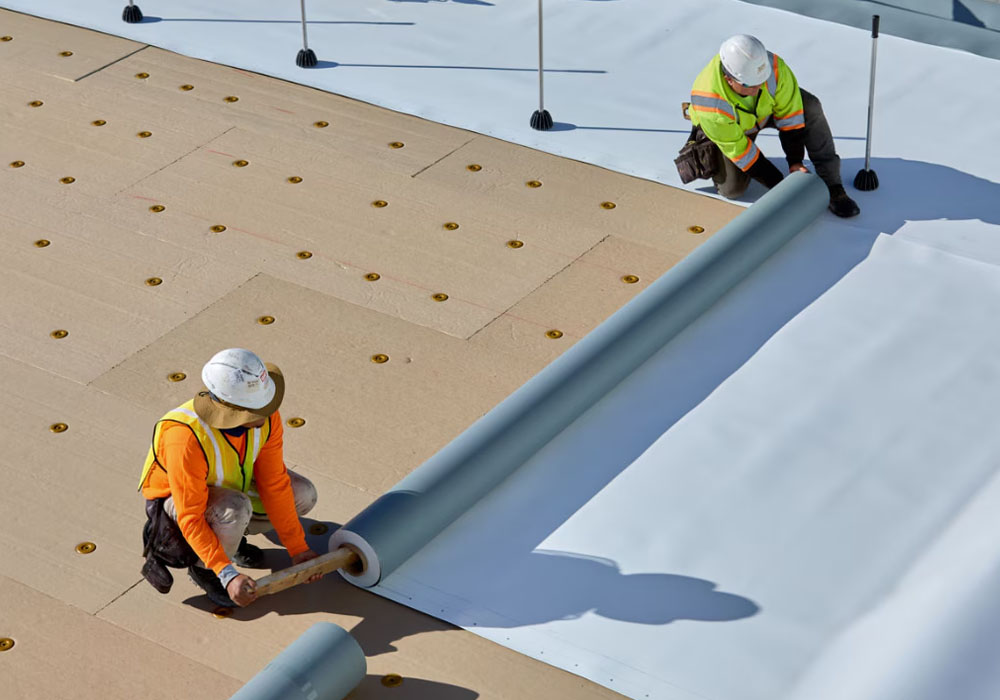
Transitioning to PVC and ECB membranes that are installed through hot-air welding does more than just replace an existing material. It significantly changes the design concept behind a flat roof waterproofing system.
Hot-air welding connects the protective lap of two sheets by heating and melting the materials directly and then pressing them together under even pressure. This doesn’t create a seam that consists of two sheets glued together – but rather forms a single, solid sheet. This type of connection doesn’t receive its mechanical strength from a third, glued material that may age differently from the membrane material. While in every other technology the membrane seam has always been the weakest point, in a thermoplastic welded system it is essentially the same material as the rest of the surface.
PVC membranes are the most common kind of single-ply membrane on commercial flat roofs and everyone knows of their high chemical resistance and protection against UV. Ethylene-copolymer bitumen formulations (ECB) add bituminous surface compatibility for a sheet that can be hot-welded. That’s why they are the go-to choice for projects that include a bituminous surface or use a variety of systems together. The advanced forms of both types involve a polyester scrim embedded within the sheet. This scrim not only strengthens the membrane under stress but also gives it its dimensionally stable properties.
Without adequate reinforcement, through usage thermal shrinking and expanding will lead to an increase in edge tearing and blistering – implicating the quality of the weld. A reinforced membrane is not an option in a long-lasting, high-performance roof – it is the deciding factor between a roof that holds its shape over 25 years and one that doesn’t.
The torch-free advantage on retrofit and occupied buildings
Site safety is now a real selection driver, not a nice-to-have. More flat roof replacements happen on the roofs of working commercial buildings – hospitals, schools, and distribution centres working to tight schedules – and the ‘no open flame’ taboo gets stronger.
Hot-air welding has no open flame. The equipment is automated, the weld parameters can be pre-set, and the fire risk is restricted to the working at hand, rather than the method. On timber deck structures, where torch-on modified bitumen is often written out of the design by the structural engineer or the building insurer irrespective of the quality of the operative, single-ply thermoplastic welding isn’t just preferred, it works as the only solution the client will ever see on a real-life tender sample.
Cold application also means no fumes. On a working building, this is no small consideration. In being able to demonstrate that a full waterproofing system can be laid down without solvent or combustion fumes penetrating to a working area, you remove one of the major reasons why night working might be preferred and spike a healthy chunk of an electrician’s weekly overtime bill.
Reflective membranes, green roofs, and the changing specification brief
The expectations around flat roof performance have changed. It has to work a lot harder than it used to. Twenty years ago, all you wanted a flat roof to do was shed water. Not any more. Your flat roof must now help you meet energy performance targets. It is often specified as part of a green or blue roof assembly. Your flat roof may even be required to support solar panels, either at the time of construction or as a future installation.
Reflective light-coloured single-ply membranes reduce the amount of solar heat absorbed at the roof surface, and thus the cooling load for mechanically ventilated buildings. They are increasingly seen as a necessary tool to help mitigate the urban heat island effect, which local authorities are starting to use as justification to require lower solar absorption rates in their demands for planning permissions. Traditional dark bitumen surfaces suck up heat. White or grey thermoplastic membranes reflect it. This isn’t a marginal improvement in performance – on a large commercial roof in summer, temperature variations of 30°C and more are not unusual between dark and light membranes.
For vegetated roof applications, the root-resistance of the waterproofing membrane is non-negotiable. Advanced single-ply membranes with confirmed root-resistance ratings are the standard specification for green roof waterproofing. BUR and modified bitumen lack the root-resistance certification that most landscape engineers require for planting schemes, which effectively excludes them from an increasing proportion of new commercial construction projects.
Lifecycle cost is the argument that should end the debate
Traditional bitumen-based systems are often selected based on their first cost. And yes, the installed cost per square metre may look competitive. But the life-cycle cost is not.
Modified bitumen and BUR roofs that need reactive maintenance and early strip-and-replace intervention within 10 to 15 years don’t compare favourably against single-ply systems carrying 20 to 25 year system warranties with documented low maintenance requirements. Strip-out of a failed bitumen roof has its own cost – disposal, contamination risk, lost operational time – that doesn’t show in the original specification comparison.
Single-ply welded membranes have been able to command these long warranties because the failure mechanisms of the traditional systems – seam adhesion degradation, lap curl, bitumen oxidation – simply don’t apply to them. A welded seam that is molecularly the same material as the sheet it’s welded to doesn’t degrade differently from it.
The specifier who picks the cheaper installed option on a building that will be in service for 30 years isn’t saving money. They’re deferring a replacement project and building the cost of it into someone else’s budget.
Closing
It’s not that flat roofing materials have been superseded by marketing. It’s that performance-based design and procurement require you to critically evaluate the root causes of failure of your historically-chosen flat roofing materials. Heat-welded, scrim-reinforced thermoplastic membranes address the seam problem directly, remove the site safety risk, and hold their performance over a timeframe that makes whole-life cost comparisons straightforward. For commercial flat roof waterproofing specification, the rational default has changed.