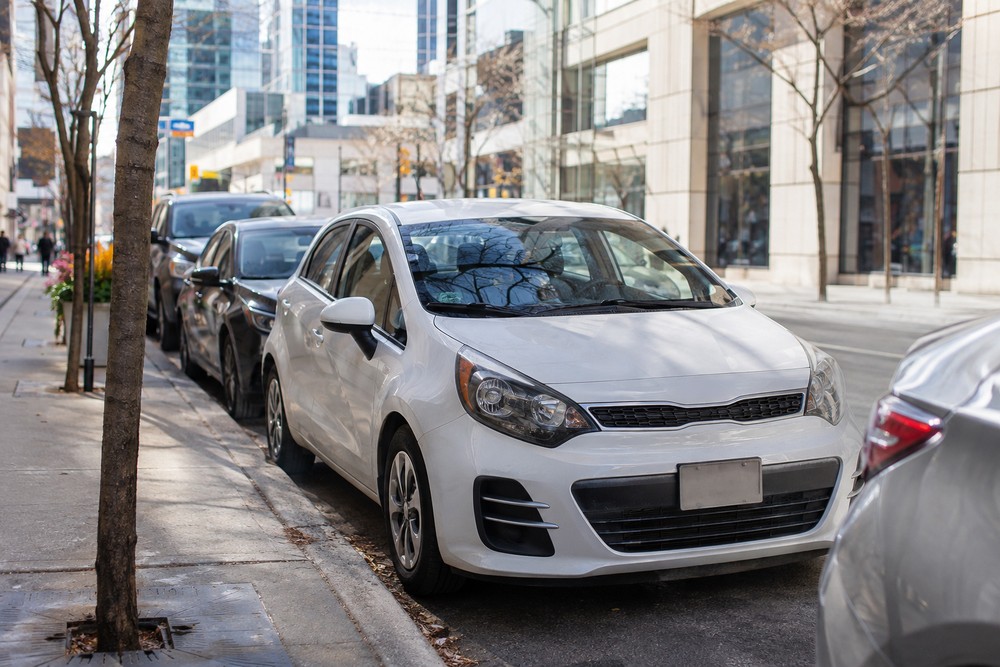
Urban drivers tend to describe the cost of their car in one number, usually the payment, occasionally the payment plus gas. It is a tidy figure and it is wrong by a wide margin. The expensive part of keeping a car in a dense city is not the car. It is the city.
Density charges rent on everything. Space costs money, so parking costs money. Traffic costs time, and time spent idling costs fuel. Short trips at low speeds wear brakes and tires faster than long highway runs, and the same congestion that slows you down raises the odds of the low-speed scrape that eventually shows up on a renewal. None of it arrives as a single bill, which is exactly why it goes unnoticed.
Toronto makes a useful worked example, partly because the numbers are published and partly because the pressures are familiar to anyone driving in a large metro. Here is where the money actually goes.
Parking Is a Quiet Second Payment
Street parking in a dense neighborhood is rarely free and never guaranteed. The City of Toronto’s residential on-street permit fees run $24.23 a month plus HST for a first vehicle where the household has no on-site parking, $70.35 for a second vehicle, and $97.97 a month if you do have a driveway and want the permit anyway. The city also notes that fees rise annually with inflation, and that a permit issued mid-month is still charged that whole month.
Stack a permit on top of occasional paid lots, the odd ticket, and a monthly spot if you work downtown, and parking can rival a modest loan payment. Households with two cars feel it hardest, since the second permit costs nearly three times the first.
Congestion Converts Time Into Fuel
Commute length is the clearest proxy for urban friction. Statistics Canada’s 2025 commuting figures put Toronto’s average one-way commute at 34.9 minutes, the longest in the country and up 1.6 minutes year over year, against a national average of 26.7 minutes. Car commuters nationally averaged 24.7 minutes, so a Toronto driver is spending meaningfully more of the day in traffic than the typical Canadian behind the wheel.
That time has a fuel price attached. Natural Resources Canada notes that idle stop-start systems cut city fuel consumption by four to ten percent or more, which tells you how much fuel urban stopping burns in the first place. The same agency puts air conditioning’s penalty at up to twenty percent, and cites EPA estimates that a drop from 24 to 7 degrees Celsius raises urban fuel use by twelve to twenty-eight percent. Short, cold, stop-heavy trips are the worst case, and they are also the standard city commute.
Wear and Depreciation Bill You Later
Mechanical wear in the city is not linear with distance. Brakes, clutches, suspension bushings, and tires all age by event rather than by kilometer, and city driving is nothing but events. A car that covers 12,000 urban kilometers a year can need more service than one that covers 25,000 on the highway.
Depreciation is the quietest line of all because nobody writes a cheque for it. It shows up once, years later, when you sell. Parking lot dings, curbed wheels, and a rough service history all take a bite then, and urban cars collect those at a faster rate. Treat depreciation as a monthly cost in your own accounting even though no one invoices you for it.
Coverage Reflects Where the Car Sleeps
Insurers price territory, and dense territory prices badly. More vehicles per square kilometer means more collisions, more theft, more vandalism, and more claims per insured car, and your postal code carries that history whether or not you contributed to it. Moving two neighborhoods over can change a premium more than changing cars.
What you can still control is who rates the file. Two insurers reading identical information routinely land hundreds of dollars apart, because each prices from its own claims experience. A broker quoting Car insurance in Toronto across several markets does in one pass what you would otherwise do in ten phone calls, and the comparison is worth repeating at every renewal rather than every third one.
Deciding What the Car Is Actually For
Once the real total is on paper, the useful question changes. It stops being how to shave a few dollars off each line and becomes what outcome the car is supposed to produce. Some households need daily reliability; others need a vehicle twice a month and are paying urban rates for the privilege of owning rather than renting. This argument for picking the outcome before the tool applies to vehicles as neatly as it does to debt.
Putting the Real Number on Paper
Add it up honestly: payment, fuel at city consumption rather than the sticker rating, insurance, permit, occasional paid parking, maintenance priced for stop-and-go wear, and a depreciation line you invent yourself. The total usually lands well above what people quote at dinner, and seeing it written down is the point.
From there the decisions are ordinary. Keep the car and cut the controllable lines, or keep it and stop pretending the cheap number was real, or go down to one vehicle and spend the difference on transit and the occasional rental. All three are defensible. Only the version where nobody does the arithmetic is expensive by accident.