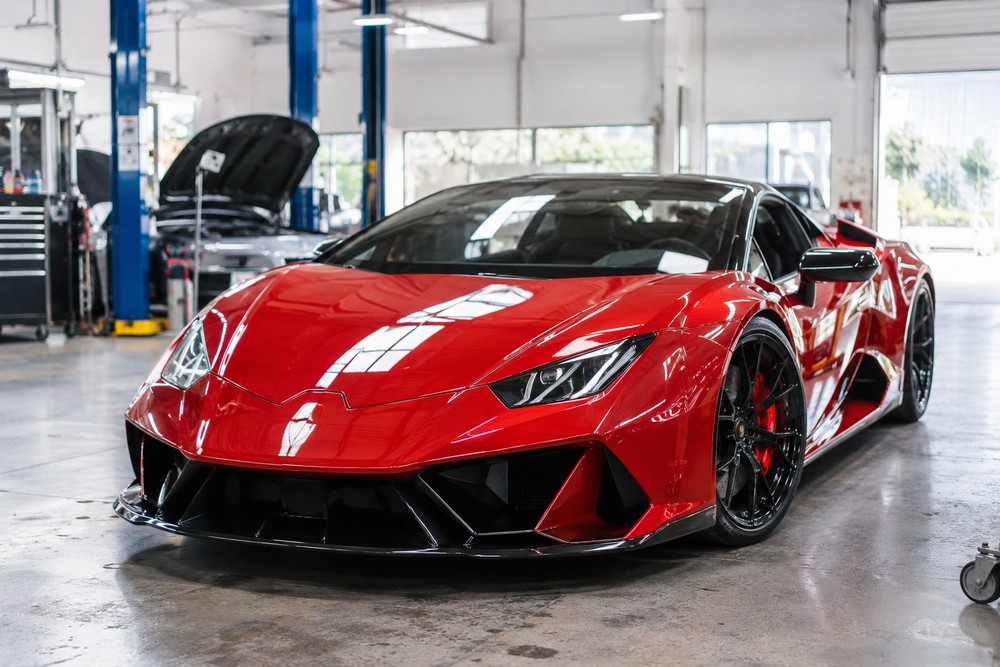
Six weeks. That is what a friend of mine lost last spring, not on parts, not on money, but on a shop that kept telling him the widebody kit was “almost there.” He had a Lamborghini Urus, a clear vision, and zero leverage, because he never asked what happened if the timeline slipped.
Most people shopping for exotic car customization in Miami spend their energy on the spec sheet. Carbon weave, wheel finish, tint percentage. The spec sheet is the easy part. The hard part is understanding how the work actually moves through a shop, and where your car sits when it isn’t moving at all. Get that part right and the rest follows.
Here’s what nobody puts on the brochure: customization is a scheduling problem wearing a paint job. Once you see it that way, every decision gets simpler.
What separates a real customization shop from a parts installer?
A real shop owns the consequences of the build. A parts installer bolts on what you hand them and hands the car back. Those are different businesses, and they fail in completely different ways.
When you walk into a serious operation, look for three things. A dedicated bay that stays with your car for the duration. A written scope that names every component down to the badge. And a single point of contact who can actually answer a question about your build without transferring you twice. If the person quoting your project can’t tell you who will be holding the torque wrench, that’s your answer.
Miami raises the stakes here because the market is dense with volume. Plenty of shops can wrap a car beautifully. Fewer can coordinate a Mansory-spec conversion, recalibrate sensors afterward, and document the whole thing for resale. The gap between those two capabilities is where most disappointment lives. I’d rather wait four extra weeks for a shop that has done the exact conversion before than save a month with a shop learning on my fenders.
The Three-Question Filter I’d Use Before Signing Anything
Forget the showroom tour. Ask these instead, in this order, and listen for how fast the answers come.
- Who installs it, and have they installed this exact part before? A confident “yes, here’s the last one” beats a long explanation about adaptability.
- What’s the written cure time and what triggers a delay notice? Paint, clear bra, and carbon bonding all have real timelines. A shop that can’t quantify them hasn’t planned your build.
- What happens to my factory parts? Good shops bag, label, and return them. Great shops itemize them on the invoice, because you’ll want that paper when you sell.
That third question is the one people skip, and it’s the one that protects your money. Original components for a Ferrari or a Rolls-Royce carry real value, and a shop that quietly discards them is quietly keeping value that belonged to you.
Why the Waiting Clock matters more than the price quote
Here’s the framework I actually use, and I’ve never seen it in a brochure. I call it the Waiting Clock. Every customization project has two costs: the invoice and the calendar. The invoice is fixed and visible. The calendar is invisible until it’s already gone.
Picture a real scenario. You approve a carbon aero package in March. The parts ship from overseas, clear customs, and land at the shop in April. The bay opens in May, the install takes two weeks, and the sensor recalibration adds a few more days because the new front lip changed the radar’s field of view. You drive out in late May. That’s normal. That’s not a scam. But if nobody told you the calendar up front, it feels like one.
So build the Waiting Clock into your decision. Ask for the projected in-bay date, not the projected delivery date, because those are wildly different numbers. Then ask what the shop does with your car during the gap. Covered storage on site is fine. A back lot with a tarp is not. According to the National Highway Traffic Safety Administration, modern vehicles rely heavily on driver assistance systems that need to function correctly after body modifications, which is exactly why a competent shop builds recalibration into the timeline instead of discovering it at the end.
My stance: take the longer, more expensive quote from the shop that maps the calendar. Every time.
The parts that get skipped, and why they shouldn’t
Customization touches safety systems whether you intend it to or not. A new wheel offset changes suspension geometry. A lowered ride height changes headlight aim. A front splitter can block a sensor. None of that is exotic trivia, it’s basic geometry, and it’s why the best shops do a post-install inspection rather than a victory lap.
The Insurance Institute for Highway Safety has documented for years how vehicle structure and lighting affect real-world crash outcomes. You’re not building a race car, and you don’t need to think like an engineer, but you should expect your shop to think like one at the end of the job. Ask for the alignment printout. Ask whether the headlights were re-aimed. The answers tell you whether you hired a builder or a decorator.
Miami-specific realities you can’t design around
Salt air, sun, and summer storms are not marketing copy here. They’re the operating environment, and they dictate material choices in ways a spec sheet won’t mention.
Paint protection film is close to mandatory, not optional, if your car lives outside. Carbon fiber needs UV-stable clear coat or it yellows. Chrome trim and polished wheels oxidize faster in coastal humidity, and the Florida Department of Environmental Protection tracks the coastal conditions that drive that corrosion, which is why experienced shops in this city reach for sealed finishes before they reach for flashy ones. I’d take a matte-sealed finish over an unsealed gloss every single time, even though gloss photographs better. Two summers from now, you’ll agree with me.
A practical checklist for your first visit
- Bring photos, not adjectives. “Aggressive but tasteful” means nothing. A reference image means everything.
- Ask what the shop will not do. A clear “we don’t touch that” is a quality signal, not a limitation.
- Request the timeline in writing with named dates for each phase.
- Confirm how the build is documented, because photos protect resale value as much as the parts do.
- Read the warranty language on labor separately from the warranty on parts. They’re rarely the same.
And if your gut says the shop is telling you what you want to hear, trust that over any brochure in the lobby.
What you’re really buying
Customization is a trust purchase dressed up as an aesthetic one. The parts are commodities. The coordination, the calendar discipline, and the willingness to hand back your factory components in labeled bags are not. You’re paying for someone to care about your car on the days when you can’t see it.
So before your next estimate, ask the three questions, sketch your Waiting Clock, and see which shop answers without flinching. What’s the longest you’d wait for a build done exactly right?



