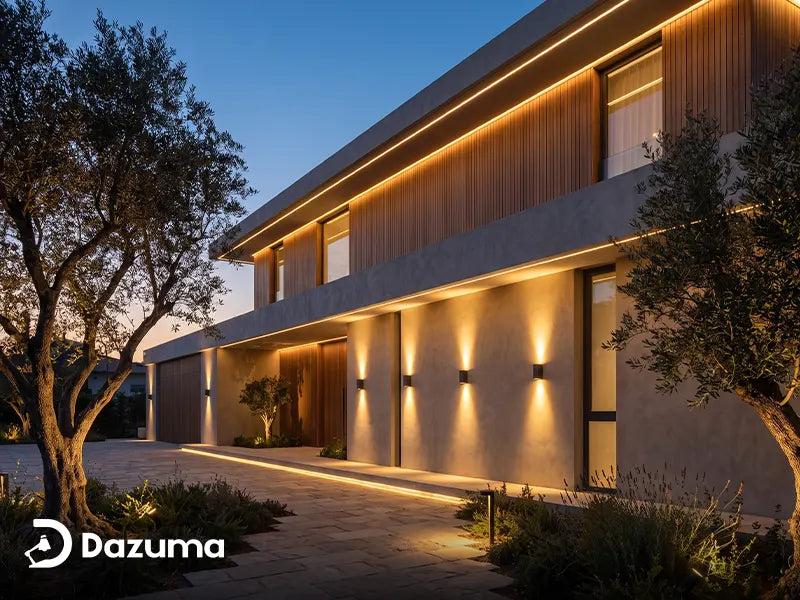
An exterior renovation is a good opportunity to think beyond paint, siding, paving, and landscaping. Once the work is complete, the way the property functions after sunset will depend heavily on another detail that is easy to overlook during the planning stage: lighting.
Outdoor lighting affects how safely people move between the driveway and the house, how welcoming the entrance feels, whether a patio can be used comfortably in the evening, and how much of the home’s architecture remains visible after dark.
Planning the lighting while other exterior improvements are underway can also make installation easier. Cable routes, wall finishes, planting layouts, pathways, and mounting positions can all be considered together rather than addressed as separate projects later.
Planning exterior lighting alongside renovation work can help the fixtures, architecture, pathways and landscaping feel more connected.
Plan the Lighting Before Exterior Work Is Finished
One common mistake is leaving lighting decisions until the final stage of a renovation. By that point, walls may already be finished, new paving installed, and landscaping completed.
Instead, identify lighting locations while the project is still being planned. Think about where electrical connections may be required, which walls will receive fixtures, where cables may need to run, and whether landscaping could eventually block a beam or sensor.
This does not mean homeowners need to select every decorative fixture immediately. However, knowing approximately where lighting will be required can help contractors avoid unnecessary disruption later.
Start With Entrances and Frequently Used Routes
Before thinking about decorative lighting, focus on the routes people use most often after dark.
The front entrance, driveway, garage, side gates, paths, and steps are generally the highest priorities. These areas do not necessarily need intense illumination. They simply need enough light for people to identify the route, notice changes in level, and complete everyday activities comfortably.
For example, a front entrance may benefit from lighting near the door as well as lower illumination along the approach. A side yard might only require a small number of fixtures around gates or changes in direction.
Walking through the property after sunset before finalizing the plan is often useful. Areas that appear simple in daylight can feel surprisingly difficult to navigate at night.
Choose Different Fixtures for Different Parts of the Property
Exterior lighting works best as a system rather than a collection of identical fixtures.
Wall-mounted lights are suitable for entrances, garages, porches, and exterior walls. Path lights provide lower-level guidance around walkways. Bollards can add more visible structure along larger paths and driveways, while spotlights and in-ground fixtures are useful for landscaping and architectural accents.
When comparing a broader range of Outdoor Lighting, it can be helpful to think first about what each area needs the light to accomplish and then select the fixture type that fits that purpose.
Using several types of lighting does not mean the exterior has to look inconsistent. Repeating similar finishes, materials, geometric forms, or color temperatures can create a coordinated appearance.
Use Wall Lighting to Strengthen the Architecture
Exterior wall lights have a particularly strong visual role because they remain part of the façade throughout the day.
Their size should relate to doors, windows, garage openings, and the scale of the wall rather than being chosen only from a close-up product photograph. A small fixture can disappear beside a large double garage, while an oversized light may overwhelm a narrow entrance.
Light direction is equally important. Some wall fixtures direct illumination downward, helping define the ground and entrance area. Others cast light both upward and downward, emphasizing the vertical surface of the building. Diffused fixtures can create softer general illumination around a porch or patio.
Homeowners considering different Outdoor Wall Lighting styles should therefore compare beam direction, dimensions, finish, mounting position, outdoor rating, and brightness rather than choosing according to appearance alone.
Avoid Making Every Area Equally Bright
A well-lit exterior is not necessarily a brightly lit exterior.
If every wall, path, tree, and patio receives the same intensity of light, the property can feel flat and visually busy. Contrast creates depth.
The entrance may be slightly brighter because it serves as a destination. Paths can use lower-level illumination, while landscaping may only need selected accents. Areas that are rarely used at night may not need permanent illumination at all.
This approach can also reduce glare. A very bright source positioned at eye level may actually make surrounding dark areas harder to see. Shielded or downward-directed fixtures often provide more comfortable visibility around residential properties.
Coordinate Lighting With New Exterior Materials
If the renovation includes new siding, render, brick, timber, stone, doors, or windows, consider how the fixture finish will look against those materials during the daytime.
Matte black lighting can complement dark window frames and contemporary details. Bronze and warmer metal finishes may suit brick, timber, and natural stone. Simple architectural fixtures often work well with concrete, stucco, and minimalist façades.
Exact matching is not always necessary. In fact, an exterior can feel more natural when different elements relate to one another without being identical.
Repeating a dark metal finish across window frames, door hardware, railings, and lighting may be enough to create visual continuity.
Do Not Forget Outdoor Living Areas
Patios and decks require a different lighting strategy from entrances and driveways because people may spend several hours there rather than simply passing through.
Instead of one strong overhead source, consider several softer layers. Wall fixtures near the house can provide general illumination, while lower landscape lighting can reveal planting around the edge of the patio. Outdoor kitchens or grill areas may require more focused task lighting.
It also helps to illuminate something beyond the seating area. A softly lit tree or planting bed further into the yard can make the outdoor space feel larger and prevent the view from ending in complete darkness.
Consider Controls During the Renovation
Different exterior areas are rarely used at the same time, so lighting controls can make the system more flexible.
The entrance may follow a regular evening schedule, while a side passage can use motion activation. Patio lighting may only be needed when people are outside, and landscape accents can turn off later in the evening.
If practical, separating these areas into different circuits or control zones can prevent homeowners from having to illuminate the entire property simply to use one part of it.
Timers, motion sensors, photocells, and compatible smart controls can all be useful, depending on how the property is used.
Make Sure Fixtures Suit the Environment
Exterior fixtures face conditions that indoor lighting never encounters. Rain, irrigation, wind, humidity, dust, ultraviolet exposure, temperature changes, and coastal air can all affect long-term performance.
Always confirm that a fixture is intended for the location where it will be installed. A light beneath a covered porch experiences different exposure from one mounted on an open wall or positioned close to the ground.
Local climate should also influence material and finish choices. In more demanding environments, durability may need to take priority over purely decorative considerations.
Electrical installation should follow applicable local requirements, and a qualified professional may be appropriate where new circuits, wiring, or other electrical work is involved.
Test the Finished Lighting After Dark
Outdoor lighting is difficult to judge properly during the day. Once installation is complete, walk around the property at night and review the system from several viewpoints.
Check for glare around entrances and seating areas. Look for dark gaps around important steps or paths. View the fixtures from inside bedrooms and living areas to make sure they are not shining unnecessarily through windows.
Also consider the view from the street. A well-planned exterior should reveal the entrance and architecture without making the house appear excessively illuminated compared with its surroundings.
Small adjustments in beam direction or mounting angle can often improve the result without requiring additional fixtures.
Final Thoughts
An exterior renovation is not complete simply because the property looks refreshed during daylight hours. The way homeowners arrive, move around, entertain, and view the house after sunset is also part of the finished design.
Planning outdoor lighting early allows electrical work, wall finishes, landscaping, pathways, and fixture placement to support one another. Start with entrances and safety, choose different fixture types according to their jobs, control glare, and use decorative lighting selectively.
The goal is not to illuminate every available surface. It is to create an exterior where the right areas remain visible, the architecture still has depth, and the property feels comfortable and considered long after daylight fades.