Visual refractive errors affect millions of people worldwide, influencing how clearly we perceive our surrounding environment. Two of the most prevalent optical conditions are myopia, commonly known as shortsightedness, and astigmatism. Recognizing early short sightedness symptoms and understanding modern contacts for astigmatism allows individuals to seek timely care and restore crystal-clear visual performance.
Shortsightedness occurs when the eyeball is slightly longer than normal from front to back, or when the cornea has too much curvature. As a result, light entering the eye focuses in front of the retina rather than directly upon its surface. This structural difference causes distant objects to appear blurry, while close-up tasks such as reading or looking at a smartphone remain clear.
Recognizing the signs of myopia early is critical for preventing persistent eye strain and headaches. Common symptoms include squinting or narrowing the eyelids to bring distant objects into focus, experiencing difficulty reading road signs while driving, struggling to see the whiteboard in classrooms, and experiencing visual fatigue after outdoor activities. In children, shortsightedness may manifest as sitting excessively close to the television or holding books near the face.
In many cases, myopia occurs alongside astigmatism. Astigmatism is an optical condition where the cornea or natural lens possesses an asymmetrical shape, resembling the oval contour of an American football rather than a round basketball. This irregular curvature causes light rays to bend unevenly, leading to distortion or subtle ghosting around images at both near and far distances.
Fortunately, modern optical technology offers highly effective solutions for correcting both conditions simultaneously. While glasses have traditionally been used to compensate for refractive errors, contact lenses offer key advantages, including natural spatial awareness, a complete field of peripheral vision, and freedom from heavy frames.
To correct astigmatism effectively, specialized toric lenses are required. Unlike standard spherical lenses, toric options feature different powers along different axes to address both the cylindrical irregularity of the cornea and the spherical power needed for shortsightedness. Because toric options must stay stably positioned on the eye surface to avoid visual fluctuation, manufacturers implement advanced stabilization features. For instance, ACUVUE utilizes Eyelid Stabilized Design technology, which interacts with the natural blinking motion of the eyelids to maintain correct alignment throughout daily activities.
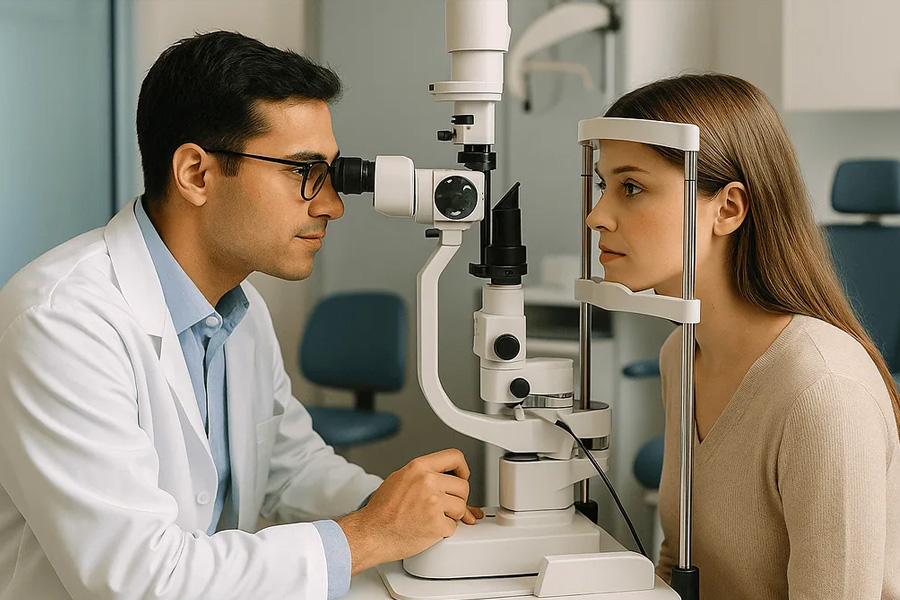
Whether choosing daily disposable or reusable modalities, securing an accurate fitting with a licensed eye care professional is paramount. Regular eye exams allow your optometrist to evaluate structural eye health, monitor any changes in refractive error, and recommend tailored correction strategies. With high quality products from ACUVUE, individuals experiencing shortsightedness and astigmatism can enjoy stable, comfortable, and vibrant vision every single day.