Manufacturing is becoming more connected as businesses seek greater productivity, operational visibility, energy efficiency, and flexibility. Modern production environments increasingly combine automation, connected equipment, real-time monitoring, analytics, and digital services to respond faster to operational changes. These technologies can also support predictive maintenance, reduce downtime, and improve resource utilization across production processes.
As manufacturers move from isolated automation toward connected, data-driven operations, the need for integrated technologies continues to grow. How can a smart factory help manufacturers build future-ready operations? By connecting machines, sensors, control systems, and software, manufacturers can turn operational data into actionable insights while creating more adaptable and resilient production environments.
What Technologies Build a Smart Factory?
A smart factory combines connected hardware, industrial control systems, and digital platforms to create greater visibility across production environments.
Key technologies include:
- Industrial Internet of Things (IIoT) sensors: Collect real-time machine and process data.
- Programmable Logic Controllers (PLCs) and Programmable Automation Controllers (PACs): Execute control logic for industrial equipment.
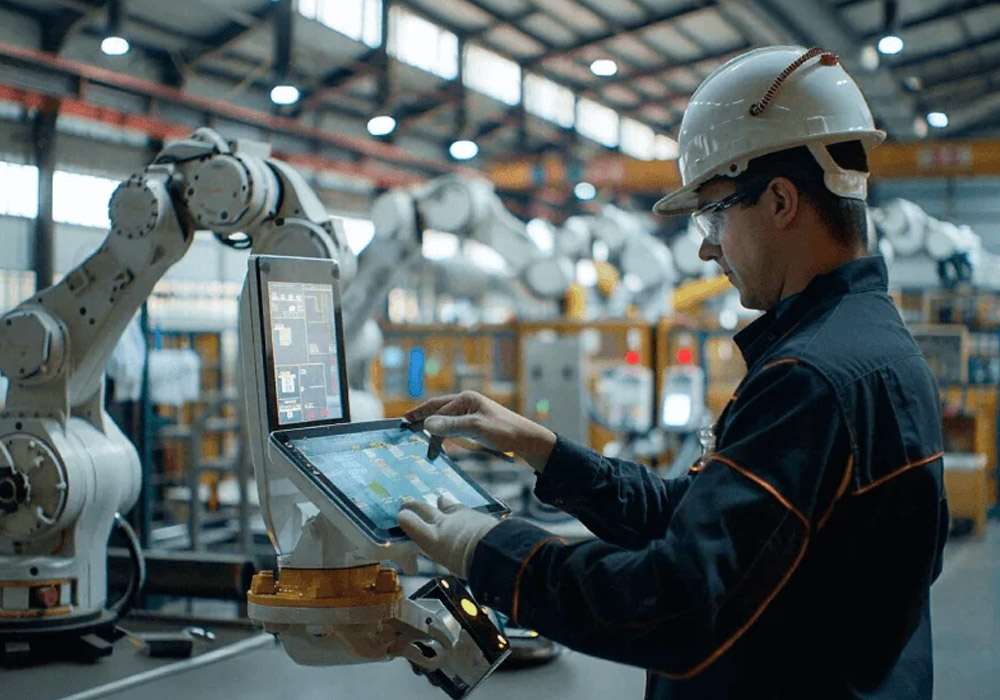
- Human-Machine Interfaces (HMIs): Provide operators with machine status, alarms, and process information.
- Supervisory Control and Data Acquisition (SCADA): Enables centralized monitoring, visualization, and supervisory control.
- Edge Computing: Processes data closer to machines for faster responses.
- Cloud Platforms: Support analytics, data storage, and remote accessibility.
- Cybersecurity: Protects connected operational technology and industrial networks.
Together, these technologies connect the device, control, network, and software layers of modern manufacturing infrastructure.
How Does a Smart Factory Improve Production Efficiency?
A smart factory gives manufacturers real-time visibility into equipment performance, production conditions, and operational trends. This information helps teams identify inefficiencies and respond to issues before they significantly affect production.
Three capabilities are particularly valuable:
- Real-time Monitoring
Connected devices continuously capture machine status, operating data, and equipment health metrics.
- Predictive Maintenance
Analytics detect anomalies and early failure indicators to support condition-based maintenance.
- Process Optimization
Production data reveals bottlenecks, cycle-time variations, and process inefficiencies to improve throughput.
- Quality Control
Sensors and vision systems identify defects and process deviations during production.
- Energy Management
Connected sensors track energy use and load patterns to identify inefficiencies and optimize consumption.
This shift from reactive decision-making toward data-driven operations can improve responsiveness while supporting more consistent production performance.
How can Connected Electrical Systems Support Manufacturing?
Electrical infrastructure provides the power foundation for automated production, making its visibility and reliability important within a smart factory. Connected low- and medium-voltage systems can provide data that helps teams monitor electrical conditions and manage critical assets.
Manufacturers can use connected electrical technologies to:
- Monitor voltage, current, and power consumption.
- Identify abnormal electrical conditions.
- Track connected equipment performance.
- Support condition-based maintenance.
- Improve visibility into energy usage.
Integrating electrical data with broader operational systems helps connect power infrastructure with production and maintenance decisions.
How Does Automation Enable Smarter Manufacturing?
Automation forms a critical control layer within a smart factory, connecting sensors, controllers, drives, robotics, and operator interfaces. PLCs can execute deterministic control functions, while HMIs provide operators with real-time process information and SCADA platforms offer broader supervisory visibility.
This architecture enables manufacturers to:
- Machine Coordination: PLCs and industrial networks synchronize connected equipment.
- Process Automation: Control logic and robotics automate repetitive operations.
- Parameter Monitoring: Sensors and HMIs track key process variables in real time.
- Alarm Response: HMI and SCADA systems detect and display abnormal conditions.
- Process Consistency: Closed-loop control maintains defined setpoints and operating conditions.
When these systems exchange information across operational layers, manufacturers gain greater visibility from individual machines through broader plant operations.
Build Future-ready Manufacturing With the Right Technology
A smart factory connects automation, IIoT, analytics, electrical infrastructure, and cybersecurity to create more responsive manufacturing operations. Manufacturers can begin by identifying critical assets, assessing data gaps, and prioritizing applications where connectivity can improve productivity, reliability, energy performance, or maintenance.
A structured digital strategy allows these capabilities to scale alongside production requirements without treating digitalization as a standalone technology project. Partnering with a reputable electrical and automation brand can provide access to connected technologies, engineering expertise, and solutions that support long-term operational performance and resilience.