The ground carries vibration further than people assume
A compactor does its work by shaking, and shaking does not stop politely at the edge of the plate. Energy travels outward and downward through whatever the soil is resting on, which is fine in the middle of an open pad and much less fine beside a service trench, a retaining wall or a slab poured the previous day. A heavy-duty plate compactor earns its place on a site by being used with a sense of where that energy is going.
What the plate is actually sending into the ground
An eccentric weight spinning inside the base generates a force that rotates with it, and the plate transmits that force into the surface as a rapid series of downward pulses. Those pulses are what rearrange soil grains into a denser packing.
The same pulses do not know what else is nearby. They spread as waves, losing strength with distance but traveling surprisingly far through dense granular material, which is exactly what most engineered fill is made of.
Buried services are the first concern
Plastic water and gas lines, conduit and shallow drainage all sit in the zone a compactor reaches. The risk is rarely a dramatic break while the machine is running; it is a joint nudged out of alignment or a pipe bedded on a void that only announces itself weeks later.
Two habits deal with most of it. Locate before compacting rather than after, and keep the first lift over any service thick enough that the plate works on fill rather than directly above the pipe.
Where cover is shallow, hand compaction or a lighter machine over that strip is cheaper than the alternative. A soil compactor is a tool with a working envelope, not a machine that improves every square meter it touches.
Walls, footings and fresh concrete
Retaining walls fail from the back, and over-compaction against them is a common contributor. Compacting hard right up against a wall loads it in a direction it was often not designed for, and the wall cannot shed that load the way open ground can.
Fresh concrete has a different sensitivity. Vibration transmitted through the ground into a slab that has set but not gained strength can disturb the bond between paste and aggregate at exactly the wrong moment. Most specifications call for a standoff and a waiting period for that reason.
A practical standoff list
Treat these as starting points rather than rules:
- Shallow services: hand compact the first lift
- Retaining walls: lighter passes within a meter
- Concrete under three days old: keep well clear
- Existing structures: watch for transmitted vibration
Distances vary with the soil and the machine, so judgement still applies. If something nearby starts to resonate, the soil compactor is too close, and moving a meter away usually solves what reducing throttle will not.
Choosing for the work rather than the number
Compaction equipment is usually compared on centrifugal force alone. That figure leaves out how the force is distributed across the plate and how controllable the machine is near an obstacle, and on a constrained site plate size, handle design and the ability to work close to an edge matter just as much.
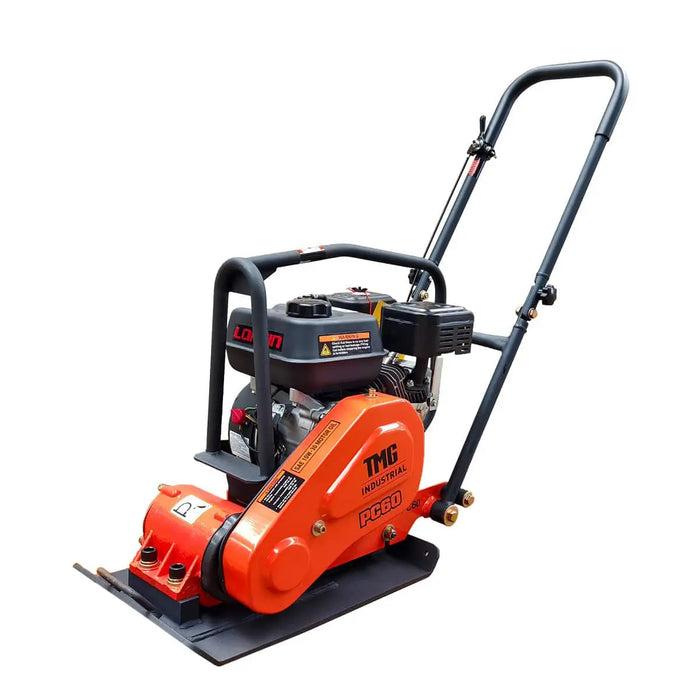
TMG Industrial builds this soil compactor with 2,380 pounds of force and eight inches of compaction depth on a 6.5 horsepower engine, which suits trench backfill and small pads. Whatever machine is on the job, the question before starting is not how hard it hits but what is sitting within reach of what it sends into the ground.