Matching a Hydraulic Breaker to a Carrier Is About Flow, Not Tonnage
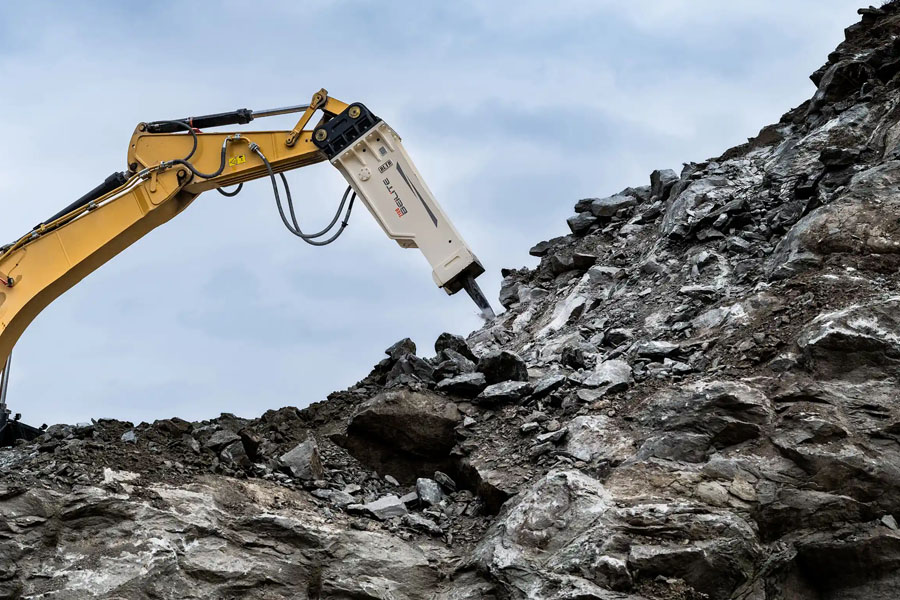
Attachments are advertised against machine weight, and weight is a reasonable first filter. It is not what makes a breaker work. An excavator hydraulic breaker is a hydraulic device, and what it needs from the machine underneath it is a flow rate inside a window and a return path that does not fight back.
Flow sets the blow rate, pressure sets the blow
Oil entering the breaker drives a piston up against a gas charge and then releases it, so the volume of oil arriving each minute determines how often that cycle completes. Too little flow and the tool hammers slowly; too much and the piston is driven beyond its intended stroke.
Pressure is a separate matter. It determines the force behind each blow, and it is set by the relief valve in the carrier rather than by the attachment. A machine delivering correct flow at insufficient pressure produces plenty of blows that accomplish very little.
Back pressure is the limit people miss
Oil has to leave the breaker as freely as it arrives. Every meter of return line, every quick coupler and every filter adds resistance, and that resistance subtracts directly from the energy available at the chisel.
A long return line routed through a case drain designed for something else is a common cause of a tool that tested well on a dealer machine and then disappoints on site. Sizing that line generously costs nothing at the point of installation and is almost never done, because nobody is measuring it.
Blank firing destroys a breaker faster than rock does
When the chisel has nothing solid to push against, the energy stored in the piston has nowhere to go except into the tool retaining pins and the breaker housing itself, which is why a few seconds of blank firing does more harm than an hour of honest work in rock.
Two habits prevent most of this damage:
- Stop the moment material gives way
- Keep the chisel loaded against the work
Operators also break tools by levering with the chisel, which bends a component designed for pure compression along its axis. Repositioning the carrier takes a few seconds, while a bent chisel and a scored lower bushing take a workshop visit and a tool nobody has in stock.
Quick coupler mounts earn their checks
A quick change mount makes a hydraulic breaker a practical attachment rather than a half day commitment, and it introduces a joint that carries every blow. That joint needs to be fully engaged and pinned before the first strike, because a partially latched coupler under impact loading fails quickly and without warning.
Hose routing on a hydraulic breaker deserves the same attention. Lines that are tight at full stick extension chafe where they cross the boom, and a rock breaker generates vibration that finds every unsupported length of hose on the machine.
Reading a specification before committing
Carrier weight range, operating pressure and required flow are the three numbers that decide whether an excavator breaker fits a machine at all. Tool diameter and blow energy describe what it will do once fitted, and the first set has to be satisfied before the second means anything.
TMG Industrial builds this one with a 100 millimeter chisel for 10 to 15 ton carriers on a quick change mount. Checking the machine’s measured flow against that window, rather than its weight alone, is what separates a breaker that works from one that merely bolts on.