3D printing is gradually becoming a practical creative tool in people’s daily lives. From customized personal items and collectible figures to educational models, design prototypes, and creative products, 3D printing allows more ideas to move beyond screens and become physical objects. As more people explore 3D creation, the challenge is no longer only about printing technology itself, but also about how to efficiently create detailed and usable 3D assets before production begins.
The development of AI 3D technology is helping close the gap between imagination and manufacturing. Instead of relying entirely on complicated modeling software and professional skills, creators can now use AI-assisted workflows to explore ideas, generate models, improve details, and prepare designs for printing.
Hi3D is designed to make this process easier by connecting AI generation with real 3D workflows. Through AI-powered model creation, texture processing, and print preparation features, Hi3D helps users transform concepts into practical 3D assets. With the launch of Hi3D V3.0, the platform further improves reconstruction accuracy, structural stability, and production usability, bringing AI 3D creation closer to real-world applications.
From Creative Inspiration to Printable Models: Simplifying the Complete 3D Workflow
Creating a 3D model is often the first challenge before printing begins. Different groups of users experience different difficulties throughout this process. Beginners may be limited by professional modeling skills, designers may need faster ways to visualize concepts, and makers may spend too much time preparing models before printing.
Hi3D focuses on reducing these barriers by providing a more complete workflow. Instead of separating idea generation, modeling, optimization, and printing preparation into different stages, Hi3D helps users move from initial concepts to generated models and then toward printable results.
Turning Images and Text Ideas into 3D Models
Many creative projects begin with a simple reference image, design concept, or idea described through words. However, transforming these inputs into complete 3D models traditionally requires professional modeling experience and complicated software.
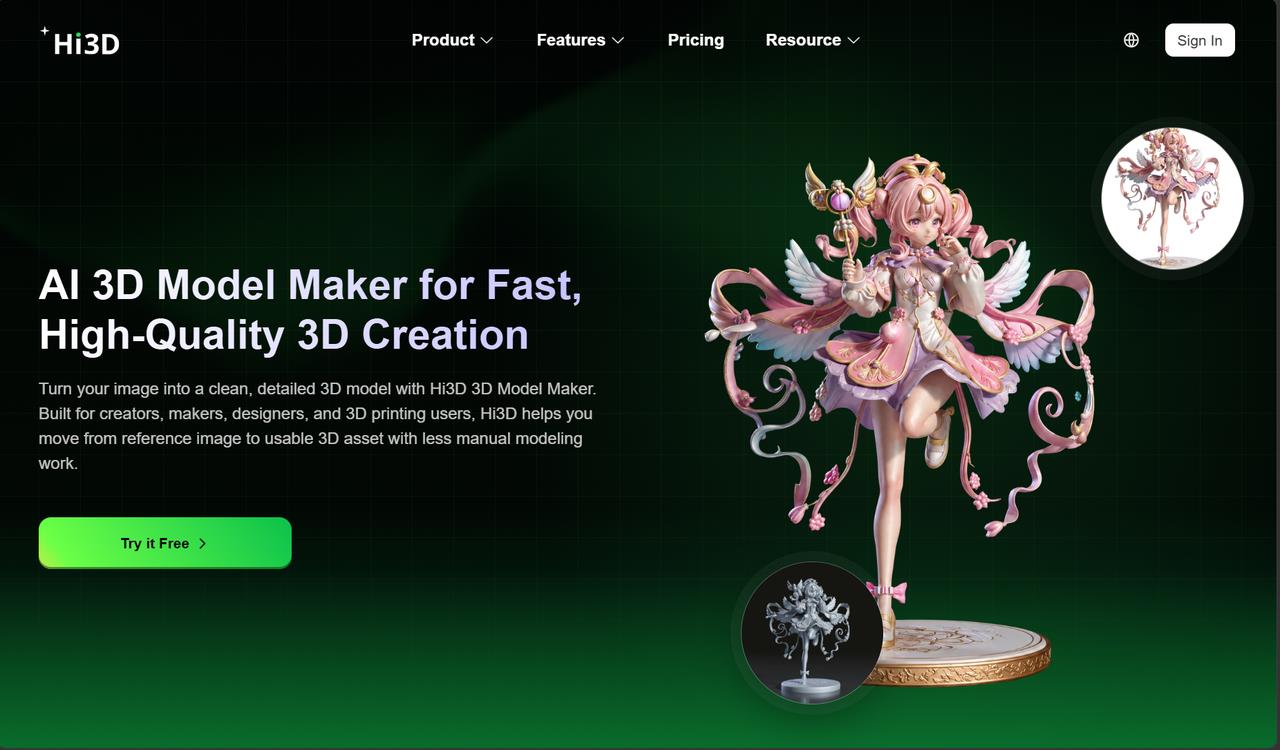
With image to 3D model capability, Hi3D allows users to create 3D models from 2D visual references. Whether users want to recreate a character, develop a product concept, or turn an artwork into a physical model, AI helps reduce the time required during the early modeling stage.
This workflow provides value for different types of creators. Beginners can use images as a starting point to explore 3D creation without mastering complex modeling tools first. Designers can also use AI-generated models as an early design foundation, allowing them to spend more time refining creative ideas rather than completing repetitive modeling tasks.
Hi3D also supports text-based creation, allowing users to describe their ideas and generate initial 3D concepts. This provides another flexible approach for brainstorming, concept testing, and prototype development.
For users who want a simpler way to enter AI-powered 3D creation, Hi3D works as an accessible AI 3D model maker that helps transform creative concepts into digital models without requiring every user to master traditional modeling techniques.
From AI Model Generation to Real Printing Preparation
Generating a model is only the beginning of the complete 3D workflow. Before a digital asset becomes a physical object, users often need to solve problems related to color separation, model size, assembly structure, and print arrangement.
Hi3D provides several functions designed for this stage. Multi-color printing helps users convert AI-generated textured models into printable multi-color objects, improving the connection between digital design intentions and actual printing results.
For creators working with larger or more complicated models, split-for-printing helps divide complete models into separate printable parts. The feature can repair parts into watertight meshes and generate assembly connectors, making complex models easier to print and assemble.
Smart arrangement further improves preparation efficiency by helping users organize models on the build plate, recommend suitable print orientations, and export 3MF files with suggested slicer settings.
AI Texture Generation for More Detailed 3D Assets
A high-quality 3D asset depends not only on its structure but also on its surface appearance. Texture details influence how models look in creative projects, digital displays, and physical products.
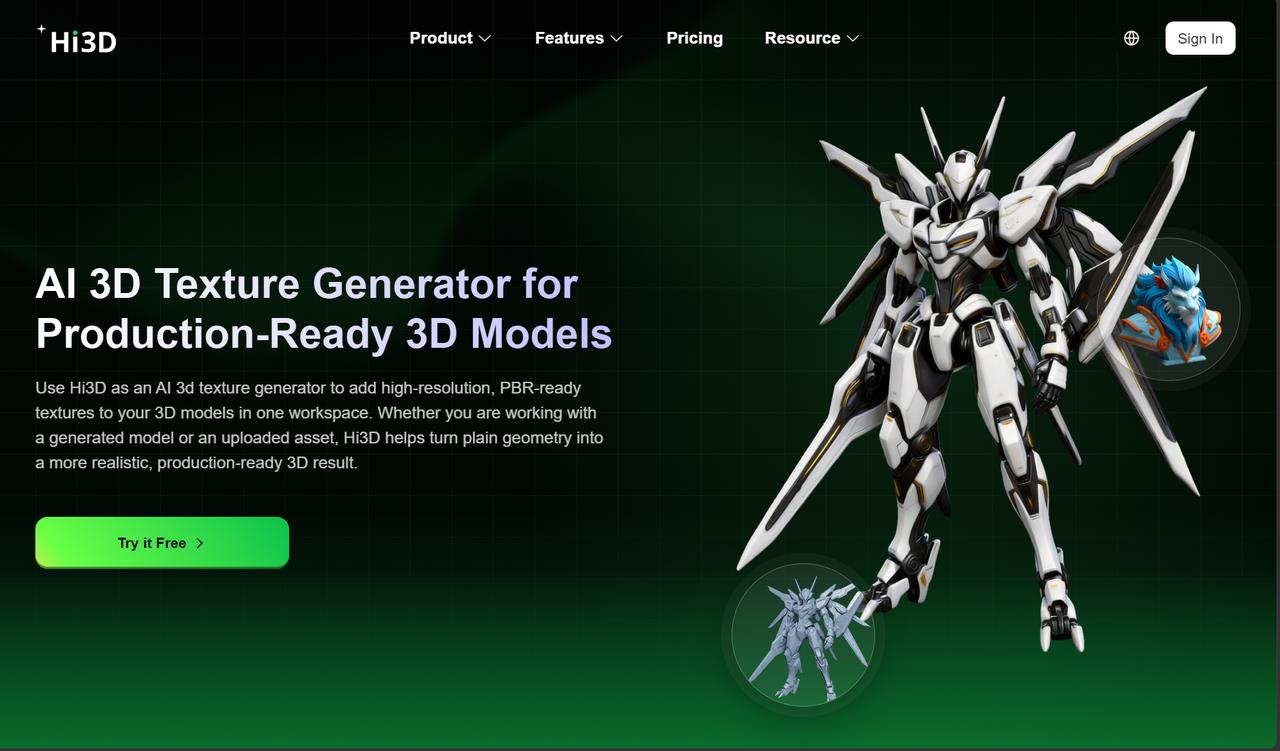
Hi3D supports AI 3D texture generator capabilities, helping users create richer surface appearances without complicated manual texturing workflows.
Hi3D V3.0 improves texture output by supporting up to 8K textures and upgrading its self-developed UV completion algorithm. These improvements enhance pattern clarity, color transitions, and fine texture details, helping models achieve stronger visual quality.
Hi3D V3.0: A Major Upgrade Toward High-Quality AI 3D Production
The value of AI 3D technology is not only measured by how quickly a model can be generated. For creators and industries, the more important question is whether these models can maintain quality when they are used for design, printing, and further production.
A generated model needs to preserve important details, maintain structural stability, and continue smoothly into later workflows. Hi3D V3.0 focuses on improving this practical value by reducing the manual adjustments needed after generation and helping AI-generated models move closer to production-ready assets.
Core Upgrade 1: 2048³ Ultra-High Precision Reconstruction
One of the most important improvements in Hi3D V3.0 is the upgrade of geometry reconstruction capability. The new version increases reconstruction resolution from 1536³ to 2048³ voxel-level resolution and becomes the first commercially available AI 3D model with 2048³ ultra-high-precision reconstruction capability.
Higher reconstruction precision allows more information to be preserved during the generation process. Details that require stronger accuracy, including small mechanical parts, engraved details, text edges, and complex surface patterns, can achieve clearer reconstruction.
The upgraded geometry representation also improves the reproduction of small components, shallow details, thin walls, and complex structures. This helps generated models maintain better completeness and accuracy when used in more demanding scenarios.
For designers and makers, improved reconstruction quality means fewer manual corrections and a smoother transition from digital concepts to physical objects.
Core Upgrade 2: More Accurate Understanding of Complex Structures
One of the biggest challenges in image-based AI 3D generation is the lack of complete information from a single view. Hidden surfaces, back-side structures, and relationships between different parts require AI to make reasonable predictions.
Hi3D V3.0 improves cross-view structural reasoning and strengthens its ability to process multi-view information, occluded areas, and complex object relationships. The upgrade improves structural stability from side and back perspectives, especially for objects with significant self-occlusion or complicated interactions.
This improvement makes generated models more reliable for applications where structural consistency matters, including physical printing, digital assets, and product visualization.
Core Upgrade 3: Building a More Complete Production Workflow
Beyond improvements in AI model quality, Hi3D V3.0 also focuses on strengthening the connection between generation and manufacturing.
The new version introduces workflow improvements including multi-color printing, smart arrangement, and split-for-printing functions, helping users reduce preparation work before real production.
Instead of stopping at model generation, Hi3D V3.0 helps users continue toward actual output. Complex models can be separated into printable components, colors can be prepared for physical printing, and parts can be arranged more efficiently before entering the slicer workflow.
This approach allows AI 3D creation to become a more practical tool rather than only a concept visualization method.
Hi3D V3.0 Evolution: From AI Generation Technology to Industry Applications
The development of Hi3D reflects the changing needs of AI 3D creation. Earlier AI tools mainly focused on generating models, while modern workflows require assets that can be edited, displayed, printed, and applied in different industries.
Hi3D V3.0 continues this direction by improving not only model quality but also the overall usability of AI-generated assets.
Version Evolution: Improving Every Stage of 3D Creation
Hi3D V1.0 introduced a commercially available image-to-3D model with 1536³ voxel-level resolution, improving the reconstruction of fine structures. Hi3D V2.0 further developed geometry and texture integration, improved hidden structure completion, and provided a more complete generation workflow. Hi3D V3.0 continues upgrading geometry accuracy, complex structure processing, texture quality, and production-related features.
Through these upgrades, Hi3D has gradually expanded from a model generation tool into a more complete AI 3D creation platform.
Industry Applications: Supporting More Creative and Production Scenarios
High-quality 3D assets are increasingly used in many areas, including 3D printing, game and film production, digital art, jewelry design, collectible creation, cultural exhibitions, education, e-commerce content, and industrial design. Different industries have different requirements, but they all need reliable geometry, detailed textures, and models that can continue through later workflows.
Hi3D V3.0 aims to reduce the difficulty of producing high-quality 3D content and help more users access editable, display-ready, and printable 3D assets.
For creators searching for a 3D model maker online solution, Hi3D provides a workflow that connects creative inspiration, AI generation, and physical production.
Why Hi3D V3.0 Represents a New Direction for AI 3D Creation
The future development of AI 3D technology is not only about creating models faster. The more important direction is making generated assets easier to use in complete creative and production workflows.
Hi3D V3.0 reflects this shift by combining higher reconstruction accuracy, stronger structural understanding, improved texture quality, and practical printing preparation tools.
For creators, this means fewer barriers between ideas and finished objects. Instead of spending most of their time solving technical problems, users can focus more on design, creativity, and application.
For industries, more reliable AI-generated assets create new possibilities for faster prototyping, digital content production, and customized manufacturing workflows.
Experience Hi3D V3.0 Free for 48 Hours
To allow more users to experience the latest AI 3D capabilities, Hi3D will open a limited-time free experience of Hi3D V3.0 from August 19, 2026, 00:00 to August 20, 2026, 24:00 (Beijing Time). During this period, users can experience Hi3D V3.0 without generation limits.
During the 48-hour experience, users can explore the improved 2048³ high-precision reconstruction, enhanced texture quality, and workflow features designed for practical printing applications.
Whether you are a beginner exploring 3D creation, a designer developing new concepts, or a maker creating physical models, Hi3D V3.0 provides a more efficient way to transform digital ideas into real-world objects.