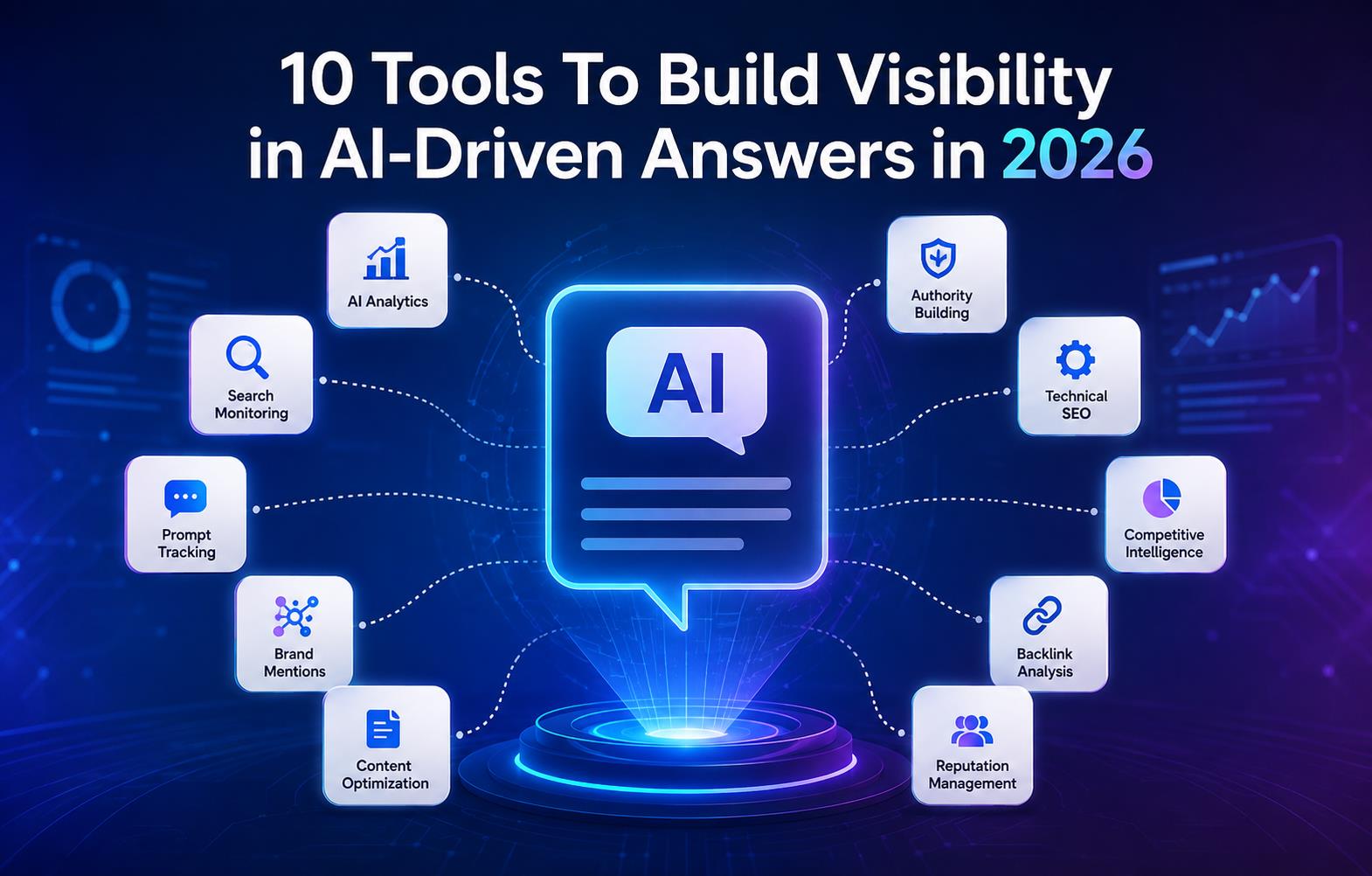
People increasingly ask AI assistants for recommendations before they ever open a website, and Google now answers a large share of searches with an AI Overview. When the assistant names a few options, those are the brands that get considered. Most people never scroll to the sources behind the answer.
AI assistants build those answers mostly from third-party coverage, not from a brand’s own site. These systems don’t read a “sponsored” label the way people do; what a model weighs is whether a brand shows up consistently on domains it already trusts. Getting onto those outlets by hand is slow. Here are 10 tools that do it for you.
Best Tools to Build Visibility in AI-Driven Answers
We evaluated tools that help a brand get mentioned in the sources AI assistants draw on, and highlighted what each does differently rather than generic features like price, which is broadly similar across the field.
Here are the 10 we picked.
| Tool | Best for |
| 1. Medialister | Agencies running continuous, AI-managed placement campaigns across a client portfolio, with post-payment to avoid cash-flow gaps |
| 2. PRNEWS | International teams that want many placement formats and outlets in one place, plus PRO tooling to plan media at scale |
| 3. PRposting | Brands that want mentions on exclusive, hand-vetted outlets not sold on public marketplaces |
| 4. PressWhizz | SEO and PR teams that want a hand-verified catalog, or a done-for-you managed service |
| 5. Linksman | SaaS and tech brands aiming for the expert reviews and comparisons AI engines lean on |
| 6. Respona | In-house teams chasing Tier-1 editorial mentions through their own direct outreach |
| 7. NO-BS Marketplace | Buyers who want to see outlet metrics and approve content before paying |
| 8. Ereferer | Teams that need multilingual visibility across European outlets on a small budget |
| 9. INSERT.LINK | Teams placing large volumes of contextual mentions into already-published pages |
| 10. LinkBuilder.com | Buyers comparing vendor prices for the same outlet at the final planning stage |
1. Medialister
Medialister is built for running AI-visibility and PR campaigns continuously and at scale, across a catalog of 106,000+ vetted outlets. The premise is simple: the more often a brand turns up in independent, credible publications, the more likely an AI model is to mention it in an answer. You set a campaign goal — market expansion, a startup launch, local presence — and the platform returns a matching set of outlets in one click.
Two things make it more than a catalog. Its MCP server connects your account directly to Claude, ChatGPT, or Gemini, so you can find, order, and manage placements from a chat. A recommendation engine tied to Google Search Console points to where a brand should publish next. For agencies, there’s team access across hundreds of projects and post-payment: one consolidated invoice at month’s end to prevent cash flow gaps.
2. PRNEWS
PRNEWS is an international paid-placement platform with one of the largest catalogs here: 107,000 outlets across 175 countries. Its edge is format flexibility — on a single outlet you can run a press release, a full sponsored article, a contributor post, or a short mention, and match the format to the campaign and budget. Filters narrow the catalog by niche, language, and price, down to finer requirements like whether an outlet accepts sensitive topics or tracking pixels. PRNEWS’s goal-based presets speed up standard campaigns.
Teams that need more can add a PRO account. Its Bulk Site Checker takes a list of outlets a competitor has appeared on and finds matching placements you can buy directly. The full catalog, with prices and metrics, exports to CSV in one click for budgeting across several clients. PRO also adds mass blacklists, saved outlet lists per project, and a monthly media plan with an expert consultation.
3. PRposting
PRposting leans on outlets you can’t reach elsewhere: about 20% of its 23,000+ publishers are exclusive to the platform, added through direct negotiation and manual review rather than pulled from public exchanges. For visibility, a placement on a credible, independently sourced outlet is exactly the kind of mention that helps a brand stand out.
Each outlet comes with a free audience breakdown across its five main source countries, so you can confirm a site’s real geography before buying — useful when you’re targeting a specific market. Payment is one-time and the placement stays live for as long as the site does. If a placement misses its agreed deadline, the balance is refunded automatically within seven days.
4. PressWhizz
PressWhizz is a marketplace for guest posts and placements in existing articles, built around a hand-verified catalog: 41,000+ sites across 90 countries, screened to keep spammy and low-trust domains out. Since AI answers favor sources they consider credible, a vetted catalog raises the odds a mention lands somewhere that counts. Placements go live in about 18 hours on average.
For teams that would rather not run it themselves, there’s a managed service from $5,000, where the platform’s own team handles outlet selection and talks to editors directly. Analytics tools also let you see where competitors are appearing and search for relevant pages by keyword.
5. Linksman
Linksman is aimed at tech, software, and B2B brands that want to appear where AI engines actually look: in-depth expert reviews, software comparisons, and analytical guides on industry sites. Its SaaS-outreach format places a product inside that kind of editorial rather than on general-interest pages — the deep, category-specific content generative engines lean on when they answer a question.
The catalog runs to 9,000+ hand-checked outlets in a single dashboard, filterable by authority, traffic, niche, and price, so you can zero in on, say, fintech sites above a given traffic level. Guest posts and mentions in existing articles are both available, priced from around $29 for an insertion and $399 for a guest-post package, with a replacement guarantee if a placement is removed.
6. Respona
Respona takes a different route: instead of buying from a catalog, you run direct outreach to newsrooms and journalists, and the tool automates the rest. It finds relevant authors, locates their personal email addresses, sets up follow-up sequences, and uses AI to draft pitches based on each recipient’s recent work.
That makes it one of the few ways to earn mentions in Tier-1 publications that won’t sell placements through marketplaces — and those authoritative, editorial mentions tend to carry the most weight when an AI decides whom to cite. The tradeoff is real: you negotiate every placement yourself, so it suits teams with time to build direct media relationships, not those who want a placement bought and live quickly. It runs on a subscription, roughly $100–500 a month depending on volume.
7. NO-BS Marketplace
NO-BS Marketplace is built around transparency: you see an outlet’s metrics and approve the content before any money changes hands. Its catalog is around 10,000 publishers.
You order in one of two ways. In Suggested Publishers, the team picks outlets to match your criteria and sends them for approval — the default for anyone who doesn’t want to dig through a catalog. In self-service, you search the database yourself; the domains stay hidden for publisher privacy, but 16 metrics from Ahrefs and Moz are visible, which is enough to judge an outlet without knowing its name. Every placement carries a 12-month guarantee, with a full refund if the link comes down.
8. Ereferer
Ereferer is a European tool for when you need visibility in more than one language: its catalog spans 20,000+ English-language outlets and 50,000 worldwide across French, English, Spanish, Italian, and German. Registration is free and there’s no subscription, so the entry cost stays low even on a small budget. Guest posts start at €10, and native-language proofreading is available before publication.
Its standout is co-purchasing: two buyers can split the cost of a single placement, which helps when a desirable outlet is too expensive for one budget alone.
9. INSERT.LINK
INSERT.LINK is narrow by design: it drops a contextual mention into an already-published, indexed article at speed. Its page-level search uses natural-language processing to find specific existing pages that fit your anchor’s topic across 45,000+ sites, instead of making you scan domains one by one — handy when you’re placing mentions in volume. If you need a link inside an article about CRMs for small business, it finds a matching published piece on that topic.
Ordering is fully self-serve and pay-as-you-go, about $20–30 per link, with no waiting on manager approvals. The tradeoff for that speed and price: the platform doesn’t vet outlets for you, so you check each site’s metrics and quality before buying.
10. LinkBuilder.com
LinkBuilder.com doesn’t sell placements at all — it compares what 50 vendors charge for the same outlet, pulling prices for roughly 300,000 sites into one interface. The spread between vendors for an identical site can be wide, so a quick check can save a real slice of the budget. It’s a final-stage tool: useful once you’ve chosen where to appear and just want the best price.
You can upload domains in bulk by CSV and filter by around 15 metrics before comparing. A Chrome extension, Check Link Price, overlays placement prices directly onto Google, Ahrefs, Semrush, Moz, Majestic, and Serpstat, so you can check a domain without leaving the tools you already use.
Start with the goal, then choose the tool
None of these tools is a strategy on its own. For visibility in AI-driven answers, what moves the needle is steady, repeated presence in credible, independent sources — the outlets AI models treat as trustworthy — rather than any single placement. The tool only decides how fast and how widely you can get there.
So set the goal first. Continuous, managed campaigns across a client portfolio point one way; a specific Tier-1 mention, or the cheapest route to a single outlet, point another. What these tools share is the time they save on the manual work of finding outlets, vetting them, and negotiating.