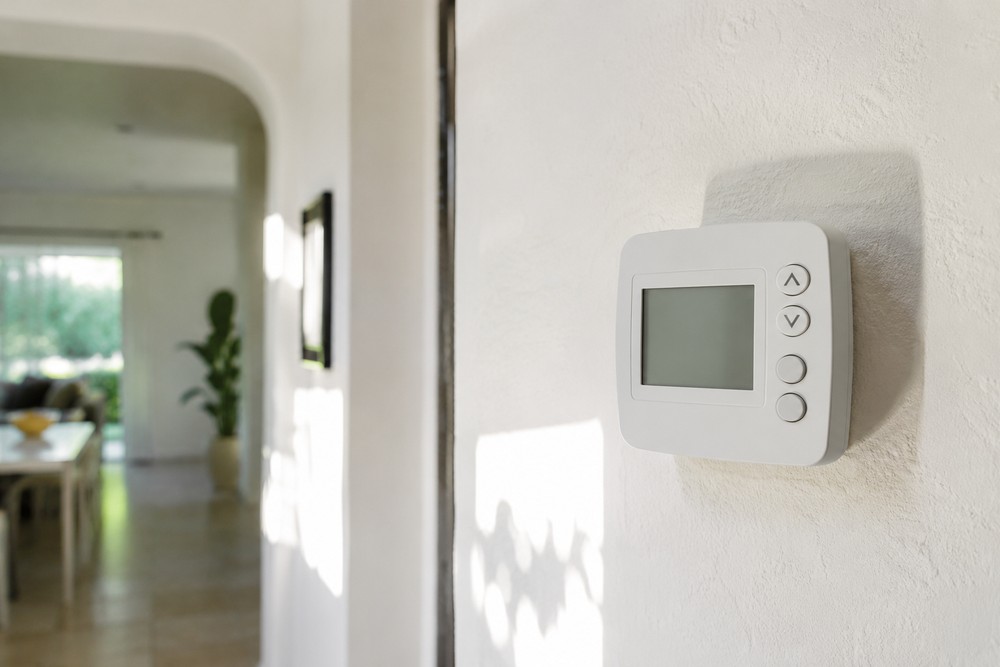
Your thermostat says 72. Your phone says 72. The wall thermometer in the hallway says 78, and your forehead agrees with the hallway. If that mismatch has become your daily summer argument, you are not imagining it, and you are not alone. More Phoenix homeowners call about this exact complaint than almost any other cooling issue.
The short answer is that most thermostats are not lying and most air conditioners are not broken. The gap usually comes from placement, sensor drift, or a system that is working exactly as designed in weather it was never meant to fight alone. Sorting out which one you have takes about twenty minutes. Fixing it ranges from free to a service call, and knowing the difference saves you from paying for the wrong repair. When the fix requires proper thermostat installation phoenix homeowners can trust, the diagnosis has to come before the hardware swap.
What your thermostat is actually measuring
A thermostat does not know the temperature of your house. It knows the temperature of the air moving across a tiny sensor inside a plastic box on your wall. Nothing more. When you understand that, the gap between the setpoint and your lived experience stops being mysterious.
Three things throw that sensor off in an Arizona summer. Direct sun on the wall behind the unit can push the reading several degrees high, which makes the thermostat think the house is warmer than it is and run the AC longer than needed. A thermostat mounted near a return duct or in a hallway with poor airflow reads air that never mixes with the rest of the house. And a unit on an exterior wall absorbs heat straight through the drywall, so the sensor is effectively measuring the outside of your home.
My rule of thumb after years of walking into hot houses: if the thermostat sits on a sunbaked wall near a window, suspect placement before you suspect the compressor. You can test it yourself by taping a piece of cardboard over the unit for an afternoon and watching whether the reading drops. It sounds crude. It works.
Why humidity in monsoon season makes it worse
Phoenix gets a stretch of sticky weeks every summer, and that changes the math. An air conditioner removes heat and moisture at the same time, so a system sized for dry heat spends extra capacity pulling water out of the air. The indoor temperature can climb while the AC runs nonstop, which reads like a thermostat failure but is really a load problem.
According to the Environmental Protection Agency, indoor humidity above roughly 60 percent feels warmer at the same thermometer reading, which explains why a monsoon afternoon at 76 degrees can feel worse than a dry 80. If your thermostat shows 78 and the air feels clammy, the system is struggling with moisture. Cleaning the drain line, changing the filter, and confirming the fan setting is on auto rather than on all help more than tapping the display ever will.
The swap that usually isn’t the answer
Every summer, homeowners buy a smart thermostat expecting the display problem to disappear. Sometimes it does. Often the new unit reads the same wrong number because the sensor was never the issue, the location was.
Before you spend money on hardware, run my three-part wall test. It takes one afternoon and costs nothing.
- Shade test: block direct sun from the wall for three hours and see whether the reading settles closer to the setpoint.
- Cross-check test: place a separate thermometer two feet away at the same height. A gap over three degrees points to sensor drift or placement.
- Battery and wiring test: pull the faceplate and look for corrosion or loose wires. A thermostat that loses power intermittently resets its calibration and forgets what it learned.
If the unit fails two of those three, replacement makes sense. If it passes all three, you are looking at an airflow or equipment problem wearing a thermostat costume. That distinction matters because replacing a working device does nothing for a house that is genuinely too warm, and it can hide a failing capacitor or a clogged coil for another season.
The numbers on the dial that everyone gets wrong
The Department of Energy has long recommended setting the cooling setpoint higher when you are away and lower when you are home, and modern programmable units can follow that schedule without you touching a dial. The part most people miss is the swing setting, the number of degrees the house is allowed to drift before the system kicks on.
A tight swing keeps the temperature steady but cycles the compressor constantly. A loose swing saves energy and lets rooms feel uneven. I would set a two degree swing in most Phoenix homes and leave it alone. Constantly chasing a number on a screen is how you end up with a home that never feels right at any setting.
When it is time to call someone
Call a technician when the gap survives the shade test and the cross-check, when the thermostat display flickers or goes blank, when the unit clicks but nothing starts, or when your electric bill jumps alongside the temperature reading. Those four signals point to wiring, low voltage, or a control board issue that is not a homeowner fix.
Standards bodies recognize that thermostat accuracy matters enough to test for it. The National Institute of Standards and Technology maintains calibration standards that manufacturers design against, so a unit that drifts more than a couple of degrees in normal conditions is not living up to its own spec sheet. That is a warranty conversation, not a guess.
One more thing worth saying plainly: do not chase the number with the breaker. Power cycling a thermostat repeatedly can wipe its programming and, on some models, leave the compressor unprotected on restart.
Frequently asked follow-ups
Why does the reading change when the AC turns off?
Because the fan stops moving air across the sensor. The thermostat then measures the still air around it, which is often warmer or cooler than the room. This is normal and one more reason placement matters.
Can I recalibrate a thermostat myself?
Many models include a calibration offset in the installer menu. Adjusting it to match a trusted room thermometer is fine as a stopgap, but treat it as a patch. It fixes the display, not the underlying imbalance.
Does a new thermostat lower my bill?
Only if the old one was miscalibrated or could not hold a schedule. The hardware itself is a control, not a cooling source. If your house fights the desert, the control was never the bottleneck.
A thermostat that disagrees with your hallway is giving you useful information, not attitude. It is telling you where it lives, what it is measuring, and whether the system behind it can keep up. Run the wall test this weekend, and if the gap holds, get the diagnosis before the hardware. What is your thermostat reading right now, and does your hallway agree?