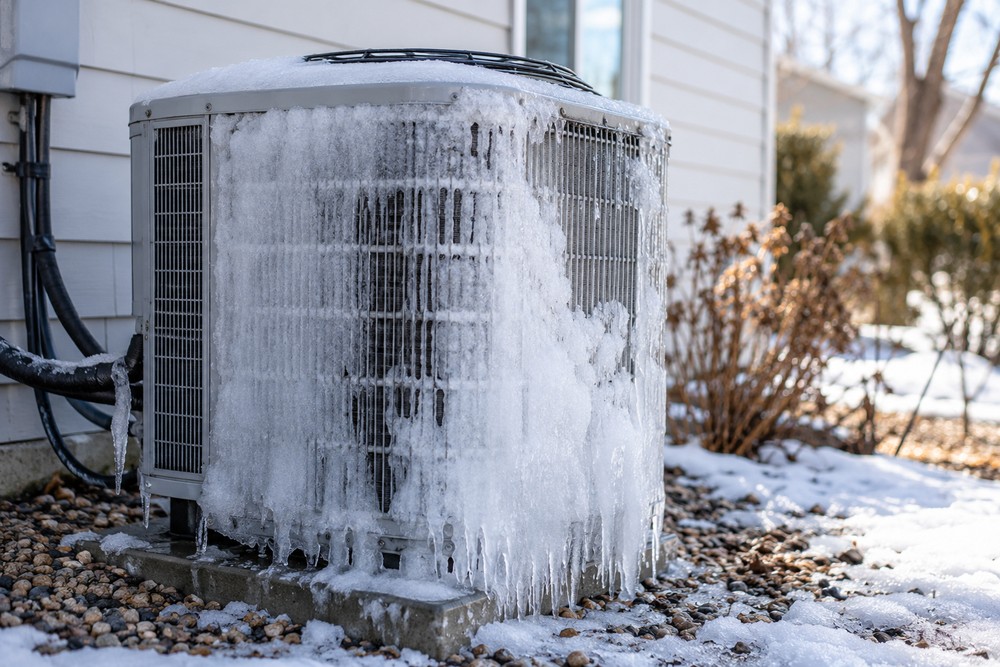
You walk out to the driveway on a 48 degree April morning and find the whole outdoor unit sheathed in white. The fan’s turning. The house is lukewarm. Your first instinct is to grab a hose, and that instinct is exactly wrong.
Freeze-ups in spring are the most misread problem in home heating. Roughly half the calls I’ve heard about from homeowners in the Potomac Valley turn out to be normal defrost behavior in the wrong weather, and the other half trace back to one of four mechanical faults. Telling them apart takes about ten minutes with no tools, which beats paying for a service visit you didn’t need. If you’d rather hand the diagnosis to someone who does this daily, a reputable HVAC company in Hagerstown can walk the system in under an hour and tell you which camp you’re in.
The Physics Nobody Explains at Install Time
Heat pumps don’t make cold. They move heat, and in heating mode they pull it out of outdoor air that feels cold to you. The coil runs colder than the air around it, so moisture in that air condenses and freezes on the fins. That’s not a defect. It’s the design working as intended, and every unit has a defrost cycle built in to melt it off.
Spring breaks the schedule. You get a 70 degree afternoon followed by a 35 degree night, and the unit swings between cooling and heating demands while the outdoor coil keeps loading up with condensation it wouldn’t see in February. Defrost runs more often. Some of those runs end with a cloud of steam and a puddle, which is normal. According to the Department of Energy, a heat pump moves heat rather than generating it, which is why its efficiency holds up in mild cold and why the outdoor coil behaves so differently from a furnace flue.
Here’s the test that separates normal from broken. Watch the unit for a full cycle. If it clears itself inside fifteen minutes and comes back to a dry coil, leave it alone. If frost survives two or three defrost attempts and starts climbing the cabinet, you have a real fault.
Four Faults That Look Identical From the Driveway
All four of these produce the same white iceberg, and none of them fix themselves. Ranked by how often I’d bet on them:
- Low refrigerant charge. A slow leak drops coil pressure, the coil runs colder than it should, and frost forms even in mild air. You’ll usually see ice in a band at the bottom of the coil first.
- Failed defrost control. The board, sensor, or reversing valve stops switching the unit into defrost. The coil never gets its melt cycle.
- Restricted airflow. A clogged filter, a collapsed return duct, or a shut register starves the indoor coil. This one is your fault more often than the equipment’s.
- A stuck reversing valve. The unit tries to defrost, can’t complete the switch, and freezes harder each cycle.
Only the third one is a homeowner fix on a Sunday. The other three need gauges and a recovery machine.
What I’d Actually Do First
Change the filter. Not because it’s the answer to everything, but because it’s free, it takes four minutes, and a genuinely choked filter will mimic a refrigerant fault closely enough to waste a service call. While you’re at it, check that no furniture, snow fence, or shrub is sitting within two feet of the outdoor unit. Spring landscaping is a sneaky cause of restricted airflow, and I’ve seen a newly planted arborvitae take out a system’s performance for an entire season.
Then leave the unit alone for two hours. No hose, no chipping, no “helping.” Pouring warm water on a frozen coil can crack a braze joint, and prying ice off the fins flattens them, which permanently reduces the coil’s ability to transfer heat. The Environmental Protection Agency regulates refrigerant handling for a reason, and that includes the small charge inside your outdoor unit.
The Questions That Reveal a Competent Technician
When you do call, the visit itself is your best quality filter. Ask three things before anyone touches a gauge:
- Are you going to check subcooling and superheat, or just top off the charge?
- If there’s a leak, how do you find it, and will you show me the location?
- What’s your diagnostic fee if the repair turns out to be a filter I could have changed?
A technician who answers those plainly is worth keeping. One who reaches for a refrigerant can without a leak search is selling you a refill that’ll leak out again by August. Weighing measurement against guesswork is the whole game here, which is the same principle the National Institute of Standards and Technology applies to measurement science at a national scale.
A Spring Maintenance List You Can Run Yourself
Twenty minutes in April buys you a quieter summer. Work through this in order:
- Replace the filter and write the date on the edge with a Sharpie.
- Clear the outdoor unit’s two foot perimeter and rinse the fins from the inside out with a garden hose on low.
- Straighten any flattened fins with a fin comb, sold at most hardware stores for under fifteen dollars.
- Check the condensate drain for algae and flush it with a cup of white vinegar.
- Listen for a rattle at startup and note which panel it comes from.
- Note the date the unit last short-cycled on you.
That last one matters more than people think. A written log turns a vague “it’s been acting up” into a pattern a technician can read in thirty seconds.
When to Stop Diagnosing and Start Calling
Call the same day if the frost climbs above the coil, if the outdoor fan stops while the compressor keeps running, if you smell a sweet chemical odor near the unit, or if the breaker trips twice. Those point to compressor or refrigerant trouble, and running the system through it makes the eventual repair more expensive. Call within the week if the unit clears itself but the house never quite reaches the thermostat setting.
Everything else can wait for business hours. Emergency pricing exists because someone decided to run a frozen system for three days.
Frost in April is a message, not a verdict. Your job is to read it fast, rule out the cheap causes, and hand off the rest before a small leak becomes a compressor replacement. Check the filter tonight, then decide whether you need help. What’s the actual condition of your outdoor unit right now, dry, lightly frosted, or wearing a full coat of ice?