Every January, HVAC companies field the same call at 11 p.m.: the heat is dead, the house is at 54 degrees, and the kids are in sleeping bags on the living room floor. You would think furnaces fail at random. They don’t.
A furnace breaks on the coldest night of the year because that’s the night it runs the hardest. Extended runtime is what pushes a dirty blower wheel, a weak ignitor, or a clogged filter past the point of no return. The equipment was already limping. The cold snap just finished the job. That’s also why scheduling service in early fall, while it’s still 70 degrees outside, gets you a technician who isn’t juggling forty emergency calls.
If you live on the north side of the metro and want a pro to look at things before the rush, a team that handles furnace repair in Cincinnati, OH can usually get out within a few days in September. In January, you’re waiting your turn like everyone else.
The cold snap theory of furnace failure
Here’s the pattern I’ve watched play out in my own house and in every house I’ve rented out since. A furnace that runs twenty minutes an hour can survive on a filter that hasn’t been changed since last spring. That same furnace running fifty minutes an hour cannot. Restricted airflow makes the heat exchanger run hotter than it should, trips the high limit switch, and shuts the burner down. You wake up to a house that’s cold and a thermostat that’s blinking a fault code you don’t recognize.
Cold snaps also expose problems that have nothing to do with the furnace itself. A condensate drain line that drips fine in October can freeze solid in a single-digit night on a high-efficiency unit. A vent pipe that’s partially blocked by a bird nest becomes a real problem when the furnace is the only thing keeping your pipes from freezing.
None of this is a reason to panic. It’s a reason to test your system in October instead of discovering all of it at once in a snowstorm.
What a fall tune-up actually checks
A tune-up isn’t just a guy wiping down the cabinet. When it’s done right, it covers the parts that decide whether you spend December comfortable or miserable.
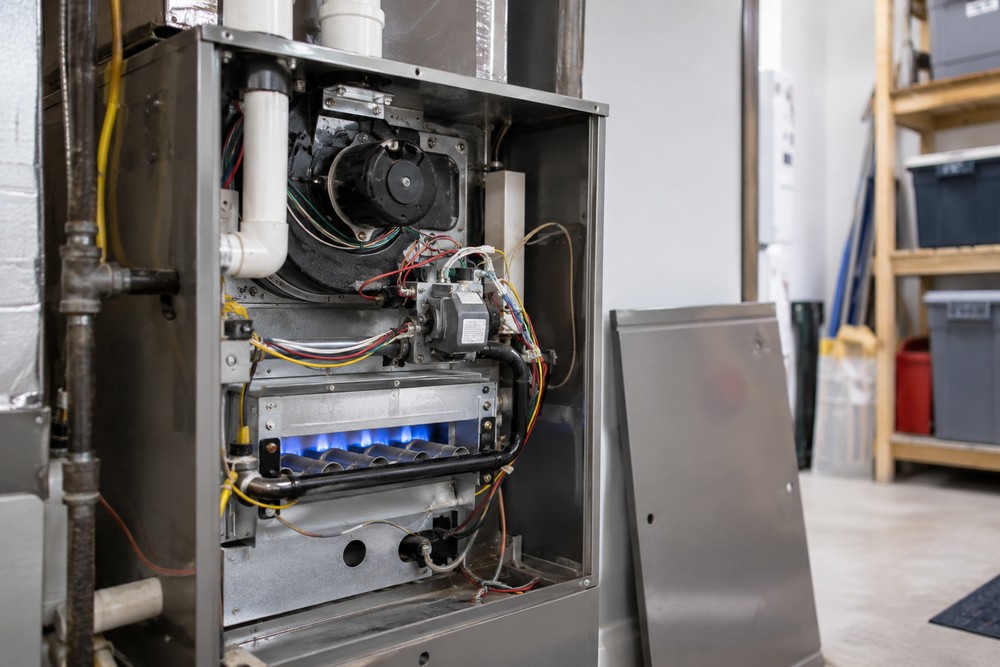
- Filter and blower wheel: A clogged filter starves the system; a dirty blower wheel throws the whole airflow balance off.
- Ignitor and flame sensor: These are the two most common reasons a furnace fires up and then shuts off a few seconds later.
- Heat exchanger inspection: Cracks here are a combustion safety issue, and a technician should be checking the metal rather than just glancing at the flame color.
- Flue and venting: Blocked or improperly pitched venting is a real hazard, and it’s a frequent cause of shutdowns on newer units.
- Thermostat calibration: If your thermostat reads 70 and your house feels like 65, you’re paying to heat a number, not a room.
The U.S. Department of Energy publishes guidance on seasonal maintenance and heating efficiency that backs up most of what technicians recommend in the field. Their homepage is a good starting point if you want a second opinion on anything a contractor tells you.
Should you repair it or replace it?
This is the question homeowners ask me most, usually while standing next to a technician holding a clipboard. My honest answer: it depends on three things, and none of them is the sticker price alone.
Ask about the age of the unit first. A furnace that’s twelve to fifteen years old and needs a blower motor is a different decision than a five-year-old unit with the same problem. Ask about the repair cost as a percentage of replacement cost. If a single repair runs more than a third of what a new unit would cost, I lean toward replacing it, especially if the old unit is already past its expected service life.
Then ask about efficiency. Older furnaces running at 80 percent efficiency waste a meaningful chunk of every dollar you spend on gas. Modern high-efficiency units do better. The trade-off is that high-efficiency models have more parts that can fail and often need different venting, so a cheap quote that doesn’t mention venting is a quote you should question.
One more thing: get the combustion analysis in writing. It takes the guesswork out of whether a repair is safe or just cheap.
A checklist you can run this weekend
You don’t need a truck full of tools to catch most furnace problems early. Run through this before the first hard freeze.
- Replace the filter. Write the date on the new one with a Sharpie so you stop guessing.
- Turn the thermostat up five degrees and listen. Rattles, bangs, or a whoosh that sounds different from last year are worth noting.
- Check the condensate line on a high-efficiency unit. If it’s PVC and runs outside, make sure it has a slope and isn’t already iced over.
- Walk outside and look at the vent and intake terminations. Clear any leaves, nests, or snow.
- Test the shutoff switch and confirm your carbon monoxide detectors work. The Environmental Protection Agency’s site has plain-language guidance on indoor air quality and combustion safety if you want to go deeper.
- Note the model and serial number. You’ll want it when you call for service, and it speeds up any warranty claim.
That’s a Saturday morning. It’s cheaper than a Sunday emergency call and a lot cheaper than a flooded basement from a burst pipe.
The scheduling math most people get wrong
Furnace work has a season, and it isn’t winter. Contractors book out further as temperatures drop, and parts availability gets tighter when every truck in the region is chasing the same ignitor. Booking in early fall means better scheduling flexibility, more time to order a part if something is on backorder, and the option to make a repair-or-replace decision without a house full of cold people staring at you.
Manufacturers publish installation and service standards that technicians are expected to follow, and the National Institute of Standards and Technology maintains reference material on building performance that helps explain why ventilation and combustion measurements matter as much as the parts themselves. A contractor who skips those measurements is skipping the part that keeps your family safe.
If you have a unit that’s already made it through one cold snap with a warning sign, that’s your cue. Weak ignitors rarely fix themselves, and a flame sensor that’s failed once will fail again, usually on a holiday.
What to ask before you sign anything
Get three things in writing: the diagnosis, the parts being replaced, and the labor warranty. Ask whether the technician will do a combustion analysis and leave you the numbers. Ask if the repair is covered if the same part fails within a year. A shop that handles furnace repair in Cincinnati, OH and answers those questions without hedging is a shop worth keeping on speed dial.
Furnaces are simple machines doing a hard job in bad weather. Treat yours to one afternoon of attention in the fall, and it will likely return the favor in January. When did you last look at yours?