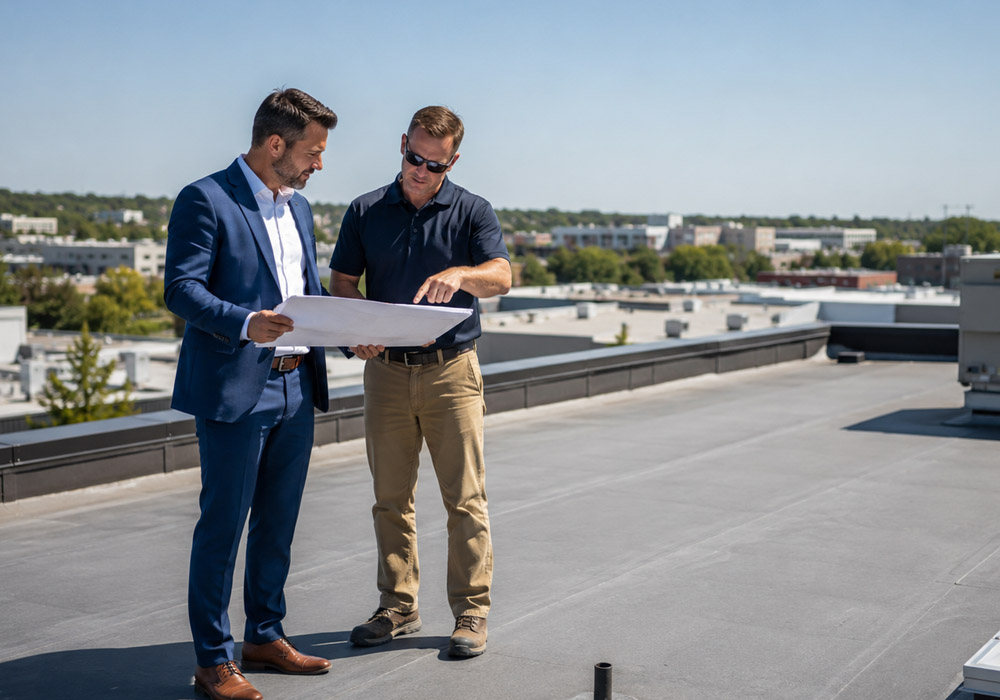
Walk through any commercial district in America and look up. Almost every warehouse, office block, and retail strip has the same profile: a flat line against the sky. That’s not a coincidence or a passing design trend. Flat roofs became the standard for commercial construction for very practical reasons, and once you understand those reasons, the decision between roofing systems gets a lot clearer.
If you own or manage a commercial building, your roof is one of the most expensive and consequential decisions you’ll make. Get it right, and you won’t think about it for 30 years. Get it wrong, and you’ll be managing leaks, energy losses, and repair invoices before the decade is out. This article breaks down exactly why flat roofs took over, what materials actually perform, and what you need to ask before hiring anyone.
The Real Reasons Commercial Buildings Go Flat
The flat roof’s dominance isn’t about aesthetics. It’s about square footage and function. On a large commercial footprint, a pitched roof would require enormous structural support, generate wasted interior attic volume, and make it nearly impossible to install HVAC units, generators, or satellite equipment at roof level. A flat surface turns the roof into usable real estate.
That matters more than most owners realize. Rooftop mechanical equipment on a flat roof stays out of sight, doesn’t compete for ground-level space, and is easier to access for maintenance than anything strapped to a pitched slope. For a building covering 20,000 square feet, that’s a significant operational advantage.
Installation cost is the other driver. On a large commercial footprint, a flat system requires less material per square foot covered, involves simpler staging, and moves faster for a roofing crew. Those savings compound quickly at commercial scale. And because flat roofs are by definition not visible from street level, there’s no curb appeal penalty for choosing the most durable material over the most attractive one.
A Flat Roof Decision Matrix: Material Comparison
Choosing the wrong material is the most common mistake commercial property owners make. Here’s an honest comparison of the four systems you’ll actually encounter in the field:
| Material | Typical Lifespan | Best For | Main Risk
|
| TPO (Thermoplastic Polyolefin) | 20 to 30 years | Energy efficiency, new construction | Seam failure if improperly installed |
| EPDM (Synthetic Rubber) | 25 to 30+ years | Large office spaces, cold climates | Seam leaks without proper sealant |
| Metal (Aluminum or Steel) | 30 to 50 years | Durability, heat reflection | Higher upfront cost, full replacement required |
| Modified Bitumen | 15 to 20 years | Budget-conscious reroofing | UV degradation without coating |
The right pick depends on your climate, your building’s age, and your maintenance budget. In colder northern states, EPDM’s flexibility in freezing temperatures gives it a meaningful edge over materials that crack under thermal stress. In sunnier or warmer climates, TPO’s reflective surface reduces cooling loads considerably.
What Flat Roofs Do to Your Energy Bill
This is where the choice of material stops being a roofing conversation and starts being a utility bill conversation. According to the U.S. Environmental Protection Agency, buildings with cool roofs use less air conditioning and maintain more comfortable indoor temperatures, and in non-air-conditioned structures, cool roofs can lower maximum indoor temperatures by as much as 3.3 degrees Celsius during peak heat. That kind of passive cooling matters enormously on a commercial roof that may cover tens of thousands of square feet of conditioned space below.
The EPA’s cool roofs research page at epa.gov documents this clearly: reflective roof surfaces reduce the heat absorbed through the building envelope, which directly shrinks the cooling load your HVAC system carries through summer. For a flat commercial roof, where every square foot of membrane sits in direct sun, the effect is substantial.
This is why the trend toward reflective white TPO membranes has accelerated. A dark EPDM roof and a white TPO roof may look like comparable choices on a spec sheet, but their real-world energy performance diverges sharply on a hot July afternoon.
The Three-Question Test Before You Hire Anyone
Most roofing problems on commercial buildings trace back to one of three installation failures: bad seam work, inadequate drainage slope, and wrong material for the climate. Asking these three questions before signing any contract screens out the contractors most likely to create those problems.
- How will you handle the seams? On membrane roofs, seams are the failure point. A qualified contractor should describe their specific seam welding or bonding process without hesitation and explain how they verify the seal before leaving the job site.
- What slope will you build into the deck? True flat roofs do not exist. Every compliant installation includes a subtle slope, typically toward an interior drain or edge scupper, to prevent standing water. If a contractor says the roof will be completely flat, walk away.
- What warranties do you carry, and who backs them? A reputable contractor offers both a manufacturer’s material warranty and their own workmanship warranty. These are separate documents covering separate risks. Insist on seeing both.
“The single most preventable failure in commercial flat roofing is standing water caused by inadequate slope planning at the design stage. By the time the leak appears inside the building, the deck underneath is often already compromised.” This reflects the consensus position among professional roofing inspectors and is echoed throughout industry training documentation from the National Roofing Contractors Association.
For property owners in Montana specifically, working with a contractor who knows the region’s freeze-thaw cycles is non-negotiable. Any water sitting in a low spot on a flat roof will expand as it freezes, widening seams and accelerating membrane failure faster than almost any other weather condition. That local knowledge is exactly why property owners searching for commercial flat roofing in Great Falls should prioritize contractors with direct experience in North Central Montana’s climate rather than generalist firms without that regional record.
Maintenance Is Where Owners Leave Money on the Table
A commercial flat roof that receives scheduled inspections twice a year will dramatically outlast one that gets attention only when something goes wrong. The math on this is not subtle. The U.S. Energy Information Administration reported in 2023 that the combined residential and commercial sectors accounted for about 27.6% of total U.S. end-use energy consumption, roughly 20.6 quadrillion British thermal units annually. A building’s roof is one of the primary variables controlling how much of that energy actually stays inside the structure versus escaping through a degraded membrane, according to the EIA’s Commercial Buildings Energy Consumption Survey reports. Letting a roof deteriorate quietly doesn’t just create repair costs; it inflates every utility bill for the life of the problem.
The two maintenance tasks that deliver the highest return are clearing drains before winter and recoating any section where the membrane has begun to chalk or thin. Both are cheap. Both prevent the kind of damage that requires a full replacement years ahead of schedule.
Picking the Right Contractor Is the Actual Decision
Material selection matters. Slope matters. Seam quality matters. But all of those factors flow downstream from a single upstream choice: who you hire. A mediocre contractor with premium materials produces worse results than a skilled contractor with mid-tier materials. Every time.
The markers that separate capable commercial flat roofers from the rest are not complicated: verifiable local project history, manufacturer-certified installer status, and a clear written scope of work that specifies material brands, membrane thickness, drain placement, and inspection protocols. Any contractor who resists putting those specifics in writing is telling you something important before a single nail goes in. Flat roofs became the standard in commercial construction because they make practical sense at scale. They’ll keep making sense for your building too, as long as the installation is right from the first day.