Every spring, rural homeowners look out at a pothole-riddled lane and immediately call the local quarry for another tri-axle load of crushed limestone. Ordering fresh aggregate feels like the easiest fix after months of freeze-thaw cycles and heavy downpours, but most aging driveways are not actually short on rock. In most cases, tons of good stone are still sitting right there on your property—either compacted into a flat pan or pushed out into the weeds along the edges. Instead of spending hundreds or thousands of dollars hauling in material that will wash out the exact same way, reshaping the surface with purpose-built tools from Road Runner Equipment lets you reclaim the gravel you already bought and fix the structural issues underneath.
Standing Water and Puddles Down the Centerline
When rainwater pools down the middle of your lane or sits for days in parallel tire tracks, you are looking at a geometry problem rather than a gravel shortage. A healthy gravel drive relies on a subtle three-to-four percent center arch—known as a crown—so water sheets off to the edges before it can soak into the roadbed. Once daily traffic flattens that arch, standing water softens the compacted stone dust underneath and allows vehicle tires to punch out deep potholes. Simply shoveling new stone into a wet low spot acts like a loose sponge that tires will scatter within a week, whereas establishing a proper center crown and drainage profile cuts away the surrounding high spots and sheds storm runoff before potholes can form.
Deep Tire Ruts Paired with High Grassy Berms
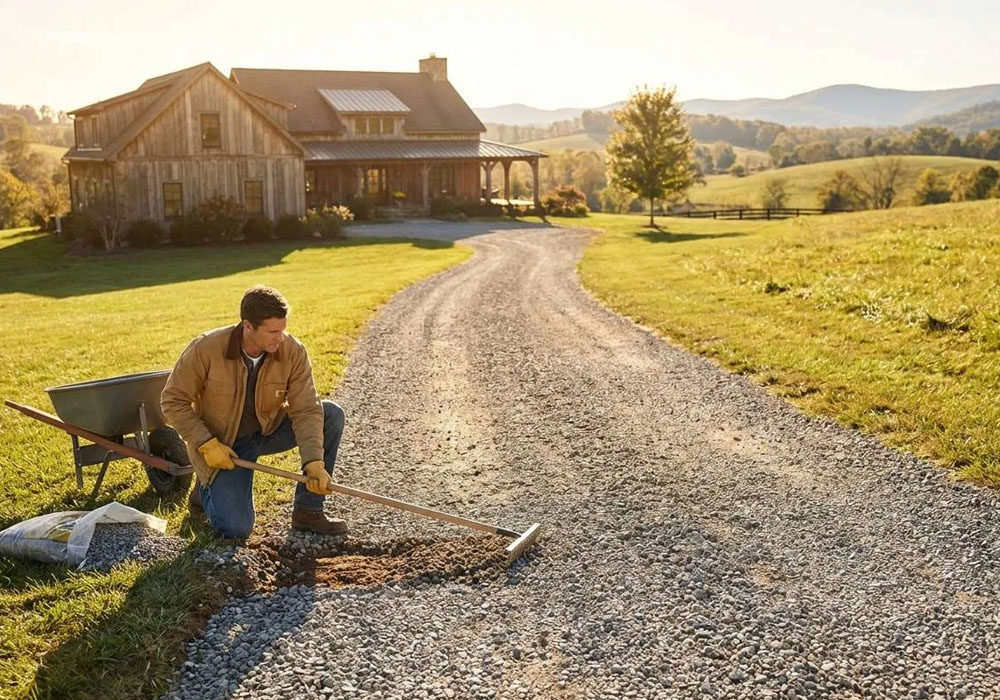
Before paying for another dump truck delivery, take a shovel and walk the outer edges of your driveway where the gravel meets the lawn. Years of tire pressure naturally push loose stone outward, creating twin wheel ruts in the travel lane and raised ridges—often called false shoulders—hidden right beneath the grass along the borders. Those raised edges act like miniature dams that trap rainwater on the driving surface and accelerate erosion down the slope. Running a heavy-duty skid steer grader attachment along those overgrown borders pulls inches of clean, migrated rock out of the turf and moves it back toward the center, restoring full driveway width without adding a single pound of new quarry stone.
Washboarding on Slopes and Braking Zones
Few things bother property owners more than the bumpy ridges that show up on driveway hills, sharp turns, and the area right before the garage or mailbox. These are called washboarding or corrugation. They happen when car tires bounce while speeding up or slowing down. The bouncing kicks up gravel and small stones, which then form repeated waves across the surface. It’s not just annoying. It’s also rough on tires and cars. Dumping fresh #57 stone or crusher run over washboard ripples is a guaranteed waste of money because the compacted base underneath still holds that wavy shape, forcing the new rock into the exact same pattern within days. The only permanent cure is shaving the surface down below the bottom of the deepest ripple while maintaining roadside ditches and unobstructed water runoff so the remixed stone and moisture pack down into a smooth, unified slab.
Loose Stone Scattering While the Base Remains Hard
Sometimes a driveway feels like you are driving on loose marbles, with clean three-quarter-inch rock rolling into the yard even though probing the ground with a steel rod reveals a rock-solid crust underneath. This separation happens when heavy rain and traffic strip away or settle the fine stone dust—the binder—leaving the larger angular rocks on top with nothing to lock them in place. Adding more clean gravel on top only adds more rolling marbles to an unbonded surface. By using commercial grading solutions from Road Runner Equipment to scarify the top two inches of that hardpan, an operator can bring buried stone dust back up to the surface, remix the coarse and fine particles, and compact them into a tight crust that stays put.