Most homeowners think of indoor renovations and outdoor maintenance as two unrelated projects. One lives on a Pinterest board. The other gets handled whenever there’s a free Saturday. But if you’re planning to host this holiday season, both land on the same calendar, and that calendar is shorter than it looks.
The window between early fall and the first big gathering is narrow. Contractors book up, materials run on lead times, and the weather stops cooperating with outdoor work. Treating the house and yard as one scheduling problem, rather than two, can mean the difference between a finished space and a half-done one when guests arrive.
Here’s how to think about both sides of the property before the deadline.
Why the Timing Pressure Is Real
The holiday hosting season compresses a lot of work into a few short weeks. The problems that make it hard are predictable:
- Trade availability drops. Carpenters, plumbers, and tree crews are busiest in late fall. The earlier you call, the better your odds of getting on the schedule.
- Materials have lead times. Custom cabinetry, specialty fixtures, and certain finishes can take weeks to arrive, sometimes longer if anything is backordered.
- The weather closes the outdoor window. Once the ground freezes or the storms start, exterior work gets harder, slower, and occasionally unsafe.
The practical takeaway: start sequencing now. Lock in outdoor work that depends on dry, workable conditions first, and place orders early for indoor builds that hinge on materials.
The Exterior Work Guests See First
Before anyone steps inside, they walk up to your home. The approach, the driveway, walkway, and trees framing the entry set the first impression and, more importantly, raise real safety concerns heading into winter.
Structural Pruning While Trees Are Dormant
Late fall and winter are the best time to prune most deciduous trees structurally. Once the leaves drop and the tree goes dormant, two things become easier:
- The structure is visible. Without foliage, an arborist can clearly see the branch architecture, crossing limbs, and weak attachment points that need attention.
- The tree handles cuts better. Dormant-season pruning reduces stress and lowers the risk of disease entering through fresh cuts, since many pests and pathogens are also inactive.
This isn’t about aesthetics alone. Good structural pruning removes deadwood and poorly attached limbs most likely to fail under the weight of snow or ice. Scheduling professional tree pruning in Northern Virginia before the first major storm is one of the few yard tasks that pays off in both curb appeal and genuine risk reduction.
Clearing What Threatens Walkways and Driveways
Beyond the trees themselves, look at where limbs hang over the paths people use. A branch that’s merely annoying in summer becomes a hazard once it’s loaded with ice.
Walk your property and check for:
- Limbs extending over the driveway, front walk, or parking area
- Branches rubbing against the roof, gutters, or power lines
- Overgrowth crowding the entry path, especially where it narrows
- Any obviously dead or hanging wood from storms earlier in the year
Clearing these before winter does two jobs at once. It removes a liability when guests come and go in the dark. It prevents storm damage that becomes an emergency call at the worst possible time.
Mistakes to avoid outdoors:
- Topping trees (cutting back the main upper branches) to control size. This damages the tree and encourages weak regrowth.
- Pruning heavily right before a hard freeze without professional guidance.
- Attempting work near power lines yourself. That’s a utility-and-professional job, not a weekend one.
Building Out a Dedicated Entertaining Area
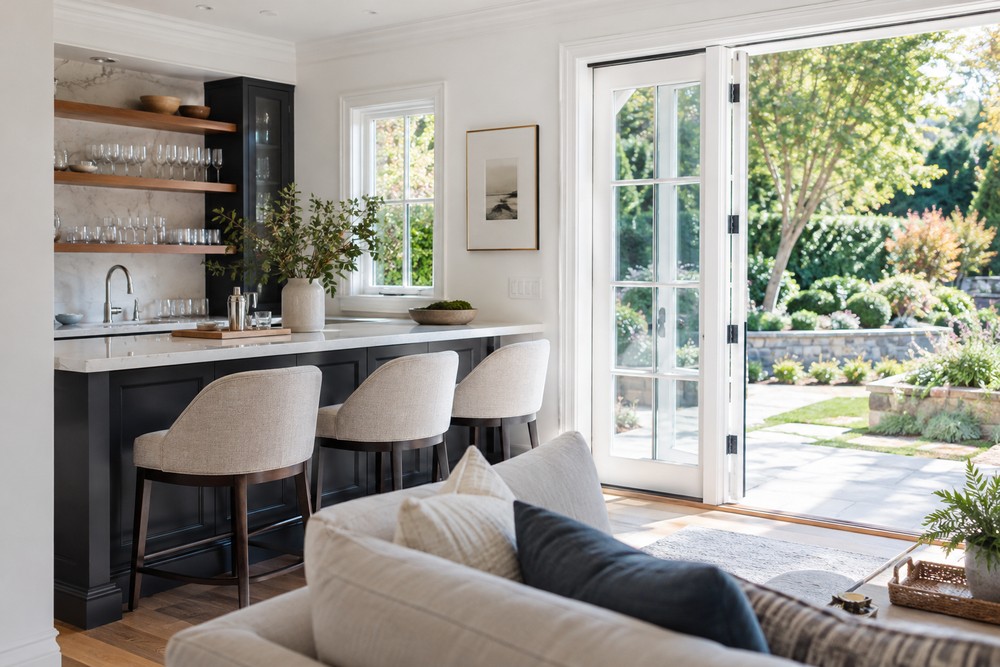
Now move inside. If the plan is to host, a defined entertaining area changes how a gathering flows. Instead of everyone crowding the kitchen, you create a second gravitational center. Here, drinks, conversation, and foot traffic can settle without blocking the cook.
The anchor of that area is usually a bar. Done well, it keeps glassware, ice, and bottles out of the main kitchen and gives guests somewhere natural to gather.
Placement Comes First
Before you think about finishing, decide where the bar belongs. Good placement considers:
- Traffic flow. Position it so guests can reach drinks without cutting through the cooking zone.
- Proximity to plumbing. The closer you are to existing water and drain lines, the simpler and less expensive the build.
- Proximity to the gathering space. It should feel like part of the room, not an afterthought tucked into a corner.
- Electrical access. You’ll likely want outlets for a small refrigerator, an ice maker, or lighting.
Plumbing Requirements
If you want a working sink, and most people do, plumbing becomes the deciding factor in both cost and timeline. Running new supply and drain lines to a far wall is a bigger undertaking than tapping into nearby lines.
A few things worth confirming early:
- Whether your layout allows a gravity drain or requires a pump
- How the new fixture ties into existing venting
- What your local code requires for the installation
This is the part of the project where lead time bites hardest. A quality custom wet bar installation depends on cabinetry and fixtures that are often made to order. So, the plumbing rough-in and the cabinet order need to be coordinated, not handled one after the other.
Lead Time on Cabinetry and Fixtures
Custom carpentry is not a last-minute purchase. The cabinetry that makes a bar feel built-in rather than bolted-on has to be designed, built, and finished before it can be installed.
Plan for these stages:
- Design and measurement, getting the dimensions and layout right.
- Fabrication, the actual build, which runs on the shop’s queue, not yours.
- Finishing, meaning staining, sealing, or painting, each of which needs cure time.
- Installation and tie-in, fitting the cabinetry and connecting fixtures.
If you’re set on a specific countertop material or fixture finish, those choices can extend the timeline further. Decide on them early so the orders can go in while everything else moves forward.
Mistakes to avoid indoors:
- Ordering cabinetry before confirming the plumbing path, then discovering the layout doesn’t work.
- Choosing fixtures based on looks alone without checking lead times.
- Underestimating the finishing stage and scheduling installation too tight against your hosting date.
Sequencing Both Projects Together
These projects share a deadline because they compete for the same two resources: your time and skilled labor. Here’s a sane order of operations:
- Book the outdoor work first. Dormant-season pruning and storm-prep clearing depend on the weather and can’t be rushed later.
- Lock in the design for your entertaining area. Measurements and layout decisions unlock everything downstream.
- Place long-lead orders immediately. Cabinetry and fixtures should be ordered the moment the design is settled.
- Schedule the plumbing rough-in to align with cabinet delivery.
- Save finish work and staging for last, with a real buffer before the first gathering.
The Bottom Line
The homeowners who host comfortably in December are the ones who stopped treating the yard and the entertaining space as separate to-do lists back in fall. Both have hard constraints, weather outside and lead times inside, and both reward early decisions.
Walk the property this week. Make the calls while the calendar still has room in it. The deadline is the same for both. The only variable is whether you start now or scramble later.