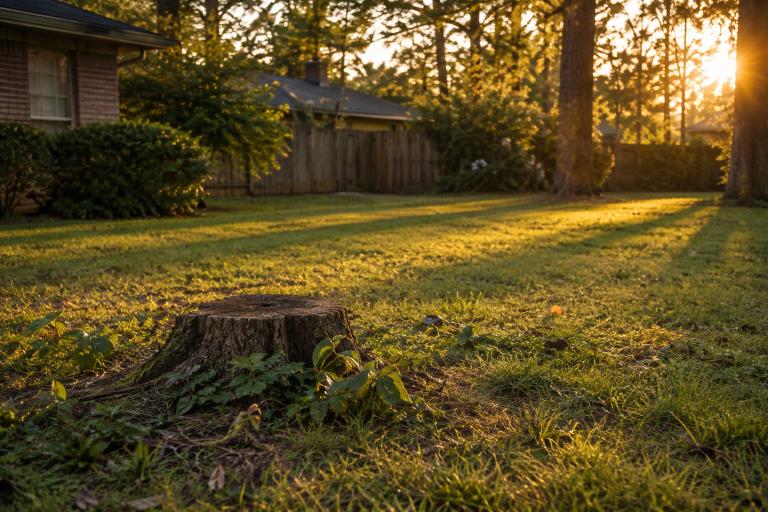
Removing a tree does not always complete the yard project. In Shreveport, a leftover stump can affect mowing, drainage, play areas, planting beds, and plans for a new fence, patio, or walkway. Reviewing the site carefully before deciding on a stump management approach, whether removal, stump grinding, or leaving it in place, can help homeowners choose the option that fits both the property and the stump’s condition.
Some stumps can remain in a low-traffic corner of the yard for years, while others become an immediate obstacle. Frequent rain, warm temperatures, and vigorous plant growth can make a low stump harder to see as grass, leaves, and groundcover build up around it. The best choice depends on how the space will be used next.
Why a Leftover Stump Still Matters
A stump occupies more than the visible piece of wood above ground. Roots may remain below the surface, decay over time, or send up new shoots. Even a short stump can interrupt a smooth lawn, create an awkward mowing route, or limit where a homeowner can place a garden bed.
When a tree must come down because of storm damage, decline, crowding, or a future landscape project, the broader tree removal decision should include a plan for the remaining stump, chips, roots, and soil. Treating those details as part of one yard plan can prevent an unfinished-looking area from becoming a recurring maintenance issue. More information about tree management in Louisiana is available from local arboricultural resources.
How to Inspect the Stump and Nearby Area
A simple inspection helps define the project’s scope before any digging or equipment enters the yard. Take photos and note the following details:
- Measure the stump’s approximate width and height.
- Check its distance from driveways, sidewalks, patios, fences, sheds, and play spaces.
- Look for soft wood, loose bark, cavities, mushrooms, or obvious insect activity.
- Watch for sprouts around the stump or along surface roots.
- Identify nearby irrigation heads, landscape lighting, drainage features, and utility boxes.
- Decide what the space should become after the stump is addressed.
Should You Remove, Grind, Reuse, or Monitor It?
Leave It in Place
Leaving a stump may be reasonable when it sits well away from foot traffic, buildings, and planned improvements. This option still calls for occasional checks. A stump that becomes soft, develops sprouts, or begins to interfere with yard maintenance may need a different approach later.
Reuse It as a Landscape Feature
A sound, stable stump can sometimes serve as a base for a planter, a birdbath, or a modest garden accent. This works best when the feature is intentional and easy to see. Avoid decorative reuse when the wood is hollow, severely decayed, or close enough to a structure that moisture and insects would be a concern.
Grind the Stump
Grinding reduces the visible stump and can make room for a lawn or a planting bed. Major roots usually remain underground, so the area may settle as wood breaks down. The resulting mixture of soil and ground wood should be considered before planting. LSU AgCenter guidance notes that soil containing a large amount of ground wood can settle and may temporarily reduce nitrogen available to a newly planted tree, making removal or replacement of that material worthwhile in some planting locations.
Remove the Stump and Major Roots
Full extraction may make sense where a driveway, foundation work, deep planting, fence post, or major grading project is planned. It generally creates a larger disturbed area than grinding, so it may also require more cleanup, soil repair, and restoration afterward.
Common Safety and Property Concerns
- Trip hazards: Grass and fallen leaves can hide stump edges, especially in shaded areas.
- Mower damage: Striking a concealed stump can damage blades and other lawn equipment.
- Blocked access: A stump can make it harder to move wheelbarrows, trash bins, and outdoor furniture.
- Project conflicts: It may occupy the exact location needed for a path, garden bed, or fence line.
- Low visibility: Evening gatherings and wet weather can make a stump harder to notice.
Pests, Decay, and New Growth
Decaying wood naturally supports fungi and insects, but activity in a stump does not automatically mean that a nearby home has a pest problem. Still, it is wise to watch for sawdust-like material, insect trails, hollow wood, or repeated sprouts. If active insects are near structural wood or if the stump is directly beside the home, a qualified tree or pest professional can help assess the situation.
New shoots are another practical concern. Some species can produce sprouts from the remaining root system, and repeated cutting may become part of routine maintenance. Monitoring those shoots early is easier than allowing them to become established around a stump or along a fence.
Planning the Yard After Stump Work
Choose the next use for the space before work begins. A lawn repair, planting bed, path, or patio each needs a different finish level. Mark underground utilities before digging, and account for possible settling where substantial wood was ground, or roots were removed. Louisiana homeowners should call 811 before digging or tilling as an essential first step when planning deeper work.
Ground stump material may be useful as mulch in a separate planting bed or on a path, but it should not be piled against tree trunks or used as the main backfill for a new tree. Keep the future grade in mind, since adding too much soil over existing roots or allowing a depression to form can create drainage problems.
Can You Plant in the Same Spot?
Planting near a former tree site is possible, but the old trunk location is not always the best spot. Remaining roots can obstruct digging, and a planting hole filled with wood-heavy debris may settle as that material decomposes. Moving the new planting slightly away from the original trunk often provides more workable soil and room for developing roots.
Before selecting a replacement tree or shrub, consider sunlight, drainage, mature size, overhead lines, and nearby structures. Use suitable soil around the new root ball, and keep mulch spread across the surface rather than pressed against the trunk.
A Simple 2026 Stump Decision Checklist
- Is the stump in a high-traffic or frequently mowed area?
- Does it affect a planned path, fence, garden, patio, or drainage improvement?
- Is it soft, hollow, sprouting, or showing visible insect activity?
- Are utilities, irrigation lines, or landscape features nearby?
- Would reusing create a stable, visible landscape feature?
- Will the site need extra soil, grading, or time to settle afterward?
- Is grinding sufficient, or does the future project require root removal too?
Final Takeaway
There is no single correct answer for every leftover stump in Shreveport. A stump in a quiet natural area may be suitable for monitoring or creative reuse. A stump near a walkway, lawn, construction site, or future planting area may call for grinding or removal. A careful inspection and a clear plan for the space afterward can make the yard safer, easier to maintain, and better suited to its next purpose. Those considering professional stump management options can explore specialized tree care services in the area.