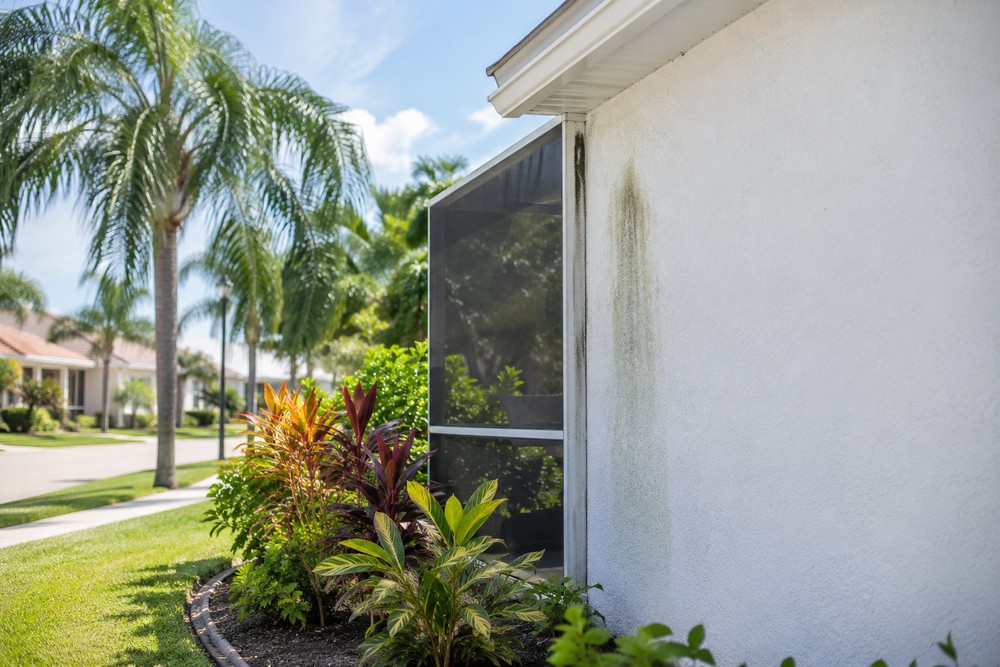
The letter showed up in March: green streaks on the north wall of a Cape Coral stucco home, a photo attached, and 14 days to fix it. That homeowner had no idea her HOA’s exterior standard existed until it cost her a fine.
Most Fort Myers associations care about a short list of things. Your home’s outside has to look maintained year round, not just when someone complains. Mildew, algae streaks, rust stains on the drive, and dirty pool cages usually count as violations. How you fix them matters too, because the wrong method on stucco or a shingle roof leaves you worse off than the mark you were trying to erase.
The tricky part is that every association writes its own covenants, and they range from vague (“keep the property in good repair”) to strangely picky about which shades of paint and which shingle styles are allowed. If you’re new to a deed-restricted community, pull your documents before you book anyone. And when it’s time to actually clean, a crew that knows the difference between a concrete driveway and a screened lanai is worth the call, which is why a lot of neighbors here just search for Pressure Washing Fort Myers and go from there.
What your HOA can actually enforce
Most exterior rules trace back to the community’s declaration of covenants, conditions, and restrictions, the governing document that runs with the property rather than with the owner. That’s the broad legal foundation behind nearly every architectural review board in Florida, and it’s why a rule that feels arbitrary to you can still be binding. The details of how those documents get enforced vary by state, and California’s mobilehome residency law is a useful reference point for how formal these rule structures can get: California MRL.
In practice, the items that get flagged most in Southwest Florida are the ones the climate creates. Green film creeping up walls that never see direct sun. Dark streaks running down the shingles. Rust bleeding from irrigation heads onto pavers. Lanai screens coated in pollen and grit. You didn’t do anything wrong. It’s just what happens when humidity sits at 80 percent for months.
Why the method matters more than the deadline
This is where I’d push back on the average homeowner’s instinct, which is to rent the biggest pressure washer at the hardware store and blast everything before the inspection. Don’t. High pressure on stucco drives water behind the finish and can pit the surface. High pressure on asphalt shingles strips granules that protect the roof. Screens tear.
Concrete and pavers take high pressure without complaint. Stucco, roofs, and pool cages need a soft wash, which means low pressure plus a cleaning solution that actually destroys the algae instead of merely lifting it off the surface. If your HOA letter says “clean the roof,” the fix is a soft wash, not a 4,000 PSI wand. A crew that quotes you one flat method for every surface is telling you something.
The three-pass compliance check
Before you schedule anything, run your property through this. I call it the three-pass check because you look at the same house three different ways.
- Pass one, the curb view. Take a spot on the opposite sidewalk. What does a board member driving past at 25 mph notice first? Usually the roof line and the driveway.
- Pass two, the close view. Walk the perimeter. Rust stains, mildew on the lanai screen, green film on the pool cage frame, dirt lines under the soffit.
- Pass three, the documents. Read your covenant’s maintenance clause and your architectural review process. Some associations require approval before exterior work, even cleaning, if a contractor will be on site.
Write down what you find on each pass. That list is your quote request, and it’s also your proof of good faith if a dispute ever comes up. HOAs respond better to a homeowner who documented the problem and scheduled a fix than to one who ignored a notice.
Where to look when the rules are unclear
Florida doesn’t have a single statewide exterior cleaning code for HOAs, so the answer usually lives in your own documents. State consumer protection offices do publish guidance on homeowner rights in deed-restricted communities, and South Carolina’s consumer affairs office maintains HOA reporting resources that show how these disputes get tracked: SC Consumer Affairs. If your association won’t clarify a rule in writing, ask for the board meeting minutes where it was discussed. They’re usually public to members.
What to ask before you hire anyone
Four questions, and the answers tell you most of what you need.
- Which surfaces do you soft wash, and which ones get the pressure wand?
- Are you insured, and can you send a certificate to my HOA if they ask?
- Do you handle pool cage screens without removing them?
- What’s your plan if the mildew comes back in six weeks?
Question four is the one I’d press hardest on. In this climate, a roof that was cleaned in June can show streaking again by October if the treatment was too weak. A good crew will tell you roughly how long to expect between cleanings based on shade, tree cover, and the compass orientation of your exterior walls.
The bottom line
Your HOA isn’t really asking for a spotless house. It’s asking for evidence that someone is paying attention. Clean the roof before the streaks become a letter, soft wash anything that isn’t concrete, and keep a dated log of what you did. That’s a lot cheaper than a fine, and it keeps your stucco and shingles intact for the long haul.
So pull your covenants this week. Walk the property with the three-pass check in hand. Then decide whether you’re renting a machine or calling someone who does this every day in Lee County.