Key Takeaways
- Voting rights involve access to the ballot and a meaningful opportunity to elect representatives.
- Federal law establishes important protections, while states and local election offices administer many day-to-day rules.
- District maps can influence whether communities are kept together or divided among several districts.
- Courts can review election laws and maps when voters argue that they conflict with constitutional or statutory protections.
- Checking official information early is one of the best ways to avoid preventable voting problems.
Voting rights are about more than casting a ballot on Election Day. Registration systems, ballot access, language assistance, polling locations, election deadlines, and the boundaries of voting districts all help determine how effectively people can participate in public life. These details affect representation in Congress, state legislatures, city councils, school boards, and other local offices. Modern debates build on a long history of laws and court cases intended to protect equal participation. Understanding the Voting Rights Act of 1965 helps explain why questions about district maps, voting procedures, and access to the ballot remain important today.
Why Voting Rights Still Matter
A legal right can be difficult to use when the process is confusing or inaccessible. Consider a voter who has participated in the same district for years, only to learn that a new map has changed the candidates on the ballot. That voter may still be eligible, but the choices, polling place, and district representative could be different. Voting rules also shape which concerns reach public officials. When communities can register, receive accurate information, and vote without unnecessary obstacles, elected bodies are better positioned to reflect the people they serve. This does not guarantee policy agreement, but it supports a system in which participation is open, and representation is accountable.
How Federal Voting Protections Developed
Federal voting protections developed in response to practices that excluded eligible citizens through unequal registration procedures, literacy tests, poll taxes, and other discriminatory barriers. The Fifteenth Amendment prohibited denying the right to vote based on race, and later laws provided additional tools for enforcement. The Voting Rights Act became a central part of that framework in 1965. Today, the federal statutes enforced by the Justice Department’s Voting Section also include laws concerning voter registration, voting accessibility, and absentee voting for military and overseas citizens. These protections connect historic civil-rights concerns to current questions about election administration and representation.
Who Controls Election Rules?
Election administration is shared across several levels of government. Congress may enact nationwide standards, while federal courts interpret the Constitution and federal statutes. State legislatures often set rules for voter registration, early voting, identification requirements, mail ballots, and redistricting. Governors may sign or veto election legislation, and secretaries of state commonly oversee statewide election operations. At the local level, county election offices and election boards frequently handle voter rolls, polling places, ballot printing, equipment, and vote counting. That division of responsibility is one reason procedures can differ substantially from one state, county, or municipality to another. Courts may intervene when a rule is alleged to violate federal or state law.
How District Maps Shape Representation
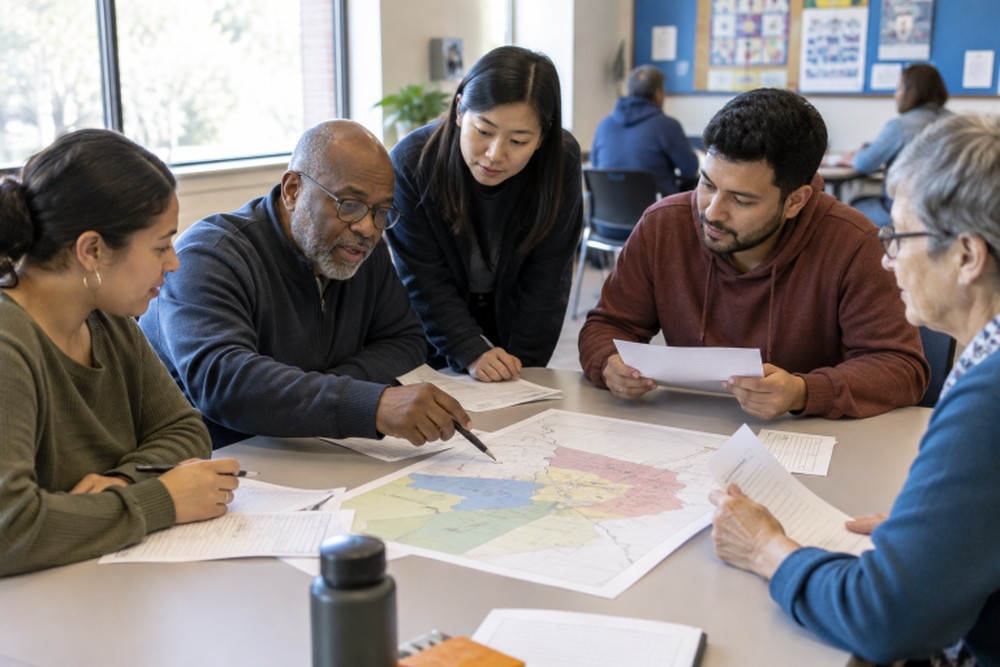
Redistricting is the process of drawing new boundaries for legislative districts after changes in population data. Because representatives are elected from defined geographic areas, the placement of a district line can affect which voters are grouped and which candidates have a realistic chance of winning. Two common terms help explain concerns about maps. Packing means concentrating many voters from one community into a small number of districts. Cracking means splitting that community among multiple districts, which can reduce its influence in each one. Vote-dilution claims may arise when a map allegedly weakens a protected group’s opportunity to elect preferred candidates.
Questions To Ask When Reviewing A Proposed Map
- Are recognizable communities divided without a clear explanation?
- Do district boundaries follow understandable geographic features where practical?
- Did mapmakers release the data and reasoning behind their proposal?
- Did residents have a meaningful opportunity to comment before adoption?
- Does the plan meet applicable federal and state requirements?
Racial gerrymandering and partisan gerrymandering are distinct legal concepts. A racial gerrymandering claim generally alleges that race was improperly used as the predominant basis for district lines. A partisan-gerrymandering dispute concerns political advantage. Both can involve similar-looking maps, but the governing legal questions are not identical.
Why Court Decisions Matter
Election lawsuits can challenge district maps, registration policies, ballot procedures, or accessibility practices. A trial court develops the factual record and issues an initial ruling. An appeals court reviews legal issues raised from that decision. The U.S. Supreme Court may review a limited number of cases, and its decisions can shape the law far beyond the original dispute. Terms such as equal protection, legislative intent, discriminatory effect, and vote dilution have specific legal meanings. Headlines can simplify those concepts too much. Readers evaluating a major ruling should look for the court’s opinion, the order that explains what must happen next, and a careful summary that distinguishes the ruling from advocacy about it.
Common Barriers Voters May Face
Many voting problems are administrative rather than dramatic. A voter may have an outdated address on file, misunderstand identification requirements, miss a deadline for a mail ballot, or arrive at an old polling place after a location change. Limited transportation, long travel distances, work schedules, disability-related access needs, and language barriers can make small procedural mistakes more consequential. These challenges can affect older voters, students, voters with disabilities, military and overseas voters, and people who live far from an election office. Clear communication, accessible materials, sufficient staffing, and dependable voter information can reduce confusion before it becomes a lost opportunity to participate.
How To Check Election Information
Start with a state or county election office, not a reposted graphic or an old social-media message. The voter information maintained by the U.S. Election Assistance Commission can also help people locate state election resources and understand common election terms.
- Confirm registration status and the address on file.
- Check election dates, registration deadlines, and ballot-request deadlines.
- Verify the current district, polling location, and early-voting options.
- Review identification, mail-ballot, and ballot-return rules for the relevant jurisdiction.
- Check publication dates before sharing election information with others.
Practical Steps For Voters And Communities
Preparation is often the most useful response to changing rules. Voters can save local election-office contact information, keep confirmation numbers for registration or ballot requests, and ask officials directly when instructions are unclear. Community groups can share verified dates, offer transportation information, and encourage people to check their status well before an election. District-map hearings and public comment periods are also opportunities for participation. In 2026 and beyond, informed voters can more readily recognize changes, ask specific questions about their representation, and use reliable information to participate in the decisions that shape their communities.
Conclusion
Voting rights are essential to meaningful participation in public life, from casting a ballot to having a fair opportunity to be represented. Understanding federal protections, local election procedures, and the effects of district maps helps voters recognize how election systems influence their communities. Although laws and court decisions continue to shape voting access, individuals can take practical steps by checking official information, meeting deadlines, and staying informed about proposed changes. Community participation and public accountability also play important roles in protecting equal access to the ballot. By understanding their rights and using reliable resources, voters can make informed decisions and participate more confidently in the democratic process.