Which caregiver resources put a person on your problem, and which ones hand you a directory.
Last checked September 2026. Every number, funding source and coverage claim below was read on the organization’s own site or a federal source in September 2026.
It is 7:40 on a Tuesday evening. Your laptop is open next to a plan document your mother mailed you in July, a denial letter for a rolling walker, and a note that says call Dr. Okafor’s office back. You have a standup at 9 a.m. You spent today’s lunch break on hold with her plan and got cut off at minute 31. She is 640 miles away and tells you everything is fine.
Everyone in this position gets handed the same list of organizations, and they blur together. Some will assign a human being who calls the plan and the equipment supplier and reports back. Some are a well-meaning phone line that emails you a PDF about talking to your parent about driving. Both get recommended in the same breath, and you find out which at 8 p.m. on a Thursday.
So this sorts them on one question: does somebody do work on your behalf, or do they tell you who to call next? The list is in no particular order. Entry one is a commercial service, first because the list has to start somewhere, and its limitation section is held to the same standard as the rest.
What “help” means, sorted by how much of your evening it saves
The word covers six different things, and the difference matters more than the brand name.
- Fact sheets and videos. Useful once.
- Someone names the agency covering your mother’s county. You still make that call.
- A trained person works through your situation and helps you decide.
- Someone calls the doctor, the plan and the supplier, then reports back.
- Paid hours of another adult physically present, so you can work or sleep.
- Paperwork on your behalf. The appeal gets filed. The hold music is someone else’s problem.
Who does the work, and who hands you a number
Understood Care
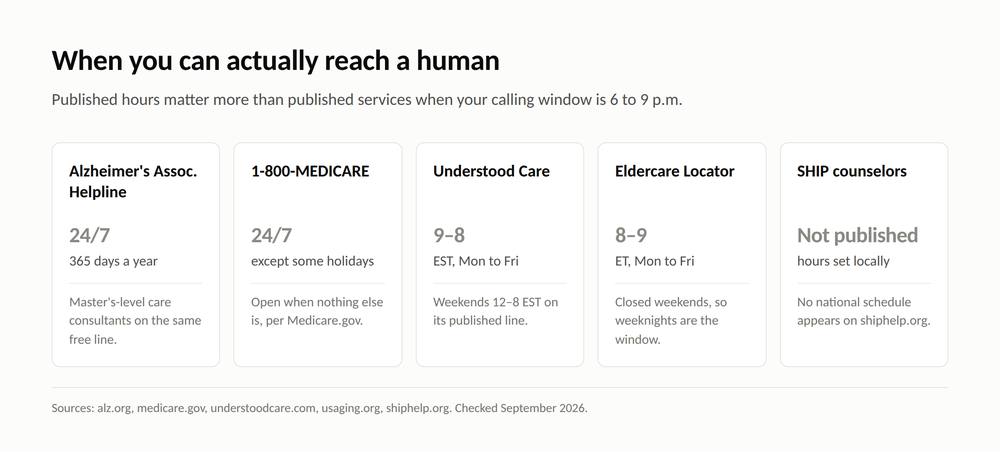
A virtual advocacy service, “available in all 50 states, delivered virtually and covered by Medicare.” Its FAQ: “All of our care is delivered through phone and video calls.” You get one advocate who stays with the case, backed by a clinician team of board-certified physicians and nurse practitioners. The work described is coordination: scheduling, medication access, transportation, equipment and benefits.
Billing sets it apart from most private advocates. Asked what advocacy costs, the FAQ answers: “our services are covered by Medicare for most patients. We accept Medicare Part B and many Medicare Advantage plans.” It also publishes its own list of the best patient advocate services for Advantage members.
Key strengths
- One named advocate for the whole case, by phone, video and secure messaging.
- Billed through Part B for most patients, not as a monthly subscription.
- The FAQ says family members can refer a patient, so you can start it.
Best for
A parent whose problem is a pile of coordination work, not one question.
Worth asking about
Coverage is narrower than “covered by Medicare” sounds. The pricing page says services are covered “if you have Original Medicare and a supplemental plan and have paid your deductible,” and the FAQ says advocacy is “not yet covered by Medicaid” or commercial insurance. Without a supplement, what you would owe is published nowhere.

Eldercare Locator
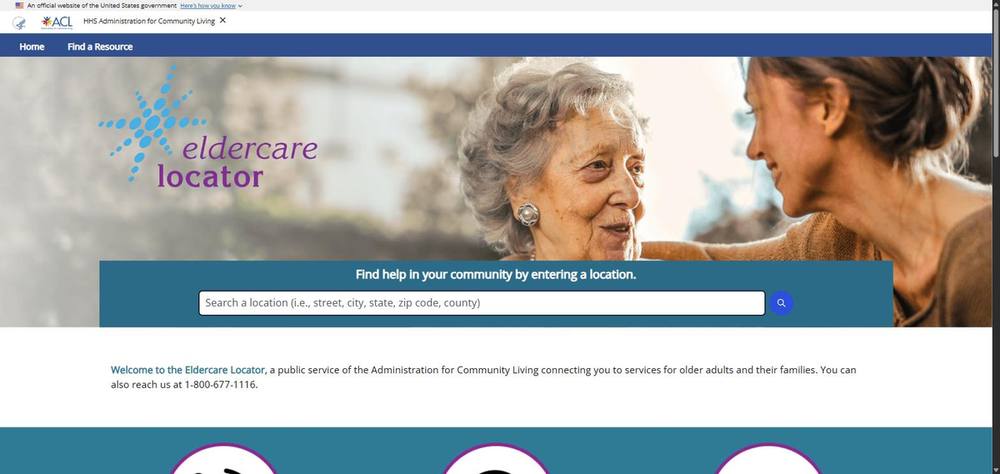
The federal front door, and probably your first call. USAging, which administers it, calls it “the only national information and referral resource to provide support to consumers across the spectrum of issues affecting older Americans.” It was established and is funded by the U.S. Administration on Aging. The number is 800.677.1116, open Monday through Friday, 8:00 a.m. to 9:00 p.m. ET.
Certified specialists handle roughly 400,000 requests a year on transportation, housing, benefits eligibility and home and community-based services, routing callers to more than 600 Area Agencies on Aging and nearly 300 Title VI Native American Aging Programs.
Key strengths
- Open until 9:00 p.m. ET on weekdays, so you can call after dinner.
- Works from the older adult’s ZIP code, so distance is not a barrier.
- Free, federally funded, and not selling anything.
Best for
Finding out which agency has jurisdiction over your parent’s address.
Worth asking about
It is information and referral, and says so itself. You get a name and number for the Area Agency on Aging in your mother’s county, then you call that agency yourself, during its hours, which will not be 9 p.m. The Locator line is closed weekends.
National Family Caregiver Support Program
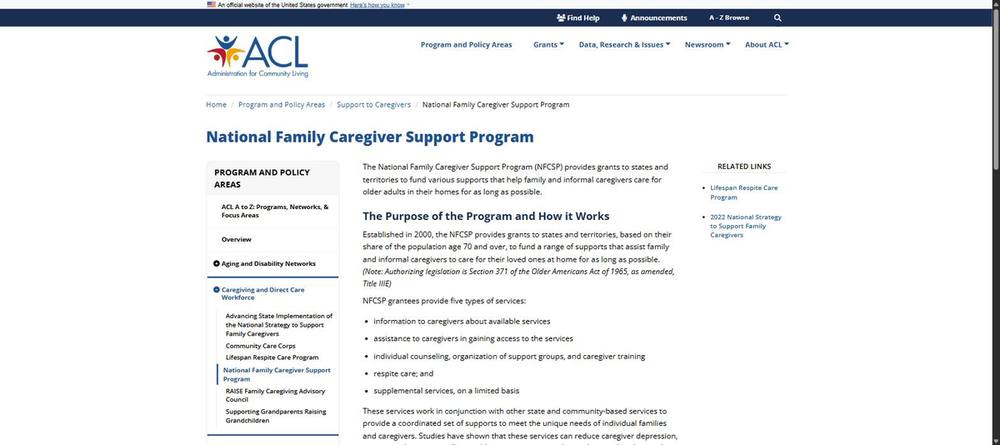
This is the one that buys you hours. Authorized by Title III-E of the Older Americans Act, it grants money to states by their share of the population age 70 and over. ACL lists five things it funds: “information to caregivers about available services; assistance to caregivers in gaining access to the services; individual counseling, organization of support groups, and caregiver training; respite care; and supplemental services, on a limited basis.”
Eligibility, as reauthorized in 2020, covers informal caregivers of people 60 and older, and caregivers of people of any age with Alzheimer’s and related disorders. You reach it through your parent’s Area Agency on Aging, which is why the Locator call comes first.
Key strengths
- Funds actual respite hours, plus counseling and caregiver training.
- You qualify as the caregiver; your parent does not have to be low income.
- Arranged locally, by someone who knows what exists in that county.
Best for
Anyone who needs another adult physically present for a block of hours.
Worth asking about
ACL’s own phrase is “on a limited basis,” and that is not boilerplate. This is a capped grant split by population, not an entitlement, and ACL publishes no per-caregiver respite allowance because there is not one. Ask first whether there is a waiting list.
State Health Insurance Assistance Programs
If the problem is specifically Medicare, this is the free equivalent of hiring someone. Medicare.gov calls SHIP “free health insurance counseling” and lists what counselors do: choose a plan, review coverage, understand costs, apply for Extra Help, and file a complaint or an appeal. ACL, which funds it, reports 54 grantees and “more than 2,200 local sites and over 12,500 team members, including staff, in-kind professionals, and volunteers.”
Counselors cover Parts A and B, Medicare Advantage, Part D and Medigap, and help with applications for Medicaid, the Medicare Savings Program and Extra Help. The number for finding a local office is 877-839-2675.
Key strengths
- Unbiased by design: no commissions, no plans to sell, funded by ACL rather than carriers.
- One-on-one and repeatable, so you can come back with the next question.
- Covers appeals and complaints, where most Advantage fights actually live.
Best for
Plan comparisons, a denial you do not understand, and anything starting with “is this covered?”
Worth asking about
Local sites set their own hours and shiphelp.org publishes no national schedule, so nothing promises anyone will answer at 8 p.m. A counselor advises you; they are not your representative. They will coach you through an appeal and explain the deadline, but the filing stays yours. Ask whether your counselor is staff or a volunteer.

Family Caregiver Alliance
FCA has spent more than 40 years providing “expert support, resources and guidance to family caregivers of adults with physical and cognitive impairments, such as Parkinson’s, stroke, Alzheimer’s and other types of dementia.” Its national offering is CareNav, a free dashboard with fact sheets, videos and secure messaging. A Services by State tool covering all 50 states and DC “helps family caregivers locate public, nonprofit, and private programs and services nearest their loved one.”
The written material is unusually good. If you want to know what a care plan should contain, or how to raise the subject of giving up the car, start here. The toll-free line is 800.445.8106.
Key strengths
- CareNav is free, registers online, and keeps your notes in one place.
- The fact sheets are written for family caregivers, not for clinicians.
- The state tool helps when your parent’s county is somewhere you have never lived.
Best for
Reading up properly before a care conference, and for Bay Area families, who get more.
Worth asking about
Geography. The hands-on services, the Comprehensive Caregiver Assessment, Family Consultants providing “personalized, ongoing support,” and the Customized Caregiver Action Plan, are offered “at no cost to you” specifically to San Francisco Bay Area residents. Everyone else gets the library and the dashboard.

Alzheimer’s Association 24/7 Helpline
If dementia is anywhere in the picture, this number solves the timing problem. The Association says the Helpline at 800.272.3900 “is a free service” and that “we are available around the clock, 365 days a year.” Call at 11 p.m. after a bad conversation with your father and someone picks up. Support comes “in your preferred language through our bilingual staff or interpreter service” covering more than 200 languages.
The depth is the surprise. Beyond the initial agent, “you’ll speak with a Care Consultant who is a master’s-level dementia expert,” and the Association offers “free care consultations” covering care planning, housing, respite funding, safety, and legal and financial planning.
Key strengths
- Answered around the clock, 365 days a year, which nothing else here matches.
- Free consultations with a master’s-level clinician, not a resource list.
- 711 relay for callers who are deaf or hard of hearing.
Best for
The 10 p.m. crisis, behavior changes you cannot interpret, and memory care decisions.
Worth asking about
It is dementia-specific by design. Nobody there will fight an equipment denial or read an explanation of benefits. And the first voice you get is a Helpline Agent whose role is resources and support group registration; the master’s-level consultation is a deeper tier, so ask for it by name.

Aging Life Care Association
The paid option where somebody physically shows up. ALCA is the professional association for Aging Life Care Professionals, also called geriatric care managers, and describes the work as “a holistic, client-centered approach to caring for older adults” across eight knowledge areas: health and disability, financial, housing, families, local resources, advocacy, legal and crisis intervention.
Credentialing is why you use its Find an Aging Life Care Expert directory rather than a general search. Advanced Professional members must hold a relevant degree, two years of post-degree supervised experience, and an approved certification: CMC, CCM, C-ASWCM or C-SWCM. A Professional Conduct Review Committee handles complaints under its Code of Ethics.
Key strengths
- In person. A care manager goes to the house, attends the appointment, and tells you what they saw.
- Verifiable credentials and a real complaints process.
- Built for families managing care from a distance.
Best for
Long-distance families who need eyes on the ground and can pay for them.
Worth asking about
Cost, because ALCA publishes none. There is no rate schedule anywhere on its site; members set their own fees and this is private pay, usually hourly. The one free offer published is an Evelyn McPherson Foundation grant of up to four hours for military families.
Reading the list the way an editor would
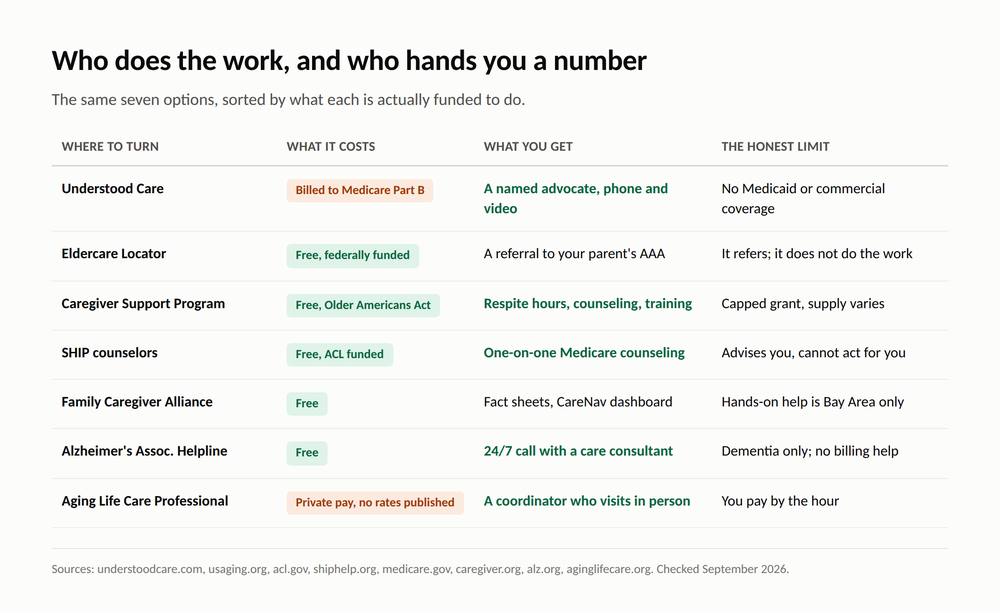
A pattern shows up. Two of them, the Eldercare Locator and Family Caregiver Alliance outside the Bay Area, tell you where to go and stop there. Two, SHIP and the Alzheimer’s Association, put a trained person on the phone for as long as it takes, free, but will not act as your agent. One hands over respite hours if the county has any left. Two do the work, and both cost money.
That is not about how good they are, but about what each is funded to do. A referral line is not failing you by referring. The failure is in the recommending, when someone hands you a number without saying which row it sits in.
When you can actually reach a human
Do this before your next call. Medicare will not discuss your parent’s account with you unless your parent has authorized it. CMS publishes Form CMS-10106, the “1-800-Medicare Authorization to Disclosure Personal Health Information” form, which can be filled out and submitted online. Sign it now, or get told mid-appeal that the representative cannot speak to you.
Questions to ask before you commit to any of them
- Will someone contact the plan, the doctor or the supplier on my parent’s behalf, or will you tell me who to contact?
- What does this cost me, given my parent’s coverage? If it is billed through Medicare, get in writing what happens before the deductible is met.
- What hours can I reach a person, including evenings and weekends?
- Is there a waiting list, and how long is it right now?
- Who is the actual person, what are their credentials, and who covers when they are out?
Where to start
Start with two calls that cost nothing. Call the Eldercare Locator at 800.677.1116 before 9 p.m. ET, give them your parent’s ZIP code, and get the direct number of the Area Agency on Aging for that county. Then call that agency and ask about the National Family Caregiver Support Program and what respite it can offer. Forty minutes, and you know the free floor.
Then match the second call to the problem. If it is coverage, a denial or a plan choice, reach a SHIP counselor through 877-839-2675. If there is dementia and it is late, use 800.272.3900. If the real issue is that there is too much of it and you have a job, that is when a paid coordinator earns its keep.
Every fact here was read on the organization’s own site or a federal source (acl.gov, cms.gov, medicare.gov, usaging.org) in September 2026. Numbers, hours, eligibility and coverage terms change without notice, and what Medicare pays depends on your parent’s plan.