Start With What the Room Already Knows
Before you pick fabric or hardware, listen to the space. Architecture, daylight, and use patterns whisper answers long before swatches arrive.
- Architecture: Where does your eye naturally rest? Cornices, concrete beams, angled ceilings, and mullion rhythm will either beg for emphasis or request silence.
- Daylight: Track sun paths and glare pockets for a week. Note where you need diffusion at noon versus privacy at night.
- Function: Consider how the room lives. A media space needs reflection control. A nursery needs darkness on demand. A kitchen needs clearance from steam and splashes.
- Climate: In hot zones, heat gain at west windows matters. In cold climates, air gaps and heavy fibers earn their keep.
- View: If the window frames a landscape, plan treatments that frame rather than compete.
A great treatment feels inevitable because it is the visual answer to all of these inputs.
Material Logic Across Styles
Think in terms of what a textile does, not just what it looks like. Performance first, then character.
- Opacity: Sheers scatter light. Semi-opaque fabrics shape it. Opaque panels control it. Layer for nuanced control rather than forcing one fabric to do everything.
- Weight: Fabrics under roughly 150 grams per square meter behave as sheers. Between 150 and 300 grams sit in the workhorse zone for everyday drapery. Above that, you get formal drop, stronger sound absorption, and better thermal buffering.
- Shades and openness: Woven roller shades with 1 to 3 percent openness knock down glare and protect art and floors. Five percent keeps a view soft but present. Ten percent remains mostly view-first.
- Texture: Slubby linen calms polished rooms. Smooth cotton balances rugged finishes. Bamboo and seagrass add both diffusion and micro-shadows that animate sunlight.
- Blackout vs room-darkening: Blackout kills light leaks only when paired with returns, side channels, and precise sills. Room-darkening is friendlier for multilayered spaces where total darkness is unnecessary.
Choose the least amount of fabric that delivers the required performance. Restraint reads as expertise in every style.
Proportion, Placement, and Light Physics
A window is a light machine. Mounting decisions tune the machine.
- Mount high to elongate. Raising the rod or track close to the ceiling visually lifts a room. In spaces with low ceilings, even a modest lift above the casing pays dividends.
- Widen to clear glass. Extending hardware beyond the frame parks stacked panels off the glass. The window looks bigger. The room breathes.
- Inside vs outside mount: Inside mounts are precise and architectural. Outside mounts are forgiving and amplify scale. If your trim is outstanding, show it. If it is not, cover it with a clean outside mount.
- Stacking and clearance: Calculate stack width before you order. Pleat type, fabric weight, and fullness factor determine how much glass remains unobstructed when open.
- Hem behavior: A crisp break looks tailored. A long puddle romanticizes. In high-traffic zones, a kiss-length hem is sanity.
Light bends, scatters, and bounces. Your job is to decide which of those behaviors the room needs.
Style-Specific Moves That Elevate
Small decisions create fidelity to a style without slipping into cliché. Use the moves that resonate with the room’s grammar.
- Farmhouse
- Use ring clips that actually show their rivets or screws. The hardware should feel useful, not ornamental.
- Mix a simple cafe curtain with a relaxed top panel to keep the horizon line low and the sky open.
- Favor soft selvedges and hems that do not look laser precise. Slight irregularity is charm, not error.
- Modern
- Specify a square fascia that aligns with door headers or ceiling reveals. Keep profiles thin and linear.
- Choose shades with a faint slub or basketweave that reads at two or three feet, not across the room.
- Integrate motorization to remove pull cords. The quietness of operation becomes part of the aesthetic.
- Minimalist
- Recess tracks so fabric seems to originate from the ceiling. Use weighted hems for a perfectly vertical fall.
- Match fabric color to adjacent walls with ruthless accuracy. A half tone off is visible in still rooms.
- Keep counts down. Fewer panels. Fewer pleats. Fewer seams. Let light be the decoration.
- Bohemian
- Layer a utilitarian privacy shade behind panels with personality. Let patterns collide in scale, not fight in saturation.
- Use a found object as a rod only if it is strong and straight enough to avoid sag. Character without failure.
- Introduce handwork at the edges: hand-tied tassels, embroidery, or block-printed borders ground the story.
- Coastal
- Keep weaves open and on the cool side of warm. Whites should feel sunlit, not clinical.
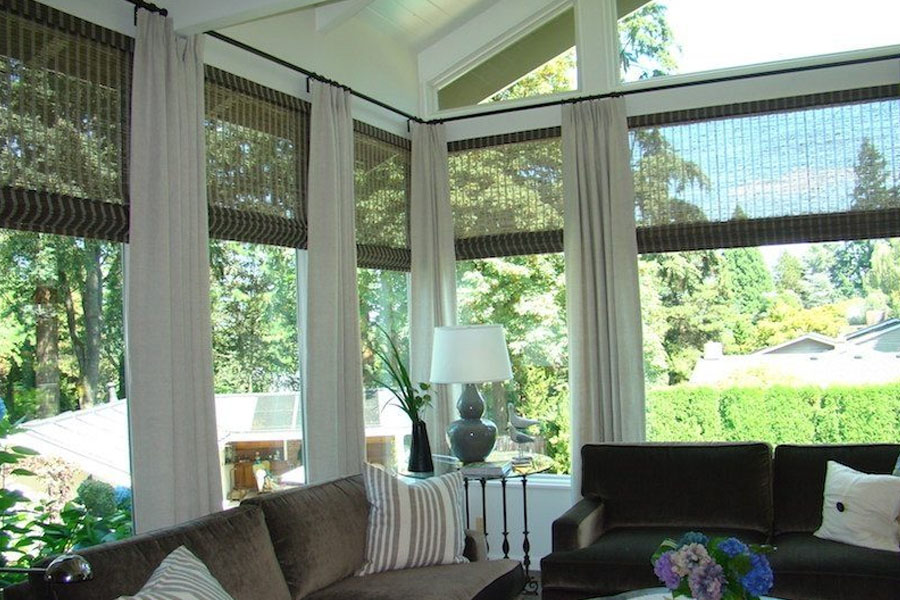
- Pair a woven wood shade with gauzy side panels. Lift for view, drop for softness.
- Choose hardware that dissolves into the palette. Brushed nickel and whitewashed wood keep the airiness honest.
- Traditional
- Invest in structure. Interlining gives body, protects from sun, and delivers the classic theater of a formal panel.
- Use tailored trimmings to outline shape. Contrast banding defines proportions from across a room.
- Layer deliberately. Sheer under, face fabric over, structured topper where the architecture calls for ceremony.
- Japandi
- Show the grain. Bamboo, rice paper, and undyed linen carry the quiet irregularity this style prizes.
- Keep rods elemental. Dark wood or matte black with no finials reads intentional.
- Accept the crease. Let natural fibers age. The patina is the poetry.
Layering for Performance Without Losing Character
Great rooms handle multiple needs at once: view, privacy, glare, sound, and heat. Layer with purpose.
- Pair a solar shade for daytime with a privacy drape for night. The room feels open while the sun is up, intimate when it sets.
- Use interlining in formal rooms for insulation and drape quality. Wool or bump interlinings soften acoustics without bulk that feels heavy.
- Employ side panels that do not fully traverse. They frame and soften without becoming the primary mechanism for privacy.
- Add discreet side returns or small L-shaped brackets to block light leaks for rooms that need darkness without resorting to hotel-level channeling.
Every layer should justify itself by delivering function or a clear aesthetic message.
Solving Tricky Windows and Doors
Complex openings are opportunities to show craft.
- Corner windows: Continue the track through the corner with a mitered carrier or use two tracks with a minimal gap. Keep fabric fullness consistent across the bend.
- Bay windows: Template the angles. A bent rod or segment-to-segment track prevents light gaps. Inside-mounted shades per face simplify and sharpen.
- Arched windows: If the arch is the star, treat below with a cafe or tailored shade and leave the curve open. If privacy demands full coverage, consider a custom arched track with low-friction carriers.
- Sliding doors: Panel tracks align with the logic of the door. If you must use drapery, specify one-way draw toward the fixed panel to avoid fabric in the traffic path.
- Tilt-turn windows: Inside-mounted shades that clear the swing need shallow profiles and careful placement. Magnetic side channels help manage light while allowing tilt function.
Measure thrice. Unforgiving openings reward precision. If damage such as cracks or seal failure is present, glass windows repair should be completed before installing any treatments to ensure proper fit and insulation.
Budget Pathways and Upgrade Priorities
Allocate budget where it counts. Every dollar does not need to be premium to get a premium result.
- Spend on:
- Hardware that will not sag. A straight line is priceless.
- Linings and interlinings that control light and heat.
- Accurate installation. A perfect fabricate can fail in the last ten minutes.
- Save on:
- Decorative side panels that do not need to traverse. Less yardage, same impact.
- Simple pleat styles that reduce labor while keeping a tailored look.
- Ready-made sheers hemmed to your height when perfection is less critical.
Choose one hero move per room. Let everything else support it.
Sustainability and Care
Beauty ages best when materials and maintenance align.
- Choose natural fibers with responsible certifications or recycled content where available. Linen, cotton, bamboo, and recycled polyester blends perform well and wear gracefully.
- Expect sun exposure. Use linings that shield face fabrics, especially on south and west elevations.
- Establish care routines. Vacuum with a brush attachment, steam with distance, and rotate drapery stack positions occasionally to even out fading.
- Plan for repair. Hardware with replaceable carriers and modular tracks avoids landfill when one piece fails.
A small maintenance rhythm extends the life of a considered investment.
FAQ
How do I blend two styles without creating a fight at the window?
Choose a leader and accent. Use the functional layer leader and a smaller accent. In a Japandi-inspired bohemian home, use a rice paper shade and a small patterned panel. The proportions indicate tranquility before character.
What rod length should I order for panels that need to clear the glass?
Measure the window width including casing, then add enough on each side to park the stacked panels fully off the glass. Calculate panel stack based on fullness and pleat style, then add clearance on both ends. When in doubt, increase width slightly. A generous reveal reads intentional.
I rent and cannot drill into walls. What are my options?
Tension rods for light sheers work well inside the frame. For heavier panels, consider freestanding room dividing frames or ceiling-press systems designed for rentals. Adhesive channels paired with light roller shades can be effective when installed carefully and weighed appropriately at the hem.
How do I keep child and pet safety in mind without sacrificing looks?
Specify cordless lift systems for shades. For drapery, avoid chain-drawn tracks and instead use hand draw or motorization. If cords exist, install compliant cleats at required heights and keep slack controlled. Choose durable, claw-friendly textiles for the lower 24 inches to reduce visible wear.
Can I motorize without the window feeling tech heavy?
Yes. Hide power with recessed channels or battery wands tucked behind fascias. Choose quiet motors and program soft start and stop. Keep controls simple. The most elegant installations disappear into daily life and speak only when needed.
My floors are uneven. Should I puddle, break, or hover the hem?
If the style allows romance, a managed puddle hides minor imperfections. Choose a light break at the tallest point and a slight float elsewhere for personalized rooms. Cleanly hover off the floor in kitchens and baths to avoid moisture and filth, then appreciate the variation as part of the house’s story.
How do I reduce glare at a desk without darkening the room?
Use a shade with 3 to 5 percent openness in a neutral gray to keep color shift minimal while cutting glare. Pair with a sheer side panel for softness. Position the desk so light comes from the side rather than directly behind the screen, then drop the shade to just above eye level while seated.