There is a reason why a room with plants feels noticeably different from an identical room without them. The difference is not simply visual, and it is not merely a matter of personal preference for nature. The presence of living greenery in a domestic interior triggers a measurable shift in how the nervous system reads the space, one that researchers in environmental psychology have been documenting with increasing precision over the past decade.
For most of interior design history, plants were treated as decorative accessories, added after the main decisions had been made to soften a finished space. What more recent research suggests is that they deserve to be considered alongside colour, light, and material as a primary design element, one that shapes the psychological quality of the room from the ground up.
How plants change the sensory experience of a room
The restorative effect of indoor greenery operates through several channels simultaneously, and understanding each one helps in making more effective placement decisions.
The most immediate is visual. The eye processes organic, irregular forms differently from geometric, manufactured ones. A leaf edge, a branching stem, the slight variation in green across different parts of a plant, all register as natural rather than constructed, and that distinction carries physiological weight. The attentional system treats natural forms as low-demand, allowing the involuntary attention that is essential for mental recovery.
The second channel is acoustic. Larger plants with dense foliage absorb and scatter sound in ways that reduce the hard reflective quality of a room with bare walls and minimal soft furnishings. This effect is modest but real, particularly in rooms where hard surfaces dominate. A cluster of large-leafed plants near a hard wall will reduce reverberation and produce a slightly warmer, more enclosed acoustic quality.
The third is air quality. Plants absorb carbon dioxide, release oxygen, and some species process airborne volatile compounds. The contribution of a few houseplants to measurable air quality improvement in a well-ventilated room is limited, but the presence of living organisms actively metabolising within the space contributes to the overall sense of a room being alive rather than inert.
Integrating greenery with the rest of the room
Plants work better when they are part of the room’s composition rather than positioned after the fact in unused corners. This means considering plant placement alongside furniture arrangement, not as an afterthought.
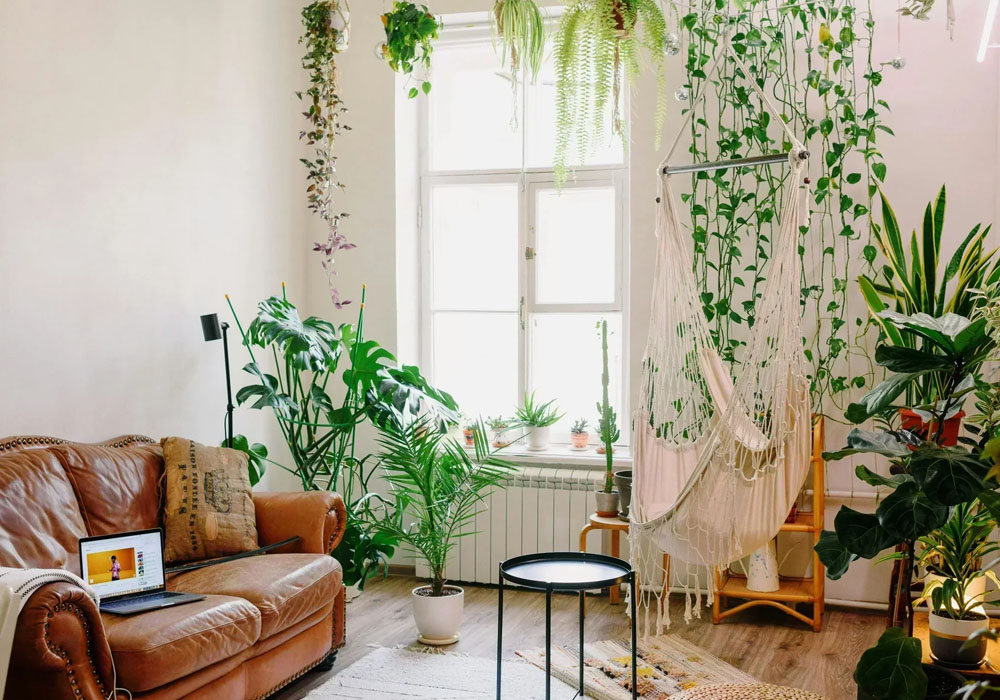
A tall plant in the corner behind a sofa creates a vertical element that grounds the seating area and frames the composition. A row of smaller plants on a shelf above a console serves as a visual transition between horizontal surfaces. A single large architectural plant can anchor a corner in the same way that a lamp or a piece of art does, with the added quality that it changes slowly over time and responds visibly to care.
When rethinking how a living room is composed, this integrated approach to greenery is worth considering alongside the more immediate decisions about furniture arrangement and fabric. The choice of Vimle covers by Norsemaison, for example, updates the dominant fabric surface of the room, and a deliberate decision about where to position greenery in relation to the sofa reinforces the mood that the fabric colour and texture establish. A warm-toned cover in linen or bouclé combined with a large organic plant form creates a room that reads as natural and considered rather than simply assembled.
Choosing plants for a domestic interior
Not all plants perform equally well in interior conditions, and the species chosen affects how much practical effort is required to maintain them at a state where they contribute positively to the room rather than becoming a source of visual disorder through neglect.
Some plants that work well in most living room conditions:
- Monstera deliciosa, whose large leaves create a strong architectural presence and which tolerates low to medium indirect light
- Sansevieria, which requires minimal watering, survives in low light, and provides strong vertical form
- Ficus lyrata, which creates a tree-like presence in corners and thrives in bright indirect light
- Pothos in various cultivars, which trail from shelves without demanding attention and add a flowing quality to horizontal surfaces
- ZZ plant, which tolerates low light and infrequent watering and offers deep green that reads well against most interior palettes
The common thread is that a neglected, wilting, or pest-affected plant does more harm than no plant at all. Species chosen for their fit with the room’s actual light conditions, and maintained at a standard that reflects the care given to the rest of the space become genuine contributors to the room’s quality.
What research confirms about greenery and domestic wellbeing
A 2025 study published in Frontiers in Psychology, involving 331 adults who evaluated domestic interior images, found that living rooms and bedrooms designed with both potted and integrated greenery scored higher for restorativeness and wellbeing compared to identical rooms without plants. Crucially, integrated greenery, where plants were built into shelving or architectural elements, produced stronger effects than potted plants placed as accessories, suggesting that the structural relationship between greenery and the room matters, not just the quantity of plant material.
The study also noted that individual differences in connectedness to nature influenced the strength of the response, but the direction of the effect remained consistent across participants. Plants made rooms feel more restorative regardless of baseline preferences, which confirms that this is not simply a matter of personal taste.
Greenery and the broader interior composition
The role of plants in interior design is increasingly understood not as decoration but as a functional element of the spatial experience. When they are included deliberately, positioned thoughtfully, and maintained well, they simultaneously introduce living organic form into an otherwise manufactured environment, contribute to the acoustic character of the space, provide a slowly evolving focal point that rewards attention without demanding it, and increase the measurable restorativeness of the room.
None of this requires a dramatic botanical installation. A living room with three or four well-placed plants in good health, integrated into the composition rather than left in the periphery, achieves these effects as effectively as a more elaborate arrangement. The scale of the intervention matters less than its quality and placement.
Combining that approach with deliberate choices about fabric, colour, and light produces rooms that are not only visually coherent but genuinely pleasant to spend time in, which is the point that interior design, at its most functional, is always trying to reach.