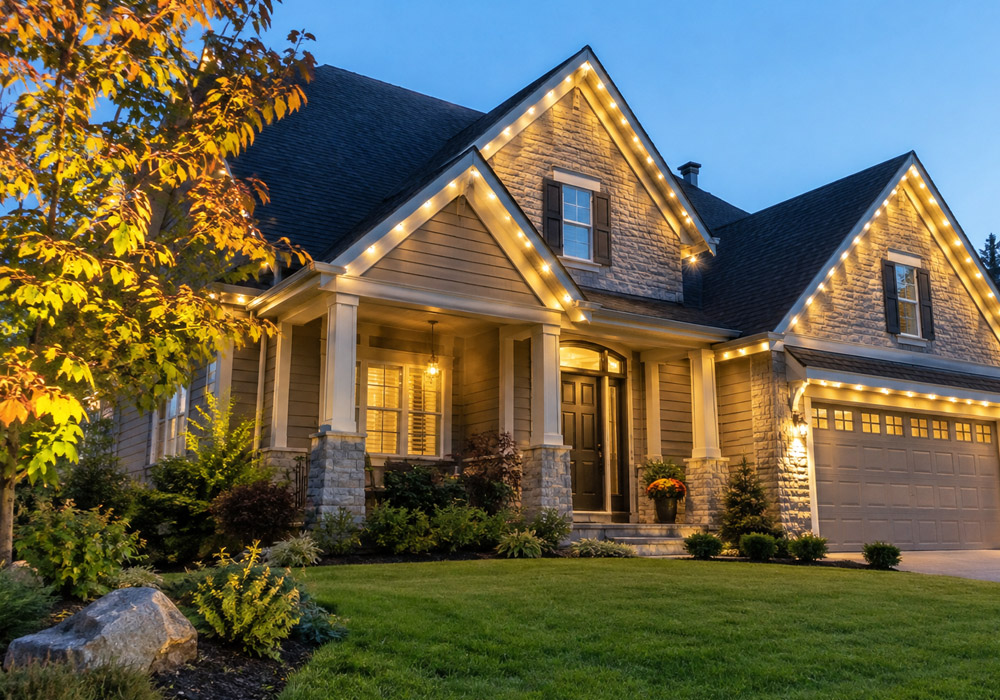
Holiday lighting creates the same decision for many homeowners every year: install temporary lights for a few weeks, or invest in a system that stays on the house permanently.
Neither approach is automatically better.
Seasonal lighting offers flexibility and a lower initial commitment. Permanent outdoor lighting removes the yearly installation cycle and can often serve purposes beyond one holiday. The better choice depends on how often the lights will be used, how much installation work the homeowner wants to repeat, what appearance is preferred during the day, and how long the property is likely to use the system.
The most useful comparison looks beyond one December and considers several years of ownership.
Compare One Installation With a Repeating Annual Task
Seasonal lighting creates a recurring cycle.
Lights are brought out of storage, inspected, installed, removed, packed, and stored again. Damaged strings or clips may need replacement along the way.
Homeowners who hire someone for the work also repeat the scheduling and installation process each season.
Astoria Lighting Co is relevant to the permanent side of that comparison because permanent roofline systems are installed to remain in place rather than being removed after each holiday.
That changes the decision from “What will decorating cost this year?” to “Which setup makes more sense over the period I expect to use it?”
Seasonal Lighting Offers More Physical Flexibility
Traditional temporary lights are easy to change dramatically from one year to the next.
A homeowner can outline the roofline one season, decorate trees the next, or switch to a completely different color and fixture style later.
That physical flexibility appeals to people who enjoy redesigning their display.
Permanent systems take another approach.
The installed fixture locations remain largely consistent, while compatible controls may allow the colors, brightness, patterns, and schedules to change.
The choice is therefore partly about where the homeowner wants the flexibility: in physically rearranging lights or in changing the appearance of an installed system.
Think About Daytime Appearance
Temporary holiday lights remain visible during the day for as long as they are installed.
Wires, clips, bulbs, and extension connections may be noticeable along rooflines and architectural features.
Permanent systems are generally designed with daytime discretion in mind, often placing lighting within a track that follows the roofline or soffit.
This makes the quality and placement of the track an important part of the project.
Before choosing a permanent system, look at how it will appear when switched off. A lighting installation will spend many daylight hours inactive, so its daytime integration with the house matters almost as much as its nighttime effect.
Consider How Often You Actually Use Decorative Lighting
Someone who decorates only for a few evenings each December may evaluate the two approaches differently from a household that lights the home for many occasions.
Permanent outdoor lighting may be used for Christmas, Halloween, birthdays, game days, celebrations, or everyday architectural accents if the installed system supports those settings.
Seasonal lights can also be used for multiple occasions, but doing so may require additional installation or leaving them up longer.
The deciding question is not simply whether permanent lighting can produce more colors.
Ask how often the household realistically wants exterior lighting during the year. Frequent use makes year-round availability more meaningful.
Look at the Annual Labor, Not Just the Purchase Price
Temporary lights often appear cheaper because the first purchase is much smaller than a permanent installation.
That is only one part of the comparison.
Yearly effort can include ladder work, attaching clips, routing cords, troubleshooting failed sections, removal, storage, and repeating the process the following season.
Homeowners who pay for seasonal installation should compare several years of those recurring expenses with the upfront cost of a permanent system.
A homeowner reviewing permanent options from Astoria Lighting Co should therefore compare the complete installed system against the realistic long-term cost of the seasonal method they would otherwise use, not against the price of one box of string lights.
The fairest comparison uses equivalent outcomes.
Storage Is a Real Part of Seasonal Ownership
Seasonal lighting needs somewhere to go for most of the year.
Boxes, reels, clips, extension cords, timers, and decorative accessories can take up garage, attic, basement, or closet space.
Poor storage can also create next-season problems.
Strings become tangled, labels disappear, and fragile components can be damaged between installations.
Permanent systems remove much of that storage cycle because the main lighting remains attached to the house.
That benefit matters more to homeowners who already struggle with seasonal storage than to those with plenty of organized space available.
Permanent Systems Shift Maintenance Rather Than Eliminating It
“Permanent” does not mean nothing will ever require attention.
Outdoor equipment remains exposed to weather, temperature changes, dust, insects, and other environmental conditions.
Individual components may eventually need service, and software or control settings may need adjustment.
Seasonal lights have maintenance too, but it often appears during installation when strings are tested and damaged pieces are replaced.
The difference is where the maintenance occurs.
Before choosing a permanent system, ask how individual lights are serviced, what components are replaceable, and what warranty or support applies to the installation.
Control Convenience Changes the Experience
Temporary lighting commonly relies on switches, plug-in timers, or separate smart plugs.
Permanent systems may offer app-based control, scheduling, dimming, and programmable color settings depending on the product.
Those controls can reduce the effort needed to change the home’s appearance for different occasions.
The benefit is strongest when the household will actually use the options.
A simple seasonal display does not need advanced programming to work well. Likewise, a permanent system with dozens of settings has limited value if the homeowner only wants warm white light every evening.
Controls should match actual habits rather than becoming the reason for buying the system by themselves.
Consider Roof Access and Repeated Ladder Work
Installation difficulty varies significantly between homes.
A low, simple roofline may be relatively straightforward to decorate seasonally. Multi-story homes, steep roof sections, tall peaks, and complex architecture can make repeated installation more demanding.
That changes the practical comparison.
At the point where a homeowner is weighing years of seasonal setup and removal against one installed roofline system, Astoria Lighting Co provides a useful reference for the permanent option because the proposed layout can be measured around the actual architecture instead of estimated from the home’s square footage.
The question becomes how much repeated access the homeowner wants to deal with over time.
Think About How Long You Expect to Use the System
Permanent lighting makes more sense as a long-term purchase than as a short experiment.
Homeowners planning to move soon may place more value on the low commitment of seasonal lights.
Someone expecting to remain in the property for years may give more weight to avoiding repeated installation and gaining year-round use.
There is no universal break-even point because installation costs, seasonal decorating habits, property size, and service choices vary.
The useful comparison is personal: how many seasons are likely to be used, what the alternative would cost each year, and how much convenience matters to the household.
Choose Based on the Routine You Want
Seasonal lighting remains a good option for homeowners who enjoy changing the physical display, want a low initial commitment, or decorate only occasionally.
Permanent outdoor lighting makes a different tradeoff. It requires a larger upfront project but removes the annual installation-and-removal cycle and can provide a ready-to-use exterior lighting system throughout the year.
The better choice depends less on which technology sounds newer and more on the routine the homeowner wants to live with.
Compare several years instead of one season, include installation and storage in the calculation, and decide how often the lighting will actually be used. That gives a much clearer answer than comparing purchase prices alone.