What is it, exactly, that you are paying for when a shop puts paint protection film on a car?
Most explanations answer that at the level of a sales sheet. The film stops rock chips, and it heals itself. Both statements are broadly true, and neither of them gives you enough to read a quote, compare two studios, or understand why one installation still looks invisible after six winters while another one starts lifting at the fender edge after two. What separates those outcomes is partly the material science of the film, and partly the hand-work of the person cutting it, and an owner can learn enough about both to ask better questions.
That matters more here than it does in a milder climate. Approximately five million tonnes of road salt are applied to Canadian roads every year, according to Environment and Climate Change Canada’s summary of road salt use, and a good share of that ends up as brine on the panels of cars driving the 400 and the 407 through Woodbridge, Maple, Concord and Thornhill. Salt spray, winter grit, freezing rain, and the stone chips that arrive with all of it make up the local load case.
This guide is arranged as a progression. It starts at the polymer itself, then works outward to the parts of the job that only make sense once you understand the polymer.
Start with the material: what the film is actually made of
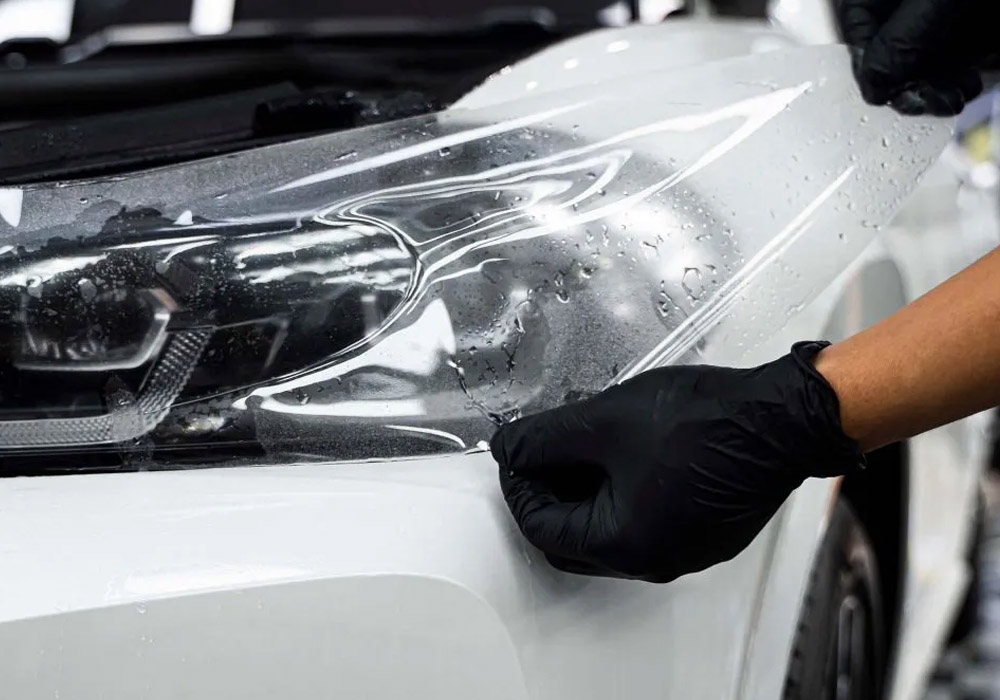
Paint protection film, which is also sold under the older name clear bra, is a transparent thermoplastic polyurethane sheet, usually somewhere around 0.15 to 0.2 mm thick (approximately 6 to 8 mils), that is applied over a vehicle’s painted panels with a pressure-sensitive adhesive.
The important word in that definition is the polyurethane part. Thermoplastic polyurethane, normally abbreviated to TPU, is an elastomer, which is a class of polymer whose long molecular chains are only loosely tied to one another. Because those chains can slide and then return, a TPU sheet deforms under a sudden load and comes back to its original shape. It is the same broad family of material used in phone cases and in the cushioned midsole of a running shoe, and it behaves the same way here: it takes an impact by spreading the energy out over time and area instead of by resisting it rigidly.
Automotive clear coat cannot do that. A cured clear coat is a hard, cross-linked network, and a hard network handles a stone strike by fracturing locally, which is what a chip is. The film, then, should be understood as a mechanically different material that has been placed in front of the paint deliberately, rather than as a thicker version of the paint itself.
Three functional layers are normally stacked inside a modern film:
- The adhesive layer, an acrylic pressure-sensitive adhesive, which is the part that sits against your clear coat and is also the part that has to release cleanly years later.
- The TPU body, which does the actual energy absorption and accounts for most of the thickness.
- The top coat, a thin elastomeric surface layer, which is where the self-healing behaviour and the water-shedding behaviour live.
It is worth separating film from vinyl wrap at this point, because buyers confuse them constantly. A colour-change vinyl wrap is typically plasticized PVC in the range of 3 to 4 mils, and it is designed for appearance rather than for impact. Vinyl changes what the car looks like. Film changes what happens to the car when a truck ahead of you throws a stone.
The repair mechanism, and why a Vaughan January switches it off
The self-healing claim is real, and it is also more conditional than the marketing suggests.
The mechanism is reversible chemistry rather than any kind of active repair. Research published in Nature Communications on thermoplastic polyurethane elastomers describes how these materials recover through the dynamic exchange of hydrogen bonds between polymer chains, with the paper’s own sample healing at approximately 35°C and showing partial recovery at room temperature. A rough analogy is a strip of hook-and-loop fastener. Pulling it apart does not destroy anything permanently, and if you give the two faces a little energy and let them meet again, they refasten.
The consequence for an owner is straightforward. Healing requires thermal energy, and thermal energy is a seasonal resource in southern Ontario. The City of Toronto’s climate report puts the annual average temperature for the region at 9.7°C over the 1991 to 2020 period, with roughly 14 days a year above 30°C. Installers commonly describe the film as healing on its own once ambient temperature is above approximately 20°C, which in practice means the car largely repairs itself from May through September and does very little of that on a cold February morning. In the colder months, the reliable method is applied heat, either from warm water over the panel or from a heat gun used carefully by someone who knows the safe distance.
There are limits worth stating plainly, since they are the source of most disappointment:
- Only marks confined to the top coat close up. Light swirl marks from washing, faint scuffs and wash-mitt scratches are the realistic scope.
- A cut that goes down into the TPU body will not heal, and neither will a strike that has already gone through to the paint.
- Staining is a separate problem from scratching. Bird droppings, tree sap, road tar and bug residue left sitting on the surface can etch the top coat, and etching is chemical damage rather than a mechanical mark, so heat does not undo it.
Coverage tiers, defined precisely
Coverage is where quotes diverge, and the vocabulary is not standardised across shops, so it is worth defining the tiers rather than trusting the label.
Partial front. Normally the front bumper, the mirrors, and a partial section of the hood and fenders, often around the leading 18 to 24 inches. It covers the highest-probability impact zone at the lowest cost, and it leaves a transition line somewhere across the hood.
Full front. The full hood, full fenders, the front bumper, the headlights and the mirrors. Most studios also include the A-pillars, and many add door sills and door cups, because those are the areas that collect damage from shoes, rings, luggage and neighbouring door edges rather than from stones.
Full vehicle. Every painted panel, including the roof, doors, quarter panels and rear bumper. This is the only configuration that removes the visual transition entirely, which is the main argument for it on dark paint.
On price, the numbers published by studios around Vaughan tend to cluster. Starting figures of approximately $850 for a partial front, in the range of $1,400 to $1,500 for a full front, and around $4,500 for full-vehicle coverage are typical of what is advertised in this market, with individual pieces such as a front bumper quoted separately from roughly $450. Those are starting points rather than quotes. The actual number moves with panel size, paint colour, how much disassembly the car requires, and whether any paint correction is needed first. A large SUV and a low-slung sports car with complex bumper geometry do not cost the same to cover, even though both are described as a full front.
Treat a quote well below the local floor with some caution. The two ways to get there are a thinner or lower-grade film and less labour on the edges, and both of those show up later rather than sooner.
Why the edge decides whether the job survives
Here is the part that separates a competent installation from a good one, and it follows directly from the material.
The film is durable across its face. Its vulnerable feature is any exposed cut edge, because at a cut edge the adhesive line is open to the environment. Brine, wash chemicals, pressure-washer spray at close range and ordinary road grime all attack that seam first. An edge that has been wrapped around the back of a panel is protected by the panel itself. An edge that stops on the visible surface is not, and it is also the line you can see on a black car in direct sun.
Two cutting methods produce those edges, and they are worth understanding as a real decision rather than as an upsell.
Pre-cut, sometimes called plotter-cut, uses digitised patterns from a pattern library. The pattern is cut on a plotter before the car is touched, and the installer lays it without disassembling the vehicle. Because the pattern has to be layable by hand on an assembled car, it is drawn slightly inside the true panel outline. That inset is exactly why you can end up seeing a line.
Custom cut, sometimes called bulk cut, means film is trimmed on the vehicle. Trim pieces, lights or bumper covers come off, the film is cut with a small allowance beyond the panel edge, and that allowance is tucked behind the edge and out of sight. It takes considerably longer, and the finished result is a car where the film is difficult to spot at all.
The useful thing to know is that the two are not a binary. A skilled installer can take a pre-cut pattern and extend or reposition material to tuck an edge where the panel geometry allows it, so a pre-cut job does not have to mean visible lines everywhere. There are also places on almost any car where a shop that is being honest will tell you the edge is going to be lined up rather than hidden, and vehicle-specific exceptions where a standard piece simply does not work.
This is the level of detail worth asking about when you are collecting quotes for paint protection film in Vaughan, because it is the difference the price is actually buying. As an example of how a studio can answer it concretely, id-protection.ca, which runs a single Vaughan studio at 101 Doney Crescent in Concord and quotes PPF in Vaughan on both pre-cut and custom-cut terms, will say which panels on your specific car it can tuck and which it cannot: on a pre-cut job it lines the film up at the bumper-to-fender gap instead of hiding material inside the gap, it can produce a one-piece fender on some vehicles without pulling the headlight, and it states outright that door caps do not work on a 911 GTS. That last kind of answer, a named car and a named panel that the shop will not promise, is a better signal of competence than any general assurance about quality.
A short list of edge questions that are worth asking any shop:
- Which panels on this car will have a wrapped and tucked edge, and which will have a lined-up edge on the visible surface?
- What is coming off the car, and who reassembles it?
- Can I see a car mid-install, ideally in a dark colour, before I book?
What sits underneath: paint, preparation and unusual substrates
Film is optically clear, and clear means that whatever is under it is sealed in and magnified rather than hidden.
The practical rule is that decontamination and any paint correction happen before the film does. Iron fallout and embedded contaminants have to come out of the clear coat, and swirl marks have to be polished out, because anything left behind is under the film for the service life of the film. This is also why a used car often costs more to protect than a new one. There is correction work before the installation.
Substrate variation matters too, and there are two cases worth knowing:
- Soft paint. Some manufacturers, and electric vehicles in particular, have a reputation for this, use clear coats that mark easily. Soft paint argues for film earlier rather than later, and it makes the pre-film correction step more important.
- Unpainted stainless steel. A vehicle delivered with bare stainless panels rather than paint, which is the situation with the Cybertruck, is a different problem entirely. There is no clear coat to protect, so the film is acting as the finish layer, protecting bare metal from marking and from surface contamination. The argument for filming that kind of vehicle before it is driven is stronger than it is for a painted car.
Dark paint deserves its own note, since it is the most common source of regret. Black and other dark colours show everything, including the film’s own transition lines and any swirl left in the paint underneath. Shops that work on a lot of dark cars will often steer an owner toward full coverage instead of a partial, not to increase the invoice but because a clean, protected front sitting next to a swirl-marked rear quarter is more visible than either problem on its own.
Where Film Ends, and Coatings Begin
The last thing to sort out is the relationship between film and ceramic coating, which are frequently sold together and are often described as alternatives. They are not alternatives, because they operate on different physics.
A ceramic coating is a liquid silica-based product that cures into a hard, very thin layer bonded to the surface, measured in microns rather than mils. What it changes is surface energy: the coating makes the surface slick and water-shedding, so dirt releases more easily, washing is faster, and gloss is improved. What it does not change in any meaningful way is impact resistance, because a layer that thin has nothing to absorb.
In simple terms, the film is the mechanical answer to the problem and the coating is the chemical answer to a different problem. If a budget allows both, the normal sequence is film first over the panels you want protected from impact, and then coating applied on top of the film and over the remaining bare paint, which gives you the easy-clean surface across the whole car. If a budget allows only one, it makes sense to match it to the actual problem. Highway commuting and winter salt argue for film across the front. A garage-kept car that mostly needs to stay glossy and easy to wash is a reasonable candidate for coating alone.
Coloured paint protection film sits between the two categories and is often confused with a wrap. It is the same TPU construction as clear film, pigmented, so it changes the colour of the car while still self-healing and still absorbing impact. It costs more than a vinyl wrap and more than clear film, and it is the option for someone who wants a colour change without giving up protection.
On warranties, read what the term actually attaches to. There are normally two separate promises. The film manufacturer warrants the film itself, typically for something in the range of five to ten years depending on the product line, against yellowing, cracking, delamination and loss of adhesion, and that warranty usually needs to be registered at the time of installation. The installing studio separately warrants its own workmanship, which is what covers lifting or a badly finished edge. Those are different documents from different parties, and a shop that blurs them together is worth a follow-up question.
One more piece of context on trust signals. Installing paint protection film is not a licensed trade in Ontario, so the word certified on a shop’s website refers to a film manufacturer’s own training programme rather than to any provincial licence. That does not make it meaningless, but it does mean the useful verification is different: look at finished cars in the colour you own, ask which film line is being installed by name, and ask the edge questions above.
Six Questions Buyers Keep Asking
How long does paint protection film last?
Quality film that has been installed well and maintained is generally quoted at up to about ten years, with the manufacturer’s warranty term as the practical benchmark. Lower-grade film, or film with poorly finished edges, can begin lifting or discolouring within two or three winters, which is the entire reason the choice of installer matters more than the choice of brand.
Does self-healing actually work?
For marks confined to the top coat, yes. Light swirls and wash scratches close up when the film is warmed, which in this climate means either summer sun or applied heat. Deep scratches that reach into the film body or through to the paint do not recover, and chemical etching from bird droppings or sap is not a scratch and will not heal.
Is a partial front enough?
It covers the statistically likeliest impact zone for the lowest price, and for many commuter cars it is a sensible amount of protection. The trade-off is the transition line partway up the hood, which is visible on dark paint and largely invisible on silver or white. If the line would bother you, the choice is really between a full front and full coverage.
Which Is Better, Paint Protection Film or a Vinyl Wrap?
They answer different questions. Vinyl is a cosmetic material, usually PVC, in the range of 3 to 4 mils, and it changes colour without offering much impact protection. Film is thicker TPU built for impact. If the goal is a colour change with protection included, coloured paint protection film is the product that does both, at a higher price than either.
Do I Need Paint Correction Before the Film Goes On?
If the paint has swirl marks or embedded contamination, yes, because the film is clear and will seal that condition in for as long as it is on the car. A new vehicle usually needs decontamination and a careful wash rather than full correction. A used vehicle often needs real polishing work, and that appears as a separate line on a quote.
Which Film Brands Are Available in This Market?
The brands most commonly installed in the Greater Toronto Area include XPEL, SunTek, STEK, 3M, and KAVACA, and most shops carry one or two lines rather than all of them. The more useful question to ask concerns which specific product line within a brand is being quoted to you, since manufacturers sell several tiers at different thicknesses and different warranty terms.
Key Takeaways
- Paint protection film is a thermoplastic polyurethane elastomer of roughly 6 to 8 mils, and it protects paint by absorbing and spreading impact energy, which a rigid cured clear coat cannot do.
- Self-healing works through reversible hydrogen bonding and therefore requires heat. With a regional annual average temperature of 9.7°C, a car in this area heals passively for part of the year and needs applied heat for the rest of it.
- The tiers are partial front, full front, and full vehicle, and the labels vary between shops, so confirm the actual panel list before comparing two prices.
- Local starting prices tend to run from approximately $850 for a partial front, $1,400 to $1,500 for a full front, and about $4,500 for a full vehicle, with the final figure driven by the car and by any correction work.
- Cut edges are the failure point. Wrapped and tucked edges survive salt and washing far better than edges that stop on the visible surface, which is the real difference between a pre-cut job and a custom-cut one.
- Whatever is under the film stays under the film, so decontamination and paint correction come first, and dark paint magnifies both the swirls and the transition lines.
- Film and ceramic coating solve different problems. Film handles impact, coating handles surface behaviour, and the sequence when you use both is film first, with the coating applied over it.