Plenty of yards look great and never get used. Beds edged and mulched, grass cut in stripes, a patio set arranged just so, and everybody stays inside. Whatever the landscaping was doing, it was not making anyone want to go out there.
Usually the reason is dull. There’s no shade at five o’clock. The seating faces the neighbor’s driveway. The route from the kitchen to the grill crosses wet grass. Small things, but they add up to a yard that gets admired through a window.
Watch How the Yard Already Gets Used
Before drawing anything, spend a few weeks noticing what already happens outside.
Where does the dog wear a path? Where do people stand when a few of them are out there? Which corner of the property never gets visited, and why? Yards develop habits the same way houses do, and those habits are better information than any inspiration photo.
Time of day matters more than most plans account for. A patio on the west side is unusable from four until sundown in July, no matter how nicely it’s built. A fire pit tucked where the evening breeze funnels through gets used far more than one placed for symmetry. Standing in a spot at the hour it’s meant to be used sorts this out in about ten minutes.
Give the Yard Somewhere to Go
The most common mistake is treating a yard as one open space with decoration around the edges. Yards work better when they’re broken into a few destinations with something connecting them.
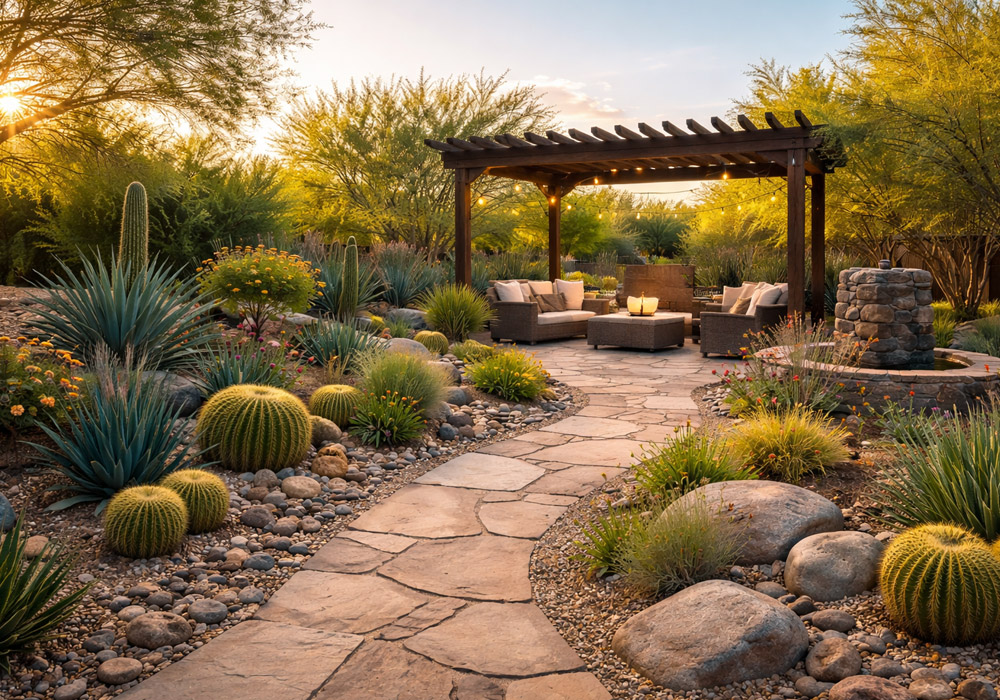
That doesn’t require walls or hedges. A change in surface, a shift in grade, a pair of trees, or a low planting is enough to make one area feel separate from another. A patio near the house for meals, a fire pit farther out, and a bench somewhere with a view gives people a reason to move through the space instead of sitting in the one spot that got furniture.
Paths should follow where people actually walk. Anyone who has watched a shortcut worn through a lawn knows that a curved walkway placed for looks gets ignored. Put the path where the traffic already is, and use planting to make the longer route worth taking.
Choosing Surfaces, Starting With the Ground
Hardscape is where most of a landscaping budget lands, and where the decisions are hardest to undo.
The stone deck vs composite question comes up in nearly every backyard conversation, and it usually gets argued on looks when it should be settled by elevation. If the back door sits close to grade, stone or pavers make sense: no framing, no substructure to rot, no railing required, and a surface that will still be there in forty years. If the door is three or four feet up, building a stone terrace means retaining walls and a lot of fill, and a framed deck gets there for a fraction of the cost.
Beyond that, the tradeoffs are practical. Stone and pavers take real base preparation, and skipping it is why patios heave and settle. They can also be repaired one piece at a time, which is a quiet advantage over decades. Composite needs no staining, holds up well, and does not splinter, but the framing underneath it is usually wood, and that framing is what fails first. Both get hot in full sun, which is a shade question more than a material question.
Cost comparisons are also worth running over twenty years rather than at purchase. Stone is expensive up front and nearly maintenance-free. Composite is cheaper to install, mostly hands-off, and will want a substructure inspection somewhere along the way.
Make the Plants Do Work
Ornamental value is fine, but the best plantings are also solving something.
A shade tree on the west side of a patio changes how usable that space is and eventually cuts the cooling bill. A row of upright evergreens screens a neighbor’s floodlight better than a fence and looks like a choice rather than a defense. Deep-rooted perennials on a slope hold soil that would otherwise end up in the driveway. Herbs near the door get used, and herbs at the back of the property do not.
Grouping by water need saves a season of frustration. Plants that want the same conditions should live together, which makes irrigation simpler and keeps anything from being chronically overwatered or ignored.
It also helps to plan for a plant’s mature size rather than the size in the pot. Half the overgrown foundation shrubs in existence were planted eighteen inches from a wall by somebody who believed the tag.
Handle the Water Before the Pretty Part
Drainage is the least interesting item on any landscaping list and the one most likely to ruin the rest.
Watch where water goes during a hard rain. Look for grade that runs toward the house, downspouts that dump beside the foundation, and low spots that stay soggy three days later. Fixing that first is unglamorous and cheap compared to redoing a patio that was built over a drainage problem.
Some of the fixes can be attractive. A dry creek bed moves water and looks intentional. A rain garden in a low corner takes runoff and holds plants that actually want wet feet.
Extend the Hours
Lighting is the highest-return item in most landscapes. A few well-placed fixtures on a path, an uplight on a good tree, and something soft near a seating area doubles the hours a yard gets used and makes the whole place look considered after dark.
The restraint matters. A handful of warm, low fixtures aimed at something specific beats a row of solar lights lining a walkway like a runway.
Done well, none of this reads as landscaping. The yard just works. There’s shade where people sit, a dry path to the grill, somewhere to go when the sun drops, and no standing water against the house in April.