Many people perceive home security as an internal issue – with cameras in hallways, alarms on windows, and motion sensors in the living room. However, the average burglar decides from the street. They view your home in the same way a prospective buyer would; what’s the condition of the entryways, how much cover do the landscaping and shadows offer, how quickly could someone enter and exit unnoticed?
This perspective is important because the best security improvements are not the ones that make your home look like a fortress, they are the ones that make your home look cared for, well-lit, and actively monitored while quietly doing away with every mechanical vulnerability a determined intruder could exploit. The security-meets-aesthetic approach is not a compromise – it’s actually the smarter strategy.
How Burglars Read A Property From The Outside
Before you start pushing money across the table, it’s helpful to think about how most residential break-ins begin. Because burglars aren’t magic. They’re people. They walk or drive around a neighborhood and assess risk – looking for homes with sightline-blocking shrubs, windows shrouded in shadows, an open garage door and a truck parked inside, no security sign in the yard, or easily accessed side or rear entry points.
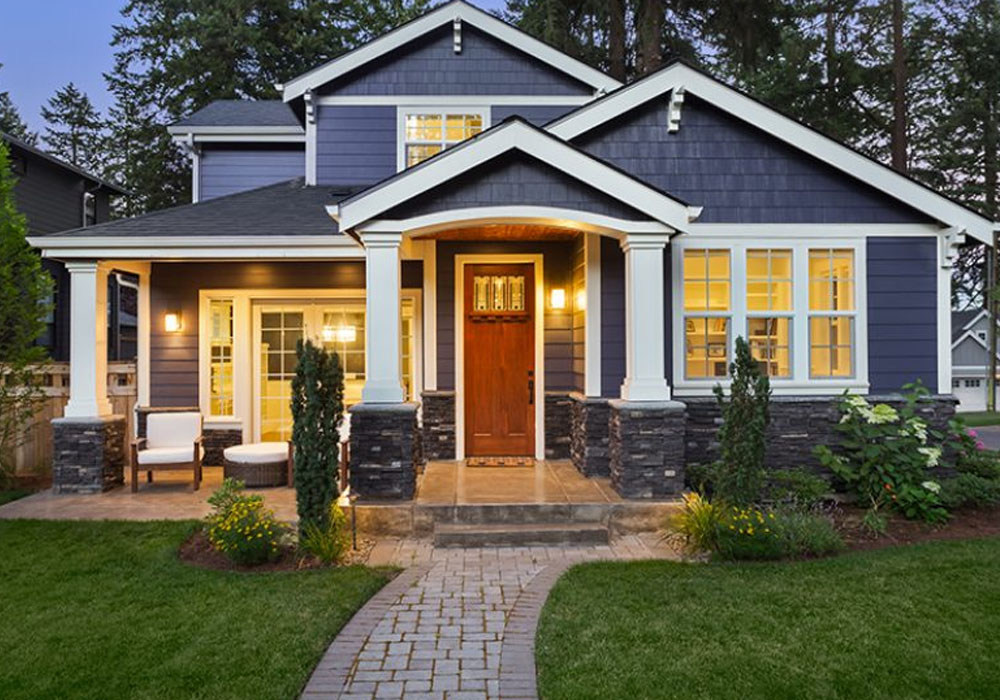
Curb appeal plays a direct role in that risk assessment. A home that’s freshly painted and well-maintained lets a burglar know you pay attention to details and there’s a high likelihood you’ve invested in your property – which raises their perceived risk. A home with peeling paint, a wonky garage door, dead landscaping, and no outdoor lighting is advertising the opposite. The story your home tells from the curb is your first line of defense.
Reinforcing The Front Door Frame
Most people think about securing their house by locking the front door, and this is true to some extent, but people are generally too focused on the lock itself. A high-quality Grade 1 deadbolt (the designation given to the best locks on the market by the American National Standards Institute) is not much use if the door and door frame are weak. A standard door frame, for example, can be kicked in with a single blow. The lock may be secure, but the door and frame give out.
Here’s why: most standard door frames are constructed of thin, weak wood that will tear and splinter on impact; the same is true of the trim around most doors. The steel plate in the door jamb in which the bolt slides isn’t an issue since it’s protected by the bolt itself during a kick-in attack. Strengthening the entire entry system can make a home more resistant to forced entry, especially when the door, frame, hinges, and hardware work together. If the existing structure is damaged or outdated, an entry door replacement can provide an opportunity to improve both security and overall durability.
The solution isn’t revolutionary or expensive – replacing that thin strike plate with a solid, heavy-gauge version that’s anchored deep into the wall studs with 3-inch screws makes the door frame dramatically harder to force. Pair this with a Grade 1 deadbolt and you’ve built a front entry that most intruders won’t bother with. From a visual standpoint, none of this is visible once installed. The door looks the same. The difference is entirely structural.
Securing First-Floor Windows Without Bars Or Grilles
Bars on windows may be effective, but for obvious reasons, they’re an aesthetic disaster and a significant percentage of homeowners and their associations will just flat-out refuse to allow them, whether they work or not. The good news is that security window film does a reasonable job of making glass smash-resistant and requires no visible modification to the exterior.
This is just a layer of polyester tape applied to the inside surface of a pane of glass, which holds the pane together upon impact. No, it doesn’t make glass unbreakable, but it will keep the hunk of glass intact so that the would-be intruder can’t just quickly step through the now-empty frame after a couple whacks with a hammer. If it takes three or four whacks to break a window and get through it, the risk changes significantly as it now takes time and possibly wirecutters.
For first-floor windows, pair the film with window pins or sash locks to prevent the window from being slid open even if the latch is defeated. These are inexpensive hardware items, completely invisible when the window is closed, and can be installed in such a way as to force a would-be thief to break the window (since it can only be opened 3 inches if they are installed), but also allow you to have the window open a few inches for ventilation.
The Garage Door Fishing Vulnerability
According to the International Association of Certified Home Inspectors (InterNACHI), about 9% of home burglaries happen through the garage. This makes it one of the most vulnerable entry points on the average home – but also one of the most commonly overlooked.
The most familiar garage vulnerability, known to security experts as “fishing,” only takes a bent clothes hanger slipped through the top of the door and used to trigger the emergency release cord – a red dangling lever that disconnects the motor – less than 30 seconds to execute. Ironically, the solution to this age-old garage weakness is just as simple: slide a zip tie through the hole in the release lever and cinch it tight. This prevents the lever from being activated in this way while still allowing it to be pulled free in a real emergency.
A more permanent solution is to install a special garage door defender lock that physically blocks the track. Unlike other solutions, this lock can be equipped with additional sensors that can tie into an existing home security system. And since the lock is physically mounted to the door itself and its bars are enclosed inside a tamper-proof case, there’s no physically possible way it can be defeated from the outside.
In more rural areas, however, some garages still rely on old, easily bypassed manual T-handle locks. Fortunately, this vulnerable lock isn’t built into the body of the door but rather added on after the fact. This makes replacing them with a deadbolt-style lock for garage-rated use a quick and easy fix; simply unscrew the old lock, swap out the faceplate, and screw the new one in.
Upgrading To A Smart, High-Security Opener
Older garage door openers used a fixed transmission code from the motor to the remote. This meant a simple, pre-Wi-Fi era “code grabber” bug could intercept a transmitted code and use it to open the door when it wanted. New openers use rolling code technology, which changes the code after each use. This simple measure ensures that any thief who used a grabber wouldn’t be able to break in using the recorded code.
Most of the modern security updates to garage doors and openers actually exist for convenience. With the Wi-Fi app-connected garage door openers, owners can track door activity in real time, receive notifications for when the door is opened, and operate it from anywhere the phone has a signal. Some will even automatically deadbolt the door when it closes. These features aren’t just security additions – a modern opener installed on a clean, insulated garage door genuinely upgrades the look and functionality of a home’s most used entry point.
What the most modern garage door opener won’t do, however, is fix the mechanical components supporting the door. That requires strong tracks, well-balanced doors, and healthy torsion springs. If any of this is compromised, having an expensive opener won’t keep the door from being simply kicked in.
If the door is knocked off balance, it is possible to pull the bottom half outwards instead of upwards. Similarly, if a torsion spring breaks a homeowner will find their garage door doesn’t seat properly when closed. Anyone searching for restore smooth garage door operation services will find plenty of options for replacing an opener, but a new unit won’t fix an underlying balance problem. The first call for a homeowner wanting a true sense of security should be getting their door inspected for flaws.
Motion-Activated Lighting and Architectural Illumination
Dark areas near entry points provide an advantage. They enable someone to move around without being noticed, tamper with a lock undetected, or approach a door with no visible signs of being seen. Motion-detected lighting takes away that advantage. Where lights are mounted is just as important as the actual hardware.
Floodlights mounted in the corners of a garage cover the full width of the door and the walking lanes on both sides. Lights with motion sensors above side doors, by back gates, and on any covered walks eliminate the shadow areas that provide an intruder with the time to tinker.
Most people, though, lose the most in terms of security precisely because they don’t realize that good design in outside lighting is not an eyesore on security but a true aesthetic upgrade. Lights that shine up into trees or onto the house, path lights that flank the walkway, and recessed soffit lights that are placed over a covering all make a house look better at night and remove the shadow areas that make a house a softer target. A properly lit exterior at 10 PM looks cared for. A dark one does not.
Defensive Landscaping Beneath Windows
Planting thorny shrubs at the base of first-floor windows is a passive deterrent that works. Holly, pyracantha, and the like serve as a living burglar-proofing. Their presence blocks easy window access; their thorns serve as a low-cost, low-tech security system. They look like border plants, not a security installation. That’s what makes them so effective. They’re a deterrent doing double duty as a garden bed.
The same principle applies to the entire perimeter. Shrubs that grow too tall or too dense against a fence line or house wall create cover, not decoration. Keep plantings below window-sill height near the house so they don’t block sightlines, while using thorny varieties specifically in spots where an intruder would need to stand to access a window or secondary door.
Well-done defensive landscaping adds texture and color to garden beds. It’s low maintenance and costs no more than regular landscaping. It’s visible deterrence that looks like a garden design choice.
The Case For Treating Security As Home Improvement
A house that seems cared for, well-lit, and secure from the outside is less vulnerable than one that appears neglected. Each upgrade discussed here – fortified door frames, smart openers, architectural lighting, defensive landscaping, security film – is also a legitimate home upgrade that influences how a property looks from the street.
The people who gain the most from this philosophy aren’t weighing “security versus aesthetics” against each other. They’re considering the overall condition and appearance of their house, and they’re opting for choices that accomplish both objectives simultaneously. That’s the sweet spot where the smartest expenditures are found.