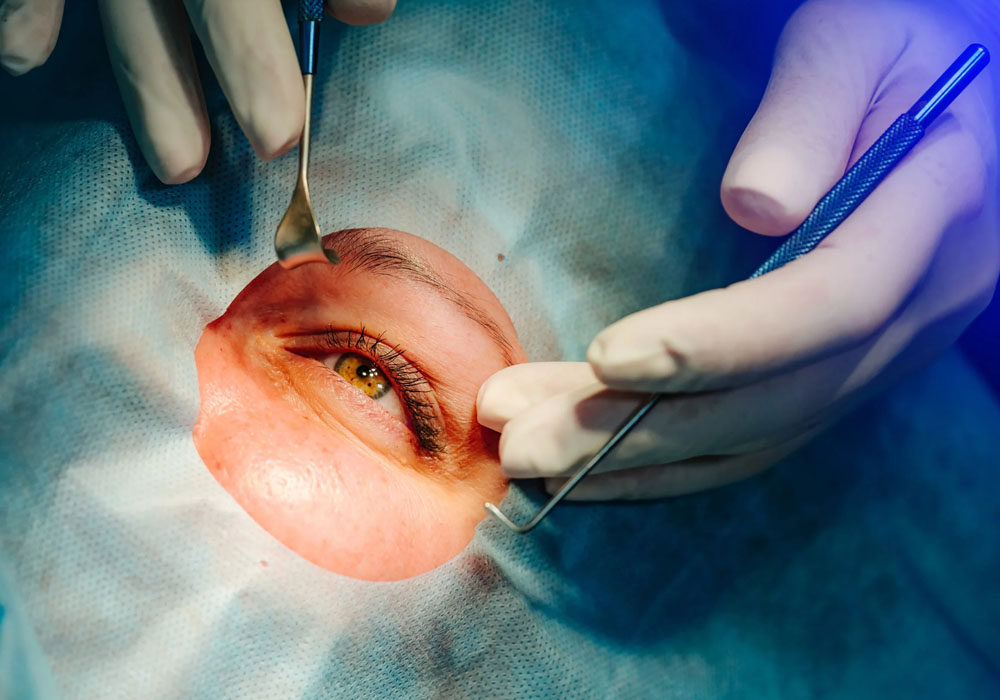
The first few days post-laser eye surgery are critical. Most patients can return to work the next day and back to the gym after a week. However, it’s essential to be cautious and protect your eyes as they heal.
The first 24-48 hours: the highest-risk window
Your eye’s protective film, the tear layer, is a key part of the healing process. In the first few days the amount, and quality, of your tears may not be normal. Your eyes can easily become dry or irritated, and the healing cornea is hypersensitive to contamination. Follow your surgeon’s advice on the comfortable use of preservative-free artificial tears. These help to quickly refresh and clean your eye while providing some nourishment in place of tears.
Light sensitivity is part of a normal response to injury in any part of the body. Darken your home for a few days and if you’re using a computer, enable a blue light filter app to reduce strain. Don’t overuse screens – keep your eyes closed for relief.
Use all prescribed medicated eye drops on schedule. They play a key role in healing and help prevent infection. If you’re applying ointment, apply a line the length of a grain of rice to keep it just inside the lower eyelid and let your blinking spread it.
Check your vision daily. It might be blurry or fluctuating; this is normal. If it gets worse, or one of your eyes begins to hurt, call your surgeon straight away. If you play sports, wear protective safety goggles.
Your prescribed drops: treat this like a medication schedule, not a suggestion
You will receive antibiotic and steroid eye drops to prevent infection and inflammation. The antibiotics prevent germs from growing in your eye after surgery and the steroids help decrease inflammation. It is important to use the drops exactly as prescribed by your ophthalmologist, at the correct times each day. To get the most benefit, these eye drops must be used on a strict schedule.
If you miss a dose, take it as soon as you remember. However, if it is almost time for your next dose, skip the one you missed and continue your regular schedule. Do not take a double dose to make up for the one you missed, as this may cause an overdose.
Most patients are off their drops after about three weeks. The exact timing of your usage is important to let your surgeon know how your body is reacting to the medication. The drop in medication after the surgery will also help your surgeon gauge how your body is delivering its natural response to the surgery. Your tear production doubles while you are on these drops – something many patients do not realize.
What to expect in the first week and beyond
Nearly all PRK patients and most LASIK patients return to work within a week. The recovery time after laser eye surgery varies by procedure, and if you have a very physically demanding job, you may want to take a bit more time because a knock to the eye can seriously complicate healing in the first seven days. Avoid all sports for at least seven days, and then ease back in as your surgeon advises.
Contact sports will be off the menu for 3-6 months and you’ll need to wear protective glasses for longer. But you can go scuba diving or skydiving again after a month. Swimmers can hit the water at a month post-op but, as with all water activities, it’s medically wise to wear goggles for three months to protect your eyes from infection.
Lifting weights and contact sports? 3-6 months because of that potential to dislodge the still-healing corneal flap (LASIK) or epithelium (PRK). You should have weekly check-ups, starting at the one-month mark.
Screen time, sunlight, and water
You can glance at screens, but you should keep screen time in check. Your blink rate decreases while looking at a screen, aggravating dry eye and hindering the recovery of your tear film. There’s no fix, but you can minimize the strain by following the 20-20-20 rule: every 20 minutes, look at something 20 feet away for 20 seconds.
On the other hand, sunlight is more of an unequivocal prohibition. Your healing cornea is more light-sensitive than usual, and UV exposure could damage the tissue. Put on protective, UV-blocking shades whenever you’re outdoors, including overcast days.
Speaking of water, keep it out of your eyes entirely for a week or two. That means no swimming or floating in a pool, no soaking in a hot tub, no steaming in a sauna, and even being careful not to splash water on your face in the shower. Water contains bugs that can lead to severe, sight-threatening infections, so skipping the pool and hot tub is non-negotiable.
The months after: visual stabilization
Over 90% of patients undergoing LASIK end up with 20/20 to 20/40 vision, as revealed by FDA quality-of-life data. But that same data underscores how long it takes for final results to lock in. The immediate post-operative improvement in vision is unmistakable, but it takes three to six months for refraction to fully stabilize as the cornea responds to being newly shaped by the laser as part of the healing process.
So while it’s true that you can see better right away, that doesn’t mean these are your exact final results. Vision at week two may shift slightly – often for the better – and patients who expect perfection at day three are more likely to panic over normal fluctuations.
Come in for every checkup and keep using your drops for at least as many weeks as recommended. Then chill out and let time do its thing. In the grand scheme of medical adventures, laser eye surgery recovery is remarkably fast. The main thing you have to do is not interfere with it.