A breakfast bench fitted tightly between two walls can be surprisingly difficult to keep clean. A dropped cracker disappears between the seat and wall, crumbs gather beneath the toe kick, and the only obvious way to reach them seems to involve removing the entire bench. Similar problems arise around wall-to-wall shelving, fixed bed frames, and entertainment units built into an alcove. The challenge is not always the amount of dirt. It is getting to it without damaging the installation.
People arranging house cleaning services for rooms with fixed cabinetry often discover that the usual instruction to “move the furniture and clean behind it” does not apply. Access may be limited to a narrow opening, and even a small amount of moisture can damage unfinished edges inside that space. When discussing such a job with North County San Diego House Cleaning, identifying which pieces are fixed, which panels open, and which areas are physically unreachable is more useful than simply asking for extra attention around furniture.
The solution begins with understanding how the piece was built. Some apparently solid units contain removable drawers or designed access panels. Others are sealed against the wall, leaving no safe path into the cavity. Knowing that difference prevents an ordinary cleaning task from turning into a repair job.
Start With the Gaps You Can Actually Reach
A built-in unit creates several distinct areas: the exposed surfaces, the joints where it meets the wall or floor, and any open space beneath or behind it. Each needs a different approach. A soft brush attachment can remove dust from an exposed shelf, but pushing that same attachment into a tight seam may scrape painted trim or pull loose caulk.
Check the gap with a flashlight from several angles. Look for loose crumbs, fabric fibers, or cobwebs, but also notice protruding staples, cables, unfinished wood, and sharp brackets. Do not insert tools where electrical wiring or moving hardware is visible. If the cavity contains a socket, lighting connection, or other electrical equipment, keep liquids out and leave any necessary disassembly to a qualified person.
Use Small Tools That Let You Control the Pressure
A vacuum crevice tool works well where it fits freely. For narrower openings, a soft detailing brush can loosen particles while a vacuum nozzle held nearby catches them. Wrap a dry microfiber cloth around a slim, smooth tool only if the cloth can be secured and retrieved easily. Avoid metal rulers, sharp picks, and improvised attachments that might snag or break off inside the furniture.
Do not force a vacuum nozzle into a joint just because you can see debris. Pressure can damage veneer, loosen edge banding, or mark a painted wall. A little material left in an inaccessible void is often less harmful than a broken finish.
Built-In Seating Has a Different Dirt Pattern
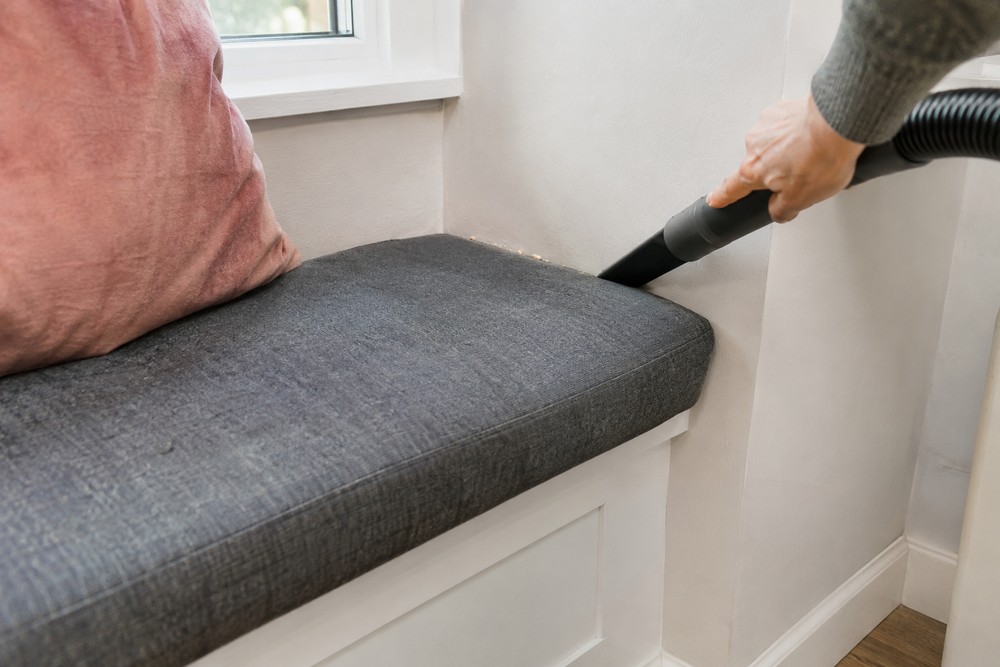
Banquettes and window seats collect crumbs at the junction between the cushion and backrest. When a cushion lifts out, vacuum both sides and the exposed platform before returning it. If upholstery is fixed, use an appropriate upholstery attachment along the seam, working slowly rather than driving particles farther into the join.
The space below a seat deserves a separate look. Some benches have a recessed toe kick that traps hair and small food particles. Others sit directly on the flooring, with only a caulked joint at the base. Scraping that joint to chase a dark line can remove sealant and create a larger opening for future debris.
Spilled drinks are more urgent than dry crumbs. If liquid has entered an enclosed bench, drying the visible floor does not establish that the concealed structure is dry. Persistent odor, swelling, or staining may call for an inspection by a carpenter or water-damage specialist. Cleaning the outer surface cannot fix moisture sealed inside.
Wall-to-Wall Shelves Need More Than Dusting
Bookshelves built into an alcove make the vertical gaps difficult to reach. Dust settles on the tops of trim, behind display objects, and around adjustable shelf pegs. Clear one shelf at a time so that objects have a safe place to rest. This is slower than moving everything at once, but it reduces the chance of chipped ceramics, bent book covers, and scratched shelves.
Painted wood, laminate, and natural veneer can look similar from a distance while responding differently to water. For unfamiliar finishes, start with a dry microfiber cloth, then consult the maker’s care directions before using any solution. Never spray liquid directly into peg holes, joints, or the gap between a shelf and its back panel.
A good scope for house cleaning services san diego distinguishes reachable shelf surfaces from the sealed cavity behind the unit. That boundary is especially useful when there are fragile decorations, integrated lights, or shelves holding heavy books.
For instance, if North County San Diego House Cleaning is given a request involving a large built-in library, explaining which shelves can be cleared and which sections contain delicate objects establishes a more realistic cleaning scope. It also avoids the expectation that inaccessible spaces can somehow be cleaned through solid panels.
Fixed Beds and Platform Bases Can Hide Debris
A platform bed attached to a wall may have a narrow floor clearance, storage drawers, or upholstered panels. Before trying to clean underneath, check whether its drawers are designed to come all the way out. Some use release clips; others have stops that should not be forced. If the removal method is unclear, clean only the accessible areas.
Hair and lint can be drawn toward a low gap by airflow from fans and heating systems. A flat vacuum attachment may reach the front section without disturbing the frame. Flexible tools are useful only when their heads cannot detach and disappear beneath the bed.
Take extra care near upholstered headboards. Excess water can leave rings, and aggressive brushing can flatten the fabric pile. Identify the upholstery’s care code, when available, and spot-test an approved method in a hidden area. If an odor seems to come from inside a fixed platform rather than the bedding, covering it with fragrance is not a solution; the source needs to be located.
Entertainment Walls Combine Dust With Electrical Risks
Built-in media cabinets often have open cable ports, ventilation slots, speakers, and equipment mounted close to the wall. Dust will collect where warm electronics move air, but those openings are not invitations to insert wet cloths or vacuum parts into devices.
Turn off equipment before cleaning nearby external surfaces and follow the manufacturer’s directions. Use a soft, dry cloth around vents and keep cables from being tugged by the vacuum. If a shelf contains a powered component that cannot be moved safely, work around it rather than attempting a deeper clean. Internal electronics maintenance is a separate job.
For recurring house cleaning services, the most useful instruction may be as simple as “clean the cabinet exterior and accessible shelving; leave the wired compartment closed.”
If a client requests work from North County San Diego House Cleaning in a room with an elaborate entertainment wall, the presence of mounted screens, concealed cables, and electronic equipment should be disclosed beforehand. Routine surface cleaning should not be confused with removing equipment or opening sealed electrical compartments.
Know When a Gap Is a Maintenance Issue, Not a Cleaning Task
Some dark lines along built-ins are shadows, missing caulk, or exposed subfloor rather than dirt. A persistent trail of fine wood dust may indicate damage or insect activity. Droppings, unexplained moisture, and repeated musty smells also deserve investigation before anyone sweeps them away. Cleaning can remove visible evidence that would help identify the cause.
Take a photograph of anything unusual, avoid disturbing suspected pest material, and ask an appropriate professional to assess it. Once the underlying problem is resolved, the accessible surfaces can be cleaned. Do not promise that a sealed void can be sanitized without opening it; access is a physical limitation, not a question of using a stronger chemical.
Make the Next Cleaning Visit Easier
Built-in furniture is simplest to maintain when the boundaries are clear. Keep removable cushions and drawer runners in good condition, avoid storing loose food near inaccessible seams, and use a small nozzle regularly along reachable edges. During renovations, consider asking the installer about access panels for areas likely to collect debris or need servicing.
The same clarity helps when booking house cleaning services. A short note identifying fixed pieces, delicate finishes, and off-limits compartments is more helpful than a broad demand for “deep cleaning everywhere.”
For a property with extensive custom furniture, providing North County San Diego House Cleaning with details about the layout and access restrictions helps establish practical expectations. The objective is not to reach every concealed cavity at any cost. It is to maintain the surfaces that can be safely cleaned while preserving the furniture’s finish, fittings, and structural integrity.