
Most business owners think of taxes as a fixed fact of life, like weather or rent. They’re not. The U.S. tax system is the product of 160-plus years of wartime emergencies, constitutional battles, economic upheaval, and political negotiation. Understanding where it came from doesn’t just make for interesting reading. It tells you why the system is built the way it is, why compliance is as complicated as it is, and what that means for your business right now.
Born in Wartime: The First Federal Income Tax
The United States had no permanent federal income tax for most of the 19th century. The government funded itself through tariffs and excise taxes, and that worked well enough until 1861. Then the Civil War started, and the Union needed money fast.
In 1861, Congress passed a revenue act placing a tax on personal income to help cover the costs of the Civil War. That first federal income tax levied a flat 3% on annual incomes over $800. It was never meant to be permanent. The law was repealed in 1872 after the war ended, and most Americans assumed they were done with income taxes forever. They were wrong.
Congress tried again in 1894 with a flat-rate federal income tax, but the Supreme Court ruled it unconstitutional just one year later. The legal fight over whether the federal government even had the power to tax income would drag on for nearly two more decades.
According to a timeline published by UT Permian Basin, the passage of the Sixteenth Amendment in 1909 granted Congress the authority to impose an income tax on citizens without regard to each state’s population, and the amendment was ratified in 1913. That single constitutional change is the direct ancestor of every W-2, 1099, and Schedule C filed today.
The 1913 Turning Point and Three Waves of Growing Complexity
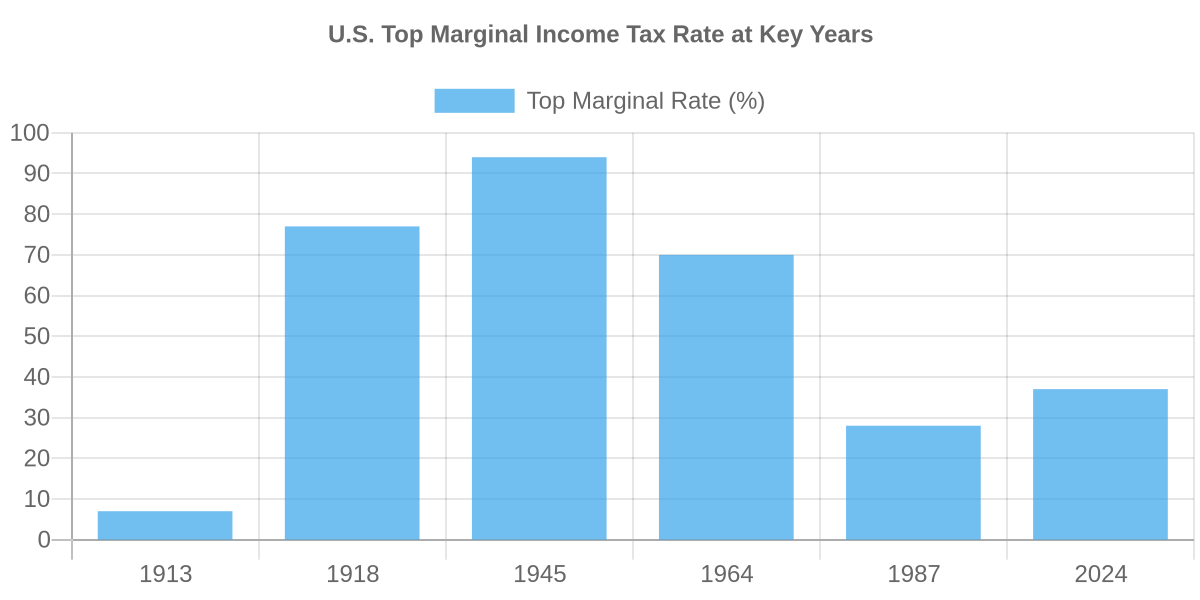
Most people know 1913 as the year the modern income tax began. What gets less attention is how simple that original system was. The top rate in 1913 was 7%, applied only to incomes above $500,000 in today’s dollars. Most Americans owed nothing at all.
A useful way to understand what happened next is what I’d call the Three-Wave Tax Complexity Model. The first wave was wartime scaling: every major conflict pushed top rates dramatically higher, and those rates rarely came all the way back down. World War I pushed the top rate from 15% to 77%, and during World War II it reached an all-time high of 94%. The second wave was structural normalization: in 1943, the government introduced payroll withholding, requiring employers to deduct tax payments directly from wages, which made tax collection more efficient and widened participation in the tax system. The third wave is the one we’re living in now: a decades-long cycle of reform, complication, and reform again, where each legislative fix creates new categories, new credits, and new exceptions that pile onto existing ones.
“The U.S. income tax system was born out of necessity.” The wartime revenue crises of the 19th and 20th centuries didn’t just fund battles. They permanently wired complexity into the American tax code as a structural feature rather than a temporary workaround. Tax historians consistently frame this as intentional design, not accidental drift.
Key Milestones in U.S. Tax History
| Year | Event | What Changed
|
| 1861 | Revenue Act of 1861 | First federal income tax: 3% flat on incomes above $800 |
| 1913 | 16th Amendment ratified | Constitutional foundation for permanent income tax; top rate 7% |
| 1918 | World War I peak rates | Top marginal rate reached 77% |
| 1943 | Payroll withholding introduced | Employers deduct taxes directly from wages; mass participation begins |
| 1954 | Filing deadline set | April 15 becomes the annual tax deadline |
| 2017 | Tax Cuts and Jobs Act | Largest tax overhaul in decades; corporate rate cut, standard deduction nearly doubled |
What Modern Filing Volumes Tell Us About Complexity
Here’s a number that puts the scale of the modern system in sharp relief. According to research published by the Urban-Brookings Tax Policy Center in 2026, the IRS processed about 161 million individual income tax returns in fiscal year 2024, with approximately 93 percent of those filed electronically. That’s 161 million separate snapshots of how different the American financial picture looks from household to household.
And of those 161 million, more than half of e-filed returns (about 85 million) were prepared and filed for a fee by a paid practitioner. That tells you something real: even in the era of tax software, the majority of Americans still decide the system is complex enough that they’d rather pay someone to handle it for them. This isn’t a failure of technology. It’s a reflection of a 160-year-old system that was never designed to be simple.
Why Atlanta Businesses Are Paying Closer Attention Than Ever
Atlanta sits at an intersection worth noting. Georgia has ranked as the number one state for business for nine straight years, and the growth numbers back that up. Between July 2023 and June 2024, Georgia’s economic development efforts supported 429 facility expansions and new business locations, generating more than $20.3 billion in investment and creating 26,900 private sector jobs, according to a 2025 report in Business Facilities citing the Georgia Department of Economic Development.
More businesses moving in means more business owners navigating federal, state, and local tax obligations simultaneously. Picture a mid-sized logistics firm that relocated its southeastern distribution hub to the Atlanta metro in 2024. Within twelve months, their CFO is juggling Georgia’s flat state income tax, local county levies, federal quarterly estimates, and payroll withholding for 80 new employees. None of those systems talk to each other cleanly. That’s the Three-Wave legacy playing out in real time. For operations like that one, working with professional Tax Serivces in Atlanta, GA is not a luxury. It’s what keeps the lights on legally.
A Practical Checklist for Business Owners Who Want to Stay Ahead
You don’t need a history degree to use this. These are the four questions every business owner should be able to answer at any point in the year:
- Are your quarterly estimates current? The IRS expects payments four times a year, not just in April. Missing one triggers penalties that compound fast.
- Have you reviewed entity structure recently? The 2017 Tax Cuts and Jobs Act changed the calculus on S-corps, LLCs, and C-corps significantly. A structure that made sense in 2016 may not be the right fit today.
- Do you know your state-specific deductions? Georgia’s tax code has its own carve-outs and credits that don’t mirror federal rules. Most business owners leave money on the table here.
- Is your recordkeeping audit-ready? The IRS can audit returns up to three years back under standard rules, and six years if it suspects a substantial understatement. Your records should be organized far in advance, not scrambled together during a notice period.
None of those questions require you to be a tax expert. They do require that you have access to one.
The Long View
The U.S. tax system didn’t arrive fully formed. It grew in fits and starts, shaped by wars, court rulings, constitutional amendments, and economic crises that had nothing to do with orderly planning. The result is a genuinely complicated system, not because anyone designed it to be cruel, but because every generation added something without fully removing what came before.
That history matters practically. When your tax situation feels impossibly tangled, that’s not a personal failure. It’s the predictable output of 160 years of accumulated policy. The businesses that handle it best aren’t the ones who ignore the complexity. They’re the ones who invest in people who understand it well enough to cut through it.