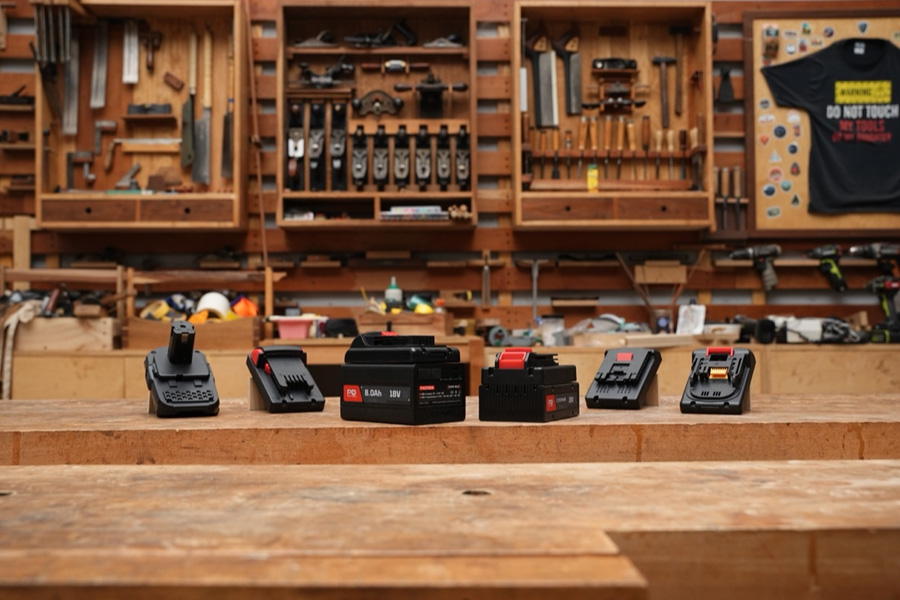
A home workshop does not become more capable simply because it contains more tools. In many cases, the real improvement comes from reducing friction between projects: fewer chargers, fewer battery types, less storage clutter, and less time spent figuring out which power source belongs to which tool. That is one reason cordless power tools built around a compatible battery platform have become an increasingly practical option for homeowners and DIY users.
The idea is straightforward. Instead of purchasing a separate battery and charger for every drill, saw, impact driver, or other tool, a compatible system allows the same battery family to power multiple tools. But battery compatibility is about more than convenience. When planned properly, it can influence purchasing decisions, workshop organization, project preparation, operating costs, and even which tools are worth adding later.
Why Battery Compatibility Matters More Than the Number of Tools You Own
The biggest advantage of a shared battery platform is not necessarily having fewer batteries. It is having a more predictable workshop.
Imagine a homeowner who owns a drill, impact driver, circular saw, reciprocating saw, and work light. With separate battery systems, that could mean several chargers and multiple battery formats competing for shelf space.
With a compatible platform, the same core batteries can potentially serve several tools. The result is a workshop where the power supply is treated as a reusable resource rather than a collection of tool-specific accessories.
This becomes particularly useful when several tools are needed for one project. Instead of stopping to locate a particular charger, the user can move charged batteries between compatible equipment as work progresses.
How a Shared Battery Platform Changes Workshop Organization
Workshop organization is often treated as a storage problem, but it is also an access problem.
Tools that are difficult to identify, charge, or retrieve tend to be used less efficiently. A shared battery system can simplify the layout by reducing the number of charging stations and accessory combinations that need to be managed.
Create a dedicated battery charging area
A practical setup is to establish one location for:
- Battery charging
- Battery storage
- Chargers
- Tool accessories
- Spare batteries
- Basic battery-maintenance supplies
Keeping these items together makes it easier to check charge levels before beginning a project.
It also creates a simple routine: batteries come off the tools after use, go to the designated charging area when necessary, and return to storage when ready.
One Battery Family Can Support Very Different Jobs
One of the more useful aspects of a compatible platform is that tools can have completely different functions while sharing the same power source.
A drill may handle pilot holes and fasteners. An impact driver can take on heavier fastening work. A circular saw can make straight cuts, while a reciprocating saw is better suited to demolition or awkward cuts.
The battery does not need to understand the job. It simply provides power within the limits established by the tool and battery system.
This makes it possible to expand a workshop incrementally instead of buying an entire collection at once.
Think About Battery Capacity Before Buying More Tools
Battery compatibility does not mean every battery is equally appropriate for every application.
Capacity, voltage architecture, physical design, and tool requirements all matter. A compact battery may be convenient for a drill used overhead, while a higher-capacity battery can be more useful for a tool performing sustained, demanding work.
A good workshop strategy is to maintain a mix of batteries according to actual usage.
For example:
- Compact batteries for lightweight, frequently handled tools
- Higher-capacity batteries for demanding applications
- Multiple batteries when projects involve continuous operation
- Fully charged backup batteries for tools that cannot easily be paused
The objective is not to own the largest battery available. It is to match battery capacity with the work.
Cordless Power Tools vs. Corded Tools: Where Compatibility Fits
Corded tools still have a place in workshops, particularly where sustained power is needed and an outlet is readily available.
Cordless equipment offers a different advantage: mobility.
A homeowner repairing a fence, assembling a structure outdoors, or working in a partially finished room may not have convenient access to electricity. A charged battery removes the extension cord from the equation.
However, battery operation introduces its own planning requirement. Runtime depends on the tool, workload, battery capacity, material, operating conditions, and user technique.
The better comparison is therefore not simply “corded versus cordless.” It is continuous electrical access versus portable stored energy.
Calculate Your Actual Battery Needs Before Expanding the Platform
One of the easiest mistakes is buying batteries based on the number of tools rather than the way those tools are used.
Instead, consider your typical project.
Suppose a weekend project requires drilling, fastening, and cutting. If the same battery can be moved between tools and charging is available between tasks, you may need fewer batteries than expected.
For a larger project where multiple tools operate continuously, additional batteries become more valuable.
Use a simple three-question test
Before buying another battery, ask:
- How long will the tool normally run continuously?
- Can another tool use the same battery during that period?
- Will waiting for a recharge interrupt the project?
If the answer to the third question is yes, a second or higher-capacity battery may provide more practical value than purchasing another tool.
Compatibility Can Make Future Tool Purchases More Deliberate
A shared platform creates a useful purchasing discipline.
Once a homeowner has established a battery system, future tools can be evaluated partly on whether they fit that ecosystem. This does not mean compatibility should override every other consideration. Tool quality, application, ergonomics, safety features, and performance still matter.
But if two otherwise suitable tools meet the same need, the one that uses batteries already owned may have a lower total acquisition cost.
This is particularly relevant for occasional DIY users who do not need professional-level equipment for every project.
Watch for Compatibility Details That Are Easy to Miss
“Compatible battery system” does not necessarily mean every battery works with every tool.
Manufacturers may have different platforms, voltage classes, physical interfaces, or tool-specific requirements. A battery that fits mechanically may not necessarily be approved for a particular tool.
Always check the manufacturer’s compatibility information before connecting batteries or chargers.
The U.S. Consumer Product Safety Commission provides general consumer safety information about rechargeable lithium-ion batteries, including safe charging and storage practices. Its lithium-ion battery safety guidance is worth reviewing for any household using rechargeable battery equipment.
Common Battery Management Mistakes in Home Workshops
A compatible platform solves some organizational problems, but it does not eliminate the need for good battery habits.
Leaving batteries wherever the project ends
This makes it difficult to know which batteries are charged and encourages unnecessary searching. Return them to a consistent storage location.
Keeping every battery permanently on a charger
Follow the manufacturer’s charging and storage instructions rather than assuming batteries should remain connected indefinitely.
Ignoring temperature conditions
Rechargeable batteries can be affected by extreme temperatures. Follow the manufacturer’s guidance for charging, storage, and operating conditions.
Mixing incompatible systems
Do not assume similar-looking batteries are interchangeable. Use only batteries and chargers approved for the specific tool platform.
Buying too many batteries too early
Build the system around actual workload. It is usually easier to add capacity after identifying a genuine runtime limitation.
A Practical Way to Build a Multi-Tool Workshop
For most homeowners, a staged approach makes more sense than buying everything simultaneously.
Start with one or two tools that cover the projects you perform most often. Add compatible batteries based on actual runtime requirements.
Then expand into specialized tools only when a project justifies them.
A sensible progression might include:
- Drill or driver for general fastening.
- Impact driver for heavier fastening tasks.
- Saw suited to the materials and projects you commonly handle.
- Specialized tools as recurring needs emerge.
- Additional batteries when runtime becomes a limitation.
This creates a workshop around actual work rather than accumulating equipment simply because it is available.
Battery Compatibility Is Also a Cost-Management Strategy
The financial advantage of a shared platform is easy to overlook.
The initial cost of a tool is only one part of ownership. Batteries, chargers, accessories, storage, and replacement equipment also contribute to the total.
When several tools can share batteries and chargers, those supporting components do not necessarily have to be purchased repeatedly.
Over several tool purchases, that can make the platform approach more economical, particularly for homeowners who gradually build their workshop over years rather than outfitting it all at once.
FAQ: Building a Battery-Compatible Home Workshop
What does battery compatibility mean for power tools?
It means multiple tools are designed to operate with the same battery platform and, where specified by the manufacturer, compatible chargers. Always verify the exact compatibility requirements for each tool.
Do all cordless tools use the same batteries?
No. Battery systems vary by manufacturer, platform, voltage, physical interface, and tool requirements. Similar appearance does not guarantee compatibility.
How many batteries does a home workshop need?
There is no fixed number. Occasional DIY users may need only a small number, while people running multiple tools continuously may benefit from several batteries. Base the quantity on actual runtime and project demands.
Are higher-capacity batteries always better?
Not necessarily. Higher-capacity batteries can provide longer runtime but may also add weight. A compact battery can be more comfortable for lightweight tools and overhead work.
Is a shared battery system worth considering?
For homeowners who expect to own several cordless tools, it can simplify charging, storage, purchasing, and project preparation. The value increases as more compatible tools are added.
Build the Workshop Around the Work, Not the Battery Shelf
Battery compatibility is most useful when it simplifies decisions rather than creating another layer of complexity.
A well-planned platform can turn several individual tools into a coordinated workshop system. The same batteries can move between tasks, chargers can be consolidated, storage becomes easier to organize, and future purchases can be made with a clearer understanding of what is already available.
The best approach is to start with the work you actually perform. Identify your most common projects, choose a battery platform that supports those applications, and expand only when another tool solves a recurring problem.
That way, compatibility becomes more than a convenience. It becomes a practical framework for building a home workshop that is easier to organize, easier to use, and less likely to accumulate equipment that rarely leaves the shelf.