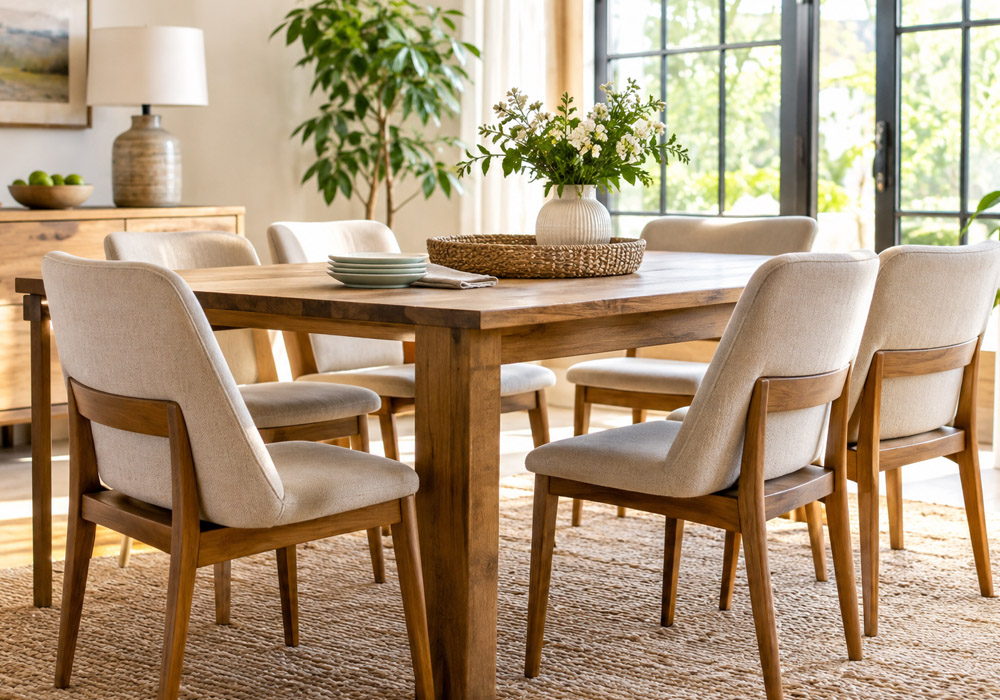
A dining chair gets more daily use than almost any other piece of furniture in the house. It holds you up through breakfast, homework, laptops, and long dinners, sometimes for hours at a stretch. Most people judge a chair by looks first and feel later, once it’s too late to return it. A well-built dining chair earns its place at the table through proportion and comfort, not just style. Get those two things right, and the look tends to fall into place on its own.
What Chair Style Actually Suits A Busy Dining Room?
Different households need different chair styles, and there is no single right answer here. The best choice depends on how often the table fills up and who is sitting at it.
Dining Chair Styles Worth Comparing
- Armless chairs: slide fully under the table, best for tight rooms and frequent extra guests
- Armchairs: end-of-table comfort pieces, best kept to two per table so the middle chairs still tuck in
- Upholstered seats: warmer to sit on for long meals, need fabric that resists spills
- Timber or moulded seats: wipe clean in seconds, better for young kids or messy cooking nights
What Is The Right Seat Height For A Dining Chair?
The right seat height for most dining chairs sits between 43 and 48 centimetres off the floor. That range pairs with a standard dining table height of 71 to 76 centimetres, which is what most tables in most homes use. The gap between the two numbers matters more than either number alone.
Why Does The 25 To 30 Centimetre Gap Matter So Much?
A seat-to-tabletop gap of 25 to 30 centimetres gives your legs room to sit, cross, and shift without bumping the underside of the table. Too small a gap and knees jam against the apron within minutes. Too large a gap and elbows sit too low to eat comfortably, forcing a hunch over the plate.
How Wide Should Each Seat Be Per Person?
Give each diner 50 to 60 centimetres of table width, elbow to elbow, so arms don’t collide during a meal. A chair narrower than its share of table width looks mismatched even when the height is correct. Wide, upholstered arms need extra room again, since they push each seat’s overall footprint out past the base measurement.
How Much Clearance Do You Need Behind Each Chair?
Leave at least 90 centimetres behind every seat so a person can push back and stand without hitting a wall or a sideboard. Busy walkways behind chairs need closer to 100 centimetres, especially if that path doubles as the route to a kitchen. Cramped clearance is the single most common mistake in small dining rooms, and it shows up the moment guests arrive and start pulling out chairs at once.
Does Cushion Density Actually Change How A Chair Feels?
Yes, and it matters more than the fabric on the swing tag. A dense foam core holds its shape for years under daily use. A soft, low-density foam feels plush in the showroom but compresses flat within a season. Press a thumb into the seat before buying. If it bounces back slowly, that chair will still feel right two years from now, not just on day one.
How Do You Pair Seat Height With Table Height Correctly?
Match your chair to your table using the gap rule, not a fixed number. A shorter table needs a shorter seat, and a tall counter table needs a much taller one, but the comfortable gap between them barely changes.
Chair Height To Table Height Pairing
| Table Height | Matching Seat Height | Resulting Gap |
| 71 to 73 cm | 42 to 46 cm | About 25 to 30 cm |
| 74 to 76 cm | 45 to 48 cm | About 25 to 30 cm |
| 90 to 95 cm (counter) | 61 to 66 cm | About 25 to 30 cm |