I wasted two full Saturdays on a spike aerator before I figured out I was making my clay soil worse. Not a little worse. Worse in a way you can see: the bare patch by the driveway got bigger, water pooled in the same low spot for three days after rain, and the grass came back thinner than it went in. That is the thing about aeration advice. Most of it sounds reasonable, and a chunk of it quietly works against you depending on what’s under your grass.
So here’s the short version. If your soil is compacted, which is likely if you’ve got clay, heavy foot traffic, or a dog with a patrol route, core aeration fixes it and spike aeration mostly doesn’t. Core aeration pulls actual plugs of soil out of the ground. Spike aeration pushes soil sideways with tines. There’s a place for each, but they aren’t interchangeable, and the difference shows up in about three weeks.
What aerating your lawn actually does
Grass roots need three things moving through soil: air, water, and dissolved nutrients. Compacted soil shuts down all three. The particles get pressed together, the pore spaces collapse, and suddenly your fertilizer sits on top of the ground instead of soaking in where roots can reach it.
You can spot it without any tools. Push a screwdriver into your lawn. If it stops dead an inch down, that’s compaction. If it slides in easy, your soil is fine and you can skip this whole article.
Compaction is also more common than people assume. The U.S. Department of Agriculture has documented soil compaction as a persistent issue on both farm fields and residential ground, largely because the same traffic and tillage patterns repeat year after year. Your backyard has a traffic pattern too. So does the strip between the sidewalk and the curb, which is often the worst soil on the property.
Core aeration: what it is, and why it works
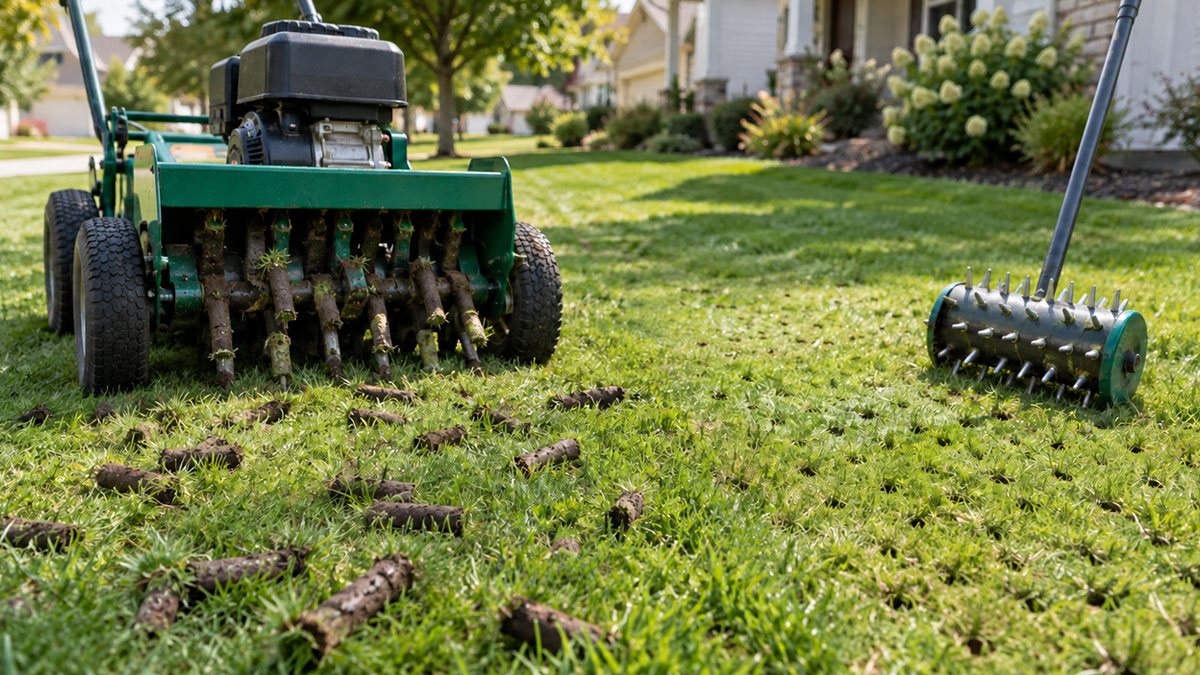
A core aerator, sometimes called a plug aerator, drives hollow tines into the ground and lifts out small cylinders of soil and thatch. You end up with hundreds of holes and a lawn dotted with little soil plugs that look like elongated rabbit droppings.
Those plugs are the point. You’re not just poking holes. You’re physically removing material, which gives the surrounding soil room to expand. Roots can push into that space. Water moves down instead of running off. Fertilizer reaches the root zone on the first rain instead of the third.
My take: if you only aerate once a year, make it core. Every professional I’ve talked to says the same thing, and the physics backs them up. Removing soil relieves pressure. Pushing soil around just rearranges it.
That leftover thatch layer is worth mentioning too. A thin thatch layer is healthy. A thick one blocks water and shelters pests. Core aeration punches through it in a way surface treatments can’t match.
Spike aeration: cheap, fast, and misunderstood
Spike aerators have solid tines, or sometimes rolling spikes you pull behind a mower. They punch holes without removing anything.
On loose, sandy soil, that’s fine. Holes are holes, water gets in, and the ground doesn’t fight back.
On clay, it’s a different story. Solid tines push soil outward and down, which compresses the walls of each hole. You’ve created a shallow divot with a compacted lining. Water sits in it. Roots hit the hard edge and turn sideways. Do this every spring for a few years and you can build a layer of tight soil just below the surface, which is exactly the problem you were trying to solve.
The other catch is depth. Most spike units reach an inch or two. Grass roots in a healthy lawn go far deeper than that, so you’re treating the zone that needed it least.
When spike aeration is genuinely the right call
Three honest scenarios:
- Your soil is sandy and drains fast already, and you just want to open the surface before seeding.
- You’re working a small area where a core aerator can’t physically fit, like a tight side yard between a fence and a foundation.
- You’re renting, the lawn isn’t yours long term, and you want a twenty dollar improvement rather than a two hundred dollar one.
Notice what’s missing from that list: fixing compaction. Spike aeration doesn’t fix compaction. It’s a surface treatment, and it should be priced and expected like one.
Core aeration vs spike aeration, side by side
| Factor | Core aeration | Spike aeration
|
| What it removes | Plugs of soil and thatch | Nothing |
| Typical depth | 2 to 4 inches | 1 to 2 inches |
| Soil types it suits | Clay, silt, compacted ground | Sandy, loose ground |
| Relieves compaction | Yes | No, can worsen it on clay |
| Best paired with | Overseeding, fall fertilizer | Light surface prep |
| Effort and cost | Higher | Lower |
If you’re weighing core aeration vs spike aeration for a lawn with any clay in it, the table gives you the answer. Core wins on everything that matters, and spike only catches up when the soil was already loose.
The lawn core method: my four season rhythm
This is the schedule I run on my own half acre, and it’s the one I’d hand to a neighbor without edits. I call it the lawn core method, four moves, one per season.
- Spring check. Screwdriver test in three spots: front, back, and the curb strip. If it stops early in two of the three, you’re aerating this year. No guessing, no calendar.
- Fall core pass. Early fall, when grass is pushing new growth but heat stress is done. Core aerate, then overseed the same day while the holes are open. Seed that lands in a hole has a head start most seed never gets.
- Feed after, not before. Let the plugs dry for a day or two, then break them up with a rake or a mowing. Fertilize into the open holes. That’s where the payoff lives.
- Winter rest. Stay off saturated ground. Walking on wet clay in March undoes an hour of aeration in about ten minutes.
The timing piece matters more than people expect. Aerating in the middle of a summer dry spell is wasted money, and aerating right before the ground freezes means the holes close up before roots ever use them.
Can you do it yourself?
Yes, with caveats. Core aerators rent for a reasonable day rate at most equipment yards, and the machine is walk-behind friendly. Two things trip people up. First, you need moisture. Not soaked, not bone dry. Soil that’s slightly damp pulls clean plugs. Dry clay just shatters the tines, and wet clay smears into a mess that looks like a mud wrestling ring.
Second, you need coverage. A single lazy pass does almost nothing. Good aeration means two or three passes in different directions over the same ground, and that’s a long afternoon for a big yard. Hiring it out makes sense when your lawn is large, when you’ve got irrigation lines and lighting cables buried in the root zone, or when you want the overseeding done at the same moment. One crew, one visit, holes and seed and fertilizer all in the same afternoon. That’s the version that actually pays off. If you’re going the DIY route, mark your sprinkler heads with flags first. I’ve replaced one, and it cost more than the rental. Worth knowing on the seed side: the Environmental Protection Agency groups lawn and garden practices among the everyday activities that influence local water quality, which is one more reason to keep bare soil covered and runoff low after you aerate.
Which one should you pick?
Core aeration. Unless your soil is genuinely sandy, or your yard is too small for the equipment, or you’re not staying long enough to care about five year soil structure, core aeration is the move. Spike aeration is a surface tool being sold as a solution to a subsurface problem.
Pick your window, do the screwdriver test this week, and book the fall pass before the calendar fills up. Your soil has been waiting for that hole for years. And if you’re in the Madison area, where the clay runs heavy and the seasons swing hard, professional lawn aeration in Madison WI beats anything you’ll manage with a rental unit and a free Saturday.



