Sixty-five decibels. That’s the number you’ll hear most often when people describe a home standby generator, and it’s the number that made my neighbor Dana knock on my door two summers ago, convinced the unit going in beside her fence would ruin her mornings.
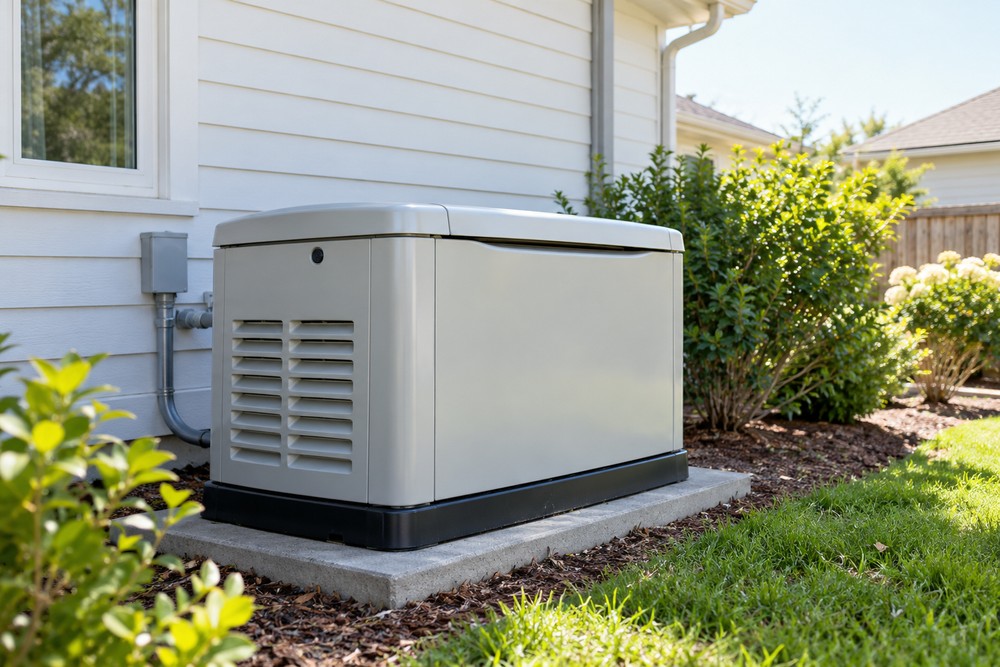
Here’s the thing nobody told her, and nobody tells most homeowners: the decibel rating on a spec sheet describes a machine running in a controlled test. What shows up in your yard depends on engine size, the enclosure around it, and how far the thing sits from the wall of your bedroom. Those three variables swing the lived experience more than the brand badge on the front panel. That question homeowners keep searching, whether are generac generators loud, has a more useful answer than a single figure, and it sounds different depending on where you’re standing.
I’ve stood in a lot of backyards while a standby unit cycled through its weekly exercise run. Some were barely noticeable from the patio. One sounded like a riding mower idling on the other side of a hedge. Same category of equipment, wildly different results. So let’s walk through what actually drives the noise, what your placement options are, and where I’d land if it were my house.
What 60 to 70 Decibels Actually Sounds Like in Your Yard
If a reading of 65 dB sounds abstract, it helps to anchor it to sounds you already tolerate without thinking. A running dishwasher sits right around that range. Normal conversation between two people lands there too. According to the Centers for Disease Control and Prevention, ordinary conversation and household appliances fall in the 60 to 70 dB range, which is why a standby generator running at spec feels less intrusive than most people fear before they hear one.
Now put yourself 20 feet away. Sound falls off with distance, so the number at your window is lower than the number at the enclosure. If you’re standing directly beside the unit, you’ll hear it clearly. From a kitchen window across the lawn, you’ll notice a low, steady hum, the kind that fades into background noise within a minute or two. From inside the house, with the AC running and a TV on, most folks stop registering it entirely.
That’s the honest answer, and it’s less dramatic than the fear. A standby generator at proper distance is a presence, not an event.
Why Two Identical Units Can Sound Completely Different
Engine displacement is the first lever. A unit sized for a whole house carries a bigger engine than one backing up a few circuits, and bigger engines move more air and more combustion. A 22 kW and a 10 kW unit from the same product line do not sound the same at the fence line.
The enclosure is the second lever, and honestly the one I’d pay the most attention to.
Manufacturers line these boxes with sound-dampening material, and the difference between a cheap enclosure and a proper one is audible from the driveway. If you’re comparing two units at similar price points, ask what’s inside the housing.
Third is maintenance condition, which is the factor people ignore for three years and then wonder why the machine got loud. An engine running with old oil, a clogged air filter, or worn vibration mounts will produce more racket than the same model serviced on schedule. Noise is often the first symptom of a maintenance problem, which makes it a useful early warning if you’re paying attention.
Fourth is the weather and the load. Cold starts are louder. A unit carrying a heavy load during a summer outage runs harder than one idling through its weekly test.
A Decibel Field Guide You Can Use Before You Buy
Rather than chase a spec sheet number, compare candidate units against sounds you already live with. I keep this rough map handy when talking with homeowners.
| Everyday Sound | Approximate Level | Standby Generator Comparison |
|---|---|---|
| Refrigerator hum | 40 to 50 dB | Quieter than any active unit |
| Normal conversation | 60 to 65 dB | Typical standby range at the enclosure |
| Dishwasher running | 65 to 70 dB | Upper end of the standby range |
| Vacuum cleaner | 75 to 80 dB | Portable and some competing units |
| Lawnmower at close range | 85 to 90 dB | Not typical for a serviced standby unit |
Noise and sound measurement rest on established standards work, and the National Institute of Standards and Technology maintains the reference framework behind how decibels are defined and compared. If you want to sanity check any claim you read, that’s the ground floor.
How Close Is Too Close? A Placement Decision Guide
This is where you actually control your outcome, and it’s the part I’d spend the most time on if we were standing in your yard together.
- Measure from your bedroom window, not your property line. Distance to the nearest sleeping room matters more than distance to the fence.
- Aim for at least 20 feet from windows when the site allows it. Every additional few feet of separation buys you real quiet.
- Use what’s already there. A hedge, a privacy fence, or a shed wall between you and the unit knocks down perceived noise more than most people expect.
- Keep clearances intact. Blocking airflow to chase quiet is a bad trade and your installer will tell you the same thing.
- Check local setback rules early. Municipal codes vary, and discovering a constraint after the concrete pad is poured is an expensive lesson.
Dana ended up moving her unit about 15 feet further from the shared fence and letting an existing row of podocarpus do some of the work. Six months later she told me she forgets it’s there until the weekly test kicks on.
The Neighborhood Scenario Nobody Plans For
Here’s the texture that spec sheets miss. Generators make the most noise during an outage, which is exactly when everyone in the neighborhood is outside, standing in their driveways, and already irritable about the power being out. That’s the moment your unit gets its public debut.
A unit running at a steady 65 dB from your side of the fence reads very differently to a neighbor standing on the other side of it. This is why I’d rather have an honest conversation with the people who share a property line before installation day than apologize afterward. Mention the weekly test schedule. Tell them roughly what to expect. Most people are fine once they know it’s normal, brief, and not a sign something’s broken.
The Three-Foot Test: before you commit to a placement, stand where your neighbor’s kitchen window sits and imagine the unit running. If you’d be annoyed there, they will be too. It’s the cheapest site survey you’ll ever run, and it takes about two minutes.
Lowering the Noise After Installation
If the unit is already in the ground and you want it quieter, you have options that don’t involve replacing equipment. Schedule the annual service, because a tuned engine runs measurably smoother than a neglected one. Replace worn vibration isolators. Confirm the enclosure panels are seated properly with no gaps or loose fasteners, since a rattling panel can be louder than the engine itself. The U.S. Department of Energy publishes general guidance on home backup power decisions if you want to understand the broader equipment landscape before you start calling installers.
I’d also time your weekly exercise cycle. Most units let your installer set the day and hour. Saturday at 8 a.m. is a different experience than Tuesday at 10 a.m. when the neighborhood is at work. It’s a small setting with an outsized effect on how your generator is perceived.
None of this is complicated. It’s just rarely explained in one place, because the industry sells kilowatts and everyone treats noise as an afterthought.
What to Do Next
The short version: a properly placed, properly maintained standby generator lands in the same noise neighborhood as your dishwasher, and you have more control over that than any brochure suggests. Engine size sets the floor. The enclosure does quiet work. Maintenance keeps it that way. Distance and barriers do the rest, and they’re free.
If you’re still deciding, spend a Saturday standing where you’d actually notice the sound, at the times you’d actually be home. That single exercise answers more than any comparison chart. Where would you put yours, and have you stood on the neighbor’s side of the fence yet?