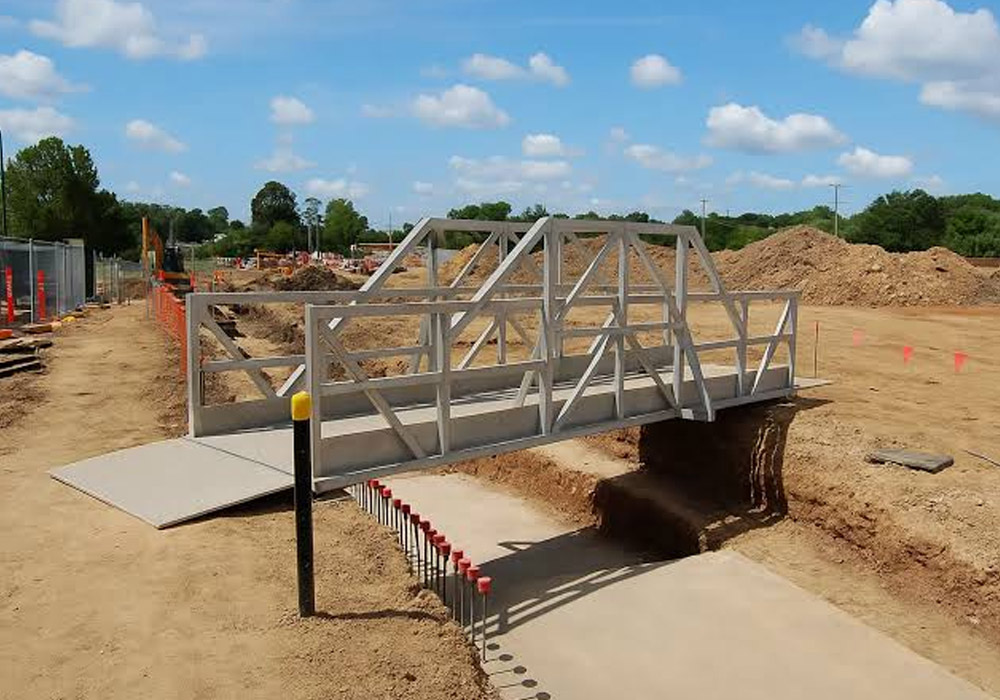
A temporary site access bridge quote is only meaningful when its scope is clear. The hire rate may cover the structure, while design, supports, delivery, installation, inspections, and removal appear elsewhere. For UK contractors and site managers, budgeting the complete crossing is more useful than comparing weekly rates in isolation.
The main cost factors are connected. A change in traffic needs may alter the bridge specification, which can affect transport and lifting arrangements. Establishing those dependencies early makes competing proposals easier to compare.
The span and usable width
The distance to be crossed is a starting point, but it is not necessarily the final structural span. Suitable support locations, bank conditions, and clearance requirements all need professional assessment.
Width should describe the usable route, not just an overall deck dimension. A single-lane crossing, two-way access, and a route with separate pedestrian provision are different requirements. Barriers and other features must be considered when establishing the available running space.
Ask suppliers to explain the dimensions assumed in their proposals. A lower-priced option is not equivalent if it depends on a narrower route or a support position that the site cannot accommodate. Resolve those differences before comparing totals.
The actual traffic requirement
A statement such as “suitable for construction vehicles” leaves too much open to interpretation. The design team needs information about the traffic expected to use the crossing, including relevant vehicle configurations and operating conditions.
Gross weight alone does not describe every loading effect. Axle arrangements, tracked plant, frequency of use, and whether vehicles may meet on the bridge can influence the engineering assessment. Pedestrian access and separation from moving equipment also need a place in the brief.
Provide the anticipated traffic information to the appointed professionals rather than selecting a capacity by guesswork. If the project’s requirements may change, ask how potential changes would be reviewed and priced before different vehicles use the bridge.
Ground conditions, supports, and approaches
The bridge needs suitable supports and a usable route onto each end. Ground conditions, bank stability, levels, and water behavior can affect the supporting works and the information needed to design them.
Check whether the price includes investigations, foundation or abutment design, earthworks, and approach construction. Also establish who provides drainage, any required erosion protection, and preparation of installation working areas. These are project-specific items, not details that should be assumed to fall within standard hire.
Unresolved ground information should be identified in the estimate. Ask what assumptions the quotation uses and how a different finding would affect the scope. That is more useful for budgeting than a firm-looking total built on unspecified conditions.
Delivery and installation access
The route to the site matters as much as the gap being crossed. Restricted entrances, tight turns, overhead services, limited storage, or unsuitable working areas may change how components are transported and assembled.
Installation costs depend on the proposed method, equipment, access, and sequence. Ask who is responsible for assessing those requirements and providing any necessary temporary works. Do not assume transport, cranage, traffic management, and installation labor are all included in the same line item.
A supplier discussion should also cover disruption to neighboring routes and any restricted working windows. If an installation depends on a closure or third-party access, its availability needs to be reflected in both the schedule and the quotation.
Hire duration, inspections, and changes
Separate one-time costs from charges that depend on the hire period. Design input, initial delivery, installation, and eventual removal may be priced differently from the recurring hire charge. A longer rental can therefore change the total and the effective weekly cost without necessarily bringing a discounted rate.
Check the minimum hire period, extension terms, and notice required to end the rental. Project delays can affect how long the crossing remains in place, so test the budget against a realistic extension scenario.
Clarify inspection and maintenance responsibilities as well. The agreement should explain who monitors the bridge and its approaches, who responds to damage or changing site conditions, and what work falls outside the hire price.
Permissions, removal, and reinstatement
Depending on the site, a temporary crossing may involve landowner agreements, watercourse or environmental requirements, highway arrangements, or coordination with other infrastructure operators. Relevant advisers should establish what applies and who will manage it.
Removal deserves its own plan and budget. Ask whether the quote includes dismantling, lifting, return transport, removing temporary supports, and restoring affected land. Equipment access available at the start may be obstructed by later construction, so consider how the bridge will leave the finished site.
Reinstatement expectations should be written down. Otherwise, “removal included” may still leave disagreement over earthworks, surfacing, drainage, or the condition in which the land must be returned.
Compare complete scopes, not isolated rates
When requesting proposals from specialists such as Beaver Bridges, issue the same site information and traffic brief. Request an itemized scope showing inclusions, exclusions, assumptions, recurring charges, and responsibilities.
Build a comparison that accounts for work retained by the client or another contractor. This exposes gaps without assuming a single supplier must perform everything. The best basis for a temporary bridge budget is a clearly defined crossing, with each cost and interface assigned to someone.