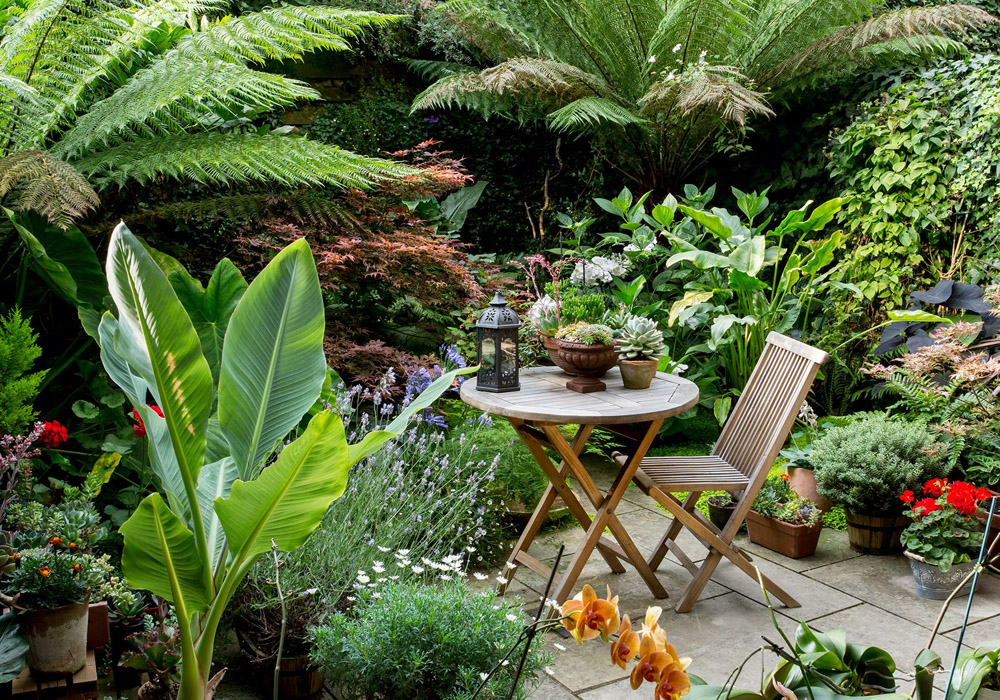
Many suggestions for low-maintenance gardens recommend you strip the site bare and stick in a bunch of cactus. The real secret to a low-maintenance garden is the opposite, a solid permanent hardscape (structure), and then get really ruthless about which plants you invite into your paradise. A garden renovation done this way doesn’t look stripped back – it looks architect-designed, and it continues looking fabulous through every season with no effort on your part.
Luxury comes from structure, not flowers
Take a stroll through a garden that looks luxurious, and you’ll quickly realize something: the flowers are seldom the main attraction. The true highlights are the paving design, the well-constructed lines of the retaining walls, the perfect alignment of a path with a house’s back door, the uniform use of materials from the property to the border fences. Flowers may bloom and wither, but the underlying structure remains.
This factor is also key in terms of upkeep, as well-designed structure does not demand your constant intervention. A limestone paver will not cry out for your attention every seven days. A raised bed incorporating timber cladding will not collapse in the face of extreme summer temperatures. If you spend time planning the bones of your garden first – hardscaping, elevations, lines of sight, geometry – you will already have made 80 per cent of the right aesthetic choices before the work of planting anything even begins. Then it is just decoration, not foundation.
What most people do is in the wrong order. They buy the plants first, find they don’t provide enough coverage for a seating area, and fix that with some extra paving – thus, making themselves a garden that needs fixing all the time. If you do it the other way around, the entire garden is easier to maintain.
Shrink the plant list, not the garden’s impact
A garden with forty different species looks busy, not luxurious. One with six species, each planted in generous repeated drifts, looks designed. This is one of those design rules that sounds counterintuitive until you see it: restriction creates the illusion of intention, and intention is what reads as expensive.
It also solves your maintenance problem almost by accident. Six species means you learn six watering patterns, six pruning schedules, six pest profiles. Forty species means forty of everything, and inevitably a few of them die, get leggy, or need replacing every year. A restricted palette is a maintenance decision disguised as a style choice.
Pick plants that work together structurally – a strappy grass, a rounded shrub, a vertical accent, maybe one flowering layer – and repeat them in blocks along the garden. Mass planting isn’t a compromise. It’s what resort landscapers and high-end residential designers do because it’s reliably good-looking and reliably cheap to run.
Evergreens are doing more work than you think
Most people tend to overlook this aspect: planting for winter. A garden with deciduous shrubs and seasonal perennials may look amazing in October, but it will resemble an empty lot in July. The twiggy and bare appearance makes a garden seem neglected, even if it’s not. This is the biggest clue that a garden was not planned but rather planted.
The solution is straight-forward: roughly 80% of what you plant should be evergreen or have a structure that persists. The other 20% are the seasonal blooms. With this ratio, your garden will look good all year round. It might just have its slightly different character as the seasons change.
In this context, ornamental grasses are something to consider. They will appear to be alive even when they are dormant. The straw-colored winter phase of ornamental grasses will still have texture and movement. This is perceived completely different than bare soil or dead annuals.
Infrastructure is what makes any of this hold up
None of the above survives bad drainage. This is the part that gets ignored because it’s invisible once the project is finished, but it’s the actual determinant of whether your low-maintenance garden stays low-maintenance for ten years or falls apart in two.
Poor grading causes water to pool against foundations, paving to heave, and root zones to sit waterlogged until plants that should have lived for decades start dying for no obvious reason. Permeable paving and proper subsurface drainage prevent all of that, but they have to be designed in during the renovation phase, not patched in afterward. Fixing drainage after the fact usually means pulling up the hardscaping you just paid for.
This is the stage of a backyard renovation where it’s worth bringing in people who do this for a living. Good Sydney landscapers will grade the site, install proper drainage, and set up irrigation zoning before anything decorative goes in, which is the difference between a garden that genuinely runs itself and one that needs constant correction because the foundations were never right. Soil preparation matters here too – compacted or poorly amended soil is why fast-growing exotic plants end up in a loop of feeding, pruning, and replacing that no amount of plant selection discipline can fix.
Get rid of most of the lawn
The lawn represents the single highest-maintenance element in most people’s backyards, and it’s rarely the part anyone is actually using. The weekly mow, edge, feed, and water it requires often adds up to more labor than the entire rest of the garden.
Shrinking the lawn footprint (or eliminating it in favor of large format paving, gravel, or a no-mow turf alternative like fescue or a clover blend) accomplishes two things at once. It takes away the weekly chore, and it instantly makes the space look more thoughtfully designed. A compact courtyard of gravel with a single specimen tree reads as resort-grade. A big, patchy lawn with mower stripes reads as suburban maintenance. If you legitimately need grass (like, you have kids or dogs), keep a smaller, well-defined panel of it rather than just defaulting to it sprawling across the whole yard.
Irrigation is the chore you can engineer away
Watering plants by hand is a seemingly small but time-consuming chore in a garden that can be easily eliminated completely. Landscape irrigation uses up almost a third of all residential water in the US, and the EPA says that’s about 9 billion gallons a day – much of it lost to overwatering or runoff from inefficient systems. Drip irrigation alone can save 20-50% of that.
The trick is hydrozoning: grouping plants by water need and then running a separate drip line for each group, rather than one sprinkler system trying to provide equally for all of them. Your Mediterranean plants – lavender, rosemary, olives – want infrequent deep watering. Your shade ferns want something different entirely. Put them on the same zone and one of them will suffer. Put them on separate zones with a smart controller that adjusts for rainfall and season, and you’ve removed the biggest recurring task in the entire garden without lifting a hose again.
Light it instead of planting it
Outdoor lighting is the cheapest way to add perceived value to a garden with zero ongoing plant maintenance. Low-voltage LED path lights, uplighting on a specimen tree, a wash of warm light across a feature wall – all of it runs on a timer and needs almost no attention beyond the occasional bulb swap.
Lighting also does something plants can’t: it extends the hours the garden is actually usable. A space that looks good at 9pm reads as considerably more valuable than one that only works in daylight. If you’re choosing where to spend budget in a renovation, lighting consistently punches above its cost.
Pick your one seasonal indulgence and stop there
You don’t need an annual bed to get seasonal colour. In fact, annual beds are the worst choice if you’re looking to reduce ongoing work: they need replanting two or three times a year, which means ongoing labour and a relatively high ongoing cost for a short payoff.
Instead, pick one high-impact feature and let it carry all your seasonal interest: a single ornamental tree with a strong flowering or colour-change moment, a large planted urn near the entry, or perhaps a container display you swap twice a year. Everything else in the garden stays fixed and evergreen. This gives you the seasonal ‘wow’ moment without multiplying your workload across the whole yard.
Right plant, right place, every time
A lot of ongoing maintenance is there simply because the wrong plant was in the wrong spot. A shrub that wants full sun planted in shade will stretch and thin, always needing constant correction. A tree that reaches eight meters planted a meter from a fence will need to be cut back constantly for its entire life.
Specify plants for their mature size and their actual sun exposure, not how they look in a four-liter pot at the nursery. It’ll look a little sparse in year one. By year three it looks exactly as intended, and it stays that way without a pruning war every spring.
A garden built this way doesn’t feel like a sacrifice. It feels like someone made deliberate decisions and then let the materials and the plant choices do their job. That’s the whole philosophy: decide in advance what you refuse to manage, build the structure so it doesn’t need managing, and spend your actual time enjoying the space instead of fighting with it.