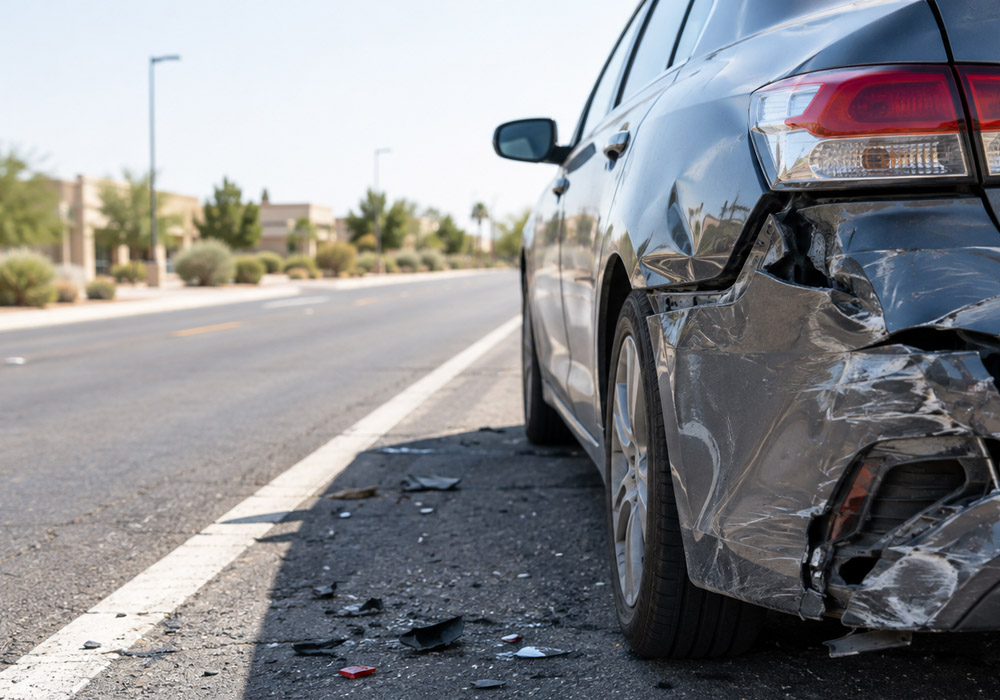
Your deductible usually hurts more than your premium does. That surprises people. Most Arizona drivers assume a hit-and-run goes straight into their file as a black mark, and their renewal notice shows up with a punishment attached. Usually it doesn’t work that way.
The short answer: it depends far more on who was at fault, what coverage you use, and your own claims history than on the fact that the other driver took off. A not-at-fault claim sits in a very different box than one where your own driving is the reason the insurer paid out. Arizona is also an at-fault state, which shapes the whole picture.
If you’re trying to figure out will a hit-and-run claim raise my insurance, the honest answer is maybe, and the reasons are more mechanical than you’d think. Here’s what actually moves the number.
Fault is the switch that flips everything
Carriers price risk. That’s the entire business. When someone else causes the crash, you’re not a riskier driver, you’re just unlucky, and insurers know the difference. A hit-and-run where you did nothing wrong typically gets coded as a not-at-fault claim, and many carriers treat those as a non-event at renewal.
Where it gets murky is the word “typically.” There’s no federal rule that forces your insurer to ignore a not-at-fault claim. Some companies forgive the first one and surcharge the second. Others look at three years of history. A few quietly weigh the dollar amount, so a small repair breeze through and a totaled vehicle does not.
Here’s the part I’d tell a friend: read your own policy’s renewal section before you assume anything. It’s usually four or five paragraphs buried near the back, and it tells you more about your future rate than any blog post can.
Two coverages, two very different outcomes
What you file under matters as much as who was at fault. Arizona drivers generally have two paths when the other car disappears.
- Collision coverage: Pays to fix your car regardless of fault. Your deductible applies, and a collision claim is the one most likely to nudge your rate.
- Uninsured motorist coverage: Exists precisely for the driver who hits you and vanishes. It can cover your injuries and, depending on your policy, property damage too.
The catch with uninsured motorist coverage is that Arizona doesn’t require it on every policy. Plenty of drivers carry the legal minimum and nothing else, then discover after a crash that the hit-and-run driver left them with no one to bill. According to the National Highway Traffic Safety Administration, hit-and-run crashes have been a persistent and growing share of fatal crashes nationwide, so this isn’t a rare edge case you can safely ignore.
I’d take uninsured motorist coverage over a slightly lower collision deductible every time. You can save up for a deductible. You can’t retroactively buy coverage for a crash that already happened.
Does an Arizona hit-and-run claim follow you to a new insurer?
Yes, and this is where people get blindsided. Carriers share claims data through industry databases, so switching companies after a claim doesn’t erase the record. What matters is how the claim is coded. A not-at-fault notation reads very differently to an underwriter than an at-fault one, even if the payout was identical.
The Insurance Information Institute notes that premiums reflect a company’s own loss experience and underwriting rules, which is why two carriers can quote the same driver hundreds of dollars apart. Shopping around after a not-at-fault claim isn’t disloyal, it’s just math.
One warning: don’t cancel your current policy before a new one is active. A lapse, even a short one, does more damage to your rate than most claims do.
What Arizona law actually says
Leaving the scene of an injury crash in Arizona is a criminal matter, not a traffic ticket. The Arizona State Legislature sets the duty to stop, give information, and render reasonable assistance, and failing to do so carries real consequences. That criminal exposure is one more reason a fleeing driver rarely turns up later with a valid policy to pay your claim.
| Type of claim | Likely effect on your rate
|
| Not-at-fault, other driver identified | Usually none or minor |
| Not-at-fault hit-and-run, UM claim | Often none, varies by carrier |
| At-fault collision claim | Typically a clear increase |
| Multiple claims in three years | Increase likely regardless of fault |
That table is a general pattern, not a promise about your renewal notice. Underwriting rules vary by company and by state filing, and yours controls.
A step by step plan for the week after
Most rate damage gets locked in during the first few days, when emotions run high and paperwork gets sloppy. Here’s the order I’d work in.
- Call the police and get a report on file, even if the other car is long gone. The report is your proof this wasn’t your fault.
- Photograph everything before you move the car, including the surrounding intersection and any debris.
- Look for witnesses and business cameras. Gas stations and corner stores keep footage for a limited window, so ask early.
- Notify your insurer promptly. Policies contain notice requirements, and late reporting gives a carrier room to push back.
- Ask which coverage the claim is being filed under, collision or uninsured motorist, and write down the claim number.
- Get your own repair estimate, not just the shop your insurer prefers.
Step five is the one people skip. The coverage code is the single biggest factor in whether your rate moves, and you’re entitled to know it.
The mistake that costs the most
Skipping the claim to protect your premium. I understand the instinct, and I think it’s usually wrong. A hit-and-run driver who’s never caught means there’s no other policy to pursue, and paying out of pocket for body work, a rental car, and a medical exam adds up fast. Saving a modest renewal increase by absorbing thousands in repairs is a bad trade.
What actually protects you long term is boring: keep uninsured motorist coverage, stay claims-free on the at-fault side, and shop your policy every couple of years. Your rate is a snapshot of your record, and records improve with time.
So no, a hit-and-run claim won’t automatically raise your insurance in Arizona. Fault, coverage type, and your history do the real work, and you have more control over all three than the phrase “hit-and-run” suggests. Pull out your declarations page today and check whether uninsured motorist coverage is listed. If it isn’t, that’s a fifteen minute phone call that could save you a five figure headache later.