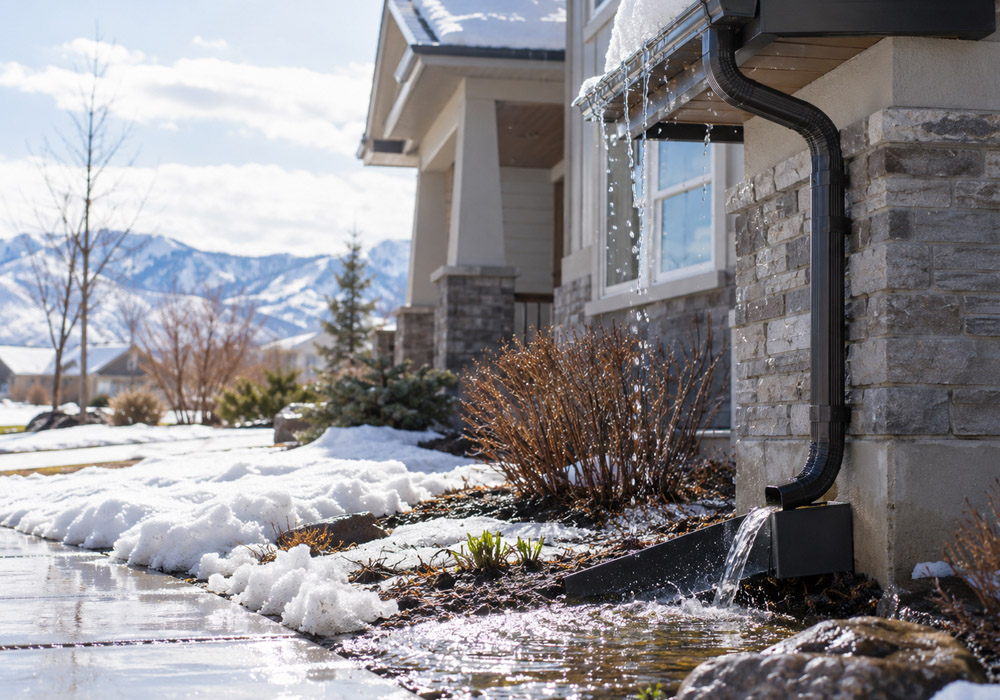
Every March, homeowners along the Wasatch Front watch the same thing happen. Days hit the fifties, the snowpack on the roof starts dripping, and by the second afternoon you can hear water running somewhere it shouldn’t. I’ve stood in enough driveways in this valley to know that sound means one of two things: your drainage system is doing its job, or you’re about to fund a foundation repair.
The thaw is the single hardest test your home’s water management will face all year. It arrives fast, it runs for weeks, and it hits a system that spent four months frozen and buried. Most people don’t think about it until the damage is already visible, which is exactly backwards.
Why the spring thaw hits harder than a summer storm
A July thunderstorm dumps water on your roof for twenty minutes and then it’s over. Snowmelt is a slow bleed that lasts for days or weeks depending on elevation and how warm the afternoons get. The National Weather Service tracks snowpack and river forecasts through exactly this period, and the general pattern holds every year in northern Utah: the pack ripens, releases over an extended window, and the ground underneath is often still frozen.
That frozen ground is the part people miss. When soil is locked solid, meltwater can’t soak in. It has to go somewhere, and if your roof drainage isn’t moving it cleanly away from the house, it pools against the foundation, seeps into window wells, and finds every crack in a basement wall. You get the same volume as a heavy rainstorm, delivered over three weeks instead of twenty minutes, with nowhere for it to drain.
So the question isn’t whether your system can handle a storm. It’s whether it can handle sustained flow while the ground beneath it is essentially a concrete slab.
Five warning signs that show up before the damage does
You can catch almost every failure in the weeks before it costs you real money. Walk your property on a warm afternoon in late winter and look for these.
- Icicles hanging from the gutter line, not the roof edge. Ice forming on the gutter itself usually means water is sitting in the channel instead of draining.
- Staining or peeling paint on the fascia board behind the gutter. That’s overflow running down the back of the system, and it’s been happening for a while.
- Daylight visible through the gutter hangers when you look up from the ground. The run is pulling away from the roofline, which means it’s holding water weight it wasn’t built to hold.
- A waterfall off one corner instead of a stream down the downspout. A clog near the outlet, almost always at a bend or an elbow.
- Damp spots or white mineral staining on the basement wall below grade. Water is already reaching the foundation.
Two of those five are worth acting on immediately. The fascia staining means ongoing rot behind the gutter, and rot is the expensive kind of problem. Anything at the foundation level means you’ve already lost the season.
What the drainage chain actually looks like
People talk about gutters like they’re a single product. They’re not. The system is a chain, and it fails at whatever link is weakest.
The chain runs roof surface to gutter channel to downspout to discharge point to grade. Water lands on shingles, flows into the channel, drops through the downspout, exits at the bottom, and then has to travel away from the house on a slope that carries it past the foundation. Break any link and the rest of the system turns into an expensive funnel pointed at your basement.
Here’s what I’d tell a neighbor: the discharge end is the link most homeowners never look at. People clean the gutter every fall, keep the downspout clear, and then let the water dump three inches from the foundation wall onto soil that slopes back toward the house. The whole system works perfectly and the water still ends up where you don’t want it.
According to the Federal Emergency Management Agency, a surprisingly small amount of water pooled against a foundation is enough to cause structural problems over time. That’s a baseline anyone who owns a home in a freeze-thaw climate should sit with for a minute.
Are bigger gutters always the answer?
No, and this is where a lot of money gets wasted. Oversizing a channel without addressing the downspout count, the hanger spacing, or the discharge point just gives you a bigger bucket with the same drain.
What actually matters in a snow-load climate is a mix of things most installers gloss over when they quote you a number.
| What gets quoted | What actually determines performance
|
| Channel width | Hanger spacing and how the run is fastened to the fascia |
| Total linear feet | Number and placement of downspouts relative to roof valleys |
| Material gauge | Slope of the run toward each outlet |
| Seam or seamless | Where the water lands after it leaves the pipe |
I’ve seen narrow channels on a steep roof outperform wide ones on a shallow roof, purely because the downspouts were positioned under the valleys where the water actually concentrated. Placement beats size. Slope beats size. Discharge beats size.
The Environmental Protection Agency’s guidance on managing runoff around residential property makes the same point in different language: the goal is directing water to a controlled location, not simply moving it off the roof. If you take nothing else from this, take that framing. You’re not buying a channel. You’re routing a flow.
A simple checklist for the week before the thaw
You don’t need a contractor for most of this. Set aside an afternoon when the roof is clear of snow and the temperature is above freezing.
- Clear the channels by hand or with a scoop. Don’t pressure wash a frozen or brittle run.
- Run a hose from the top of each downspout and confirm water exits at the bottom within a few seconds.
- Check every elbow and transition for gunk caught at the bend. That’s where clogs start.
- Stand at each discharge point and watch where the water goes. If it moves toward the house, that’s your project.
- Look at the fascia behind the gutter with a flashlight. Soft wood or peeling paint means rot is underway.
- Confirm extension pieces or splash blocks are actually attached and not lying in the yard after winter.
If you find a run that’s pulling away from the house, or a fascia board that gives when you press it, stop and get someone out to look. That’s past the DIY stage.
For anything beyond a clog, homeowners in this part of Salt Lake County usually end up calling a specialist, and gutters in West Jordan are one of those jobs where the local weather pattern genuinely changes what a good install looks like. Someone who works this valley every year knows how much snow load a run has to survive and how the freeze-thaw cycle treats different fastening methods. That’s not something you can read off a product spec sheet.
Two things worth doing before next winter
First, get the discharge points right. This is the cheapest fix with the biggest effect, and it takes an afternoon. Extend every downspout so water lands at least several feet from the foundation, and check that the soil under it slopes away rather than back toward the wall.
Second, write down what you found this spring. Note which runs overflowed, which downspouts clogged, and where the water pooled. Next fall, that list tells you exactly where to look, and it tells anyone you hire where the problems have been recurring. Most homeowners start from zero every year because nobody wrote anything down.
Spring is going to come whether your system is ready or not. The difference between a minor cleanup and a five-figure foundation repair usually comes down to one afternoon of looking at the right places. So here’s the question worth asking yourself right now: when the melt starts this year, do you know where your water is going to end up?



