A $500 deductible feels like nothing until you find out the actual repair runs $12,000. Then the real question shows up: is this damage big enough to bother your carrier, or are you about to file a claim that costs you more in future premiums than it pays out?
That is the decision most Houston-area homeowners get wrong, and it has nothing to do with how hard the wind blew. It has to do with what you can prove, what your policy actually covers, and what your roof looked like before the storm rolled through.
So here is what I have learned watching roofs get inspected, denied, and replaced across Spring, Klein, and The Woodlands: the paperwork matters as much as the shingles. You will learn the four things adjusters look for, the documentation timeline that decides most claims, and how to tell the difference between a repair you can schedule and a replacement you need to start planning.
What Does Real Storm Damage Actually Look Like?
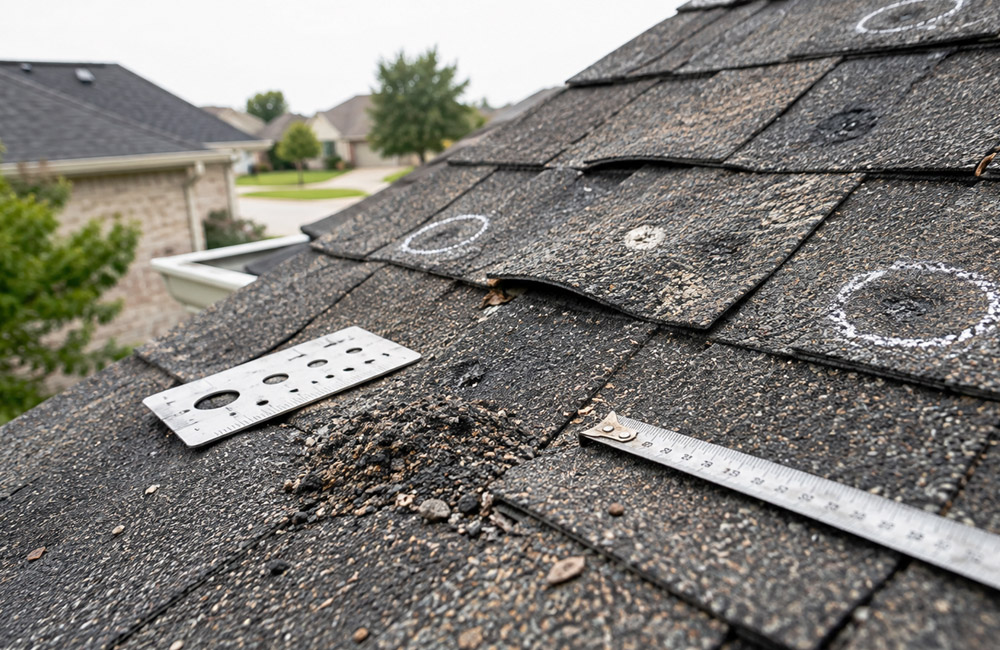
Most storm damage I see from the curb is invisible. A missing shingle is the easy one. The expensive damage hides in the granular coating on your shingles or in the soft metal flashing around your chimney.
Walk your yard after a storm and look down first. Granules in your gutters or scattered across the driveway mean the protective surface of your shingles is wearing off faster than it should. That matters because granules are what block ultraviolet light from eating the asphalt underneath.
Then look up, but not at the whole roof. Focus on three spots: the ridge line, the valleys where two roof planes meet, and anything within a few feet of a vent, skylight, or chimney. Those are the weak points where wind gets a grip. Hail hits harder on south and west-facing slopes in this part of Texas, so if you have damage anywhere, start there.
Inside the attic, grab a flashlight and check the underside of the roof deck after a heavy rain. Brown rings, dark streaks, or daylight showing through nail heads all point to water getting past the surface. Small leaks like these can rot decking long before they show up as a ceiling stain in your hallway.
When Spring Weather Turns Ordinary Storms Into Roof Killers
Spring sits in a stretch of Texas where hail and straight-line winds overlap with Gulf moisture, which is a rough combination for asphalt shingles. The National Weather Service tracks severe thunderstorm and hail activity across Harris and Montgomery counties every season, and the pattern holds: this region gets pounded repeatedly rather than once.
Repeated small hits are worse than one big one. A roof that shrugged off a hailstorm in April may fail after a similar storm in June, because the first round bruised the shingles and the second round finished them. That is why an inspection after every major storm beats waiting until you see a leak.
Heat adds another layer. Attic temperatures in a Texas summer can push past 140 degrees, and that heat stress makes brittle shingles crack along the edges. If your roof is already fifteen years old, you are starting each storm season with less margin than your neighbor with a five-year-old roof.
The Documentation Window Most Homeowners Miss
Here is the part that decides claims: timing. Once you file, your insurer wants evidence that the damage came from a specific dated event, not from neglect over the last four years. Every day you wait, that gets harder to prove.
Photograph everything within 48 hours of the storm. Wide shots of the roof from the ground. Close shots of anything dented, lifted, or missing. Pictures of downed limbs, dented gutters, and hail piled against the fence line. If your neighbor’s roof is visibly damaged and yours is not, that is worth noting too, because it establishes the storm hit your block.
Keep a written log: date, time, what you saw, who you talked to. If you call a roofer first, save their written findings even if you do not hire them. An independent inspection report dated two days after the storm carries real weight when an adjuster shows up three weeks later.
The Texas Department of Insurance publishes plain-language guidance on how claims and inspections are supposed to proceed in this state, and it is worth twenty minutes of your evening before you sign anything.
My Three-Part Test for Skipping the Claim
I would not file on every dent. Here is the filter I have watched hold up in practice.
Scope. Is the damage confined to one slope, one penetration, or a handful of shingles? A localized repair under your deductible is your money, not your carrier’s, and paying it yourself protects the claims history that keeps your premium down.
Age. A roof past the halfway point of its rated life is a coin flip for a full payout anyway, because insurers apply depreciation and often pay actual cash value rather than replacement cost. On an old roof, the check after depreciation may not cover much.
Pattern. One storm, one claim, no problem. Three claims in four years and you become a risk your carrier would rather not keep, even if every claim was legitimate.
If the damage fails all three, pay the roofer and move on. If it passes two, call your agent and ask a direct question: how would this claim affect my policy at renewal? They will tell you more than you expect.
Step by Step: From Storm to Finished Repair
- Wait for the storm to pass, then photograph the exterior of your home from the ground, including gutters, siding, and fence.
- Check the attic for water stains or daylight after the next rain.
- Post-storm, an experienced team can handle storm damage repair in Spring and document what the untrained eye usually misses. Get the inspection in writing, with photos attached.
- Read your policy’s deductible, which in Texas is often a percentage of your home’s insured value rather than a flat dollar amount.
- Decide whether to file, then notify your insurer promptly if you do.
- Get your own contractor estimate before the adjuster arrives so you can compare numbers on the same scope.
- Never sign a contract that assigns your claim rights to a contractor, and never pay in full before the work is finished.
One practical note: storm chasers show up in this region after every big event with out-of-state plates and cash-upfront offers. A local crew that will still be answering the phone in three years is worth waiting an extra week for.
Repair Now, Replace Later: How to Decide
The Federal Emergency Management Agency treats roof damage as a leading source of long-term water intrusion in homes, which is the real cost of waiting. A repair handles a defined problem. A replacement becomes the answer when damage covers more than roughly a third of the roof, when the decking underneath is soft, or when you are looking at a third round of repairs on the same slopes.
Roofing felt underlayment and flashing details also age out. If your shingles are fine but the underlayment is shot, patching the surface just postpones the leak. Any honest inspection should tell you which layer is failing, not just what the surface looks like.
One Last Thing About Texas Claims
You have a deadline in this state, and it is shorter than most homeowners assume. Texas law generally gives you one year from the date of loss to file suit over a claim dispute and two years to file a breach-of-contract claim, but notice requirements in your policy can be tighter. Read that section before you assume you have time to think about it.
Whether your damage is worth a claim depends less on the storm than on your documentation, your roof’s age, and your willingness to read the fine print. Take the photos this week. Ask your agent the hard question. Then decide with numbers in front of you instead of guessing from the driveway.