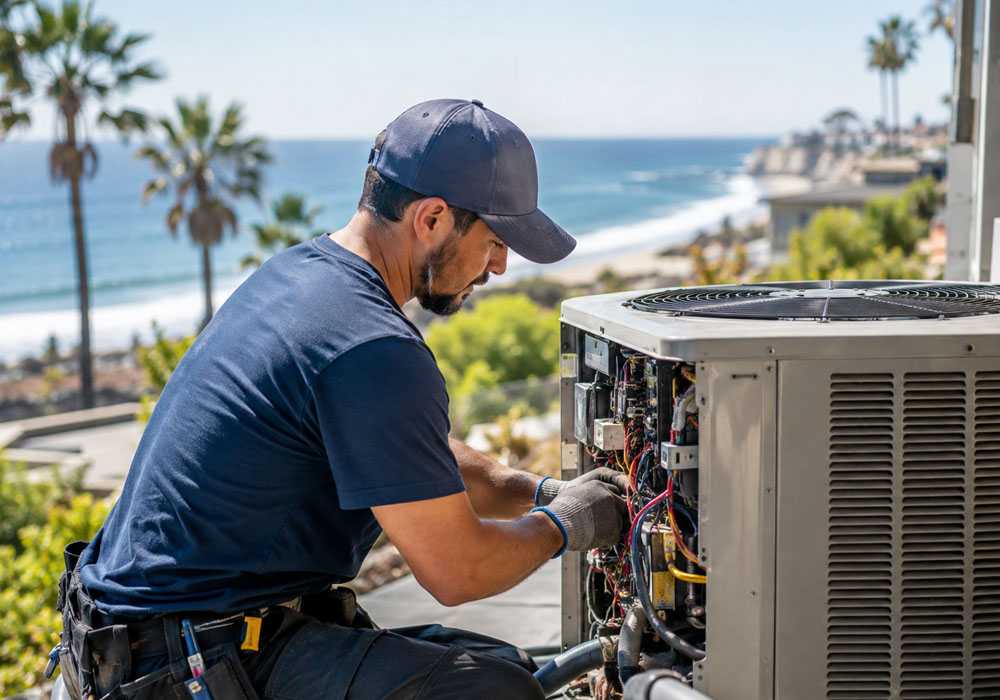
Homes along the North County coast face a unique combination of cool, damp mornings and sunny afternoons filled with salt-laden air. These conditions can make air conditioners behave unpredictably. Rooms may feel clammy even when the thermostat reads 72 degrees, outdoor condensers can corrode faster than expected, and systems may cycle on and off so frequently that comfort and efficiency suffer. The good news is that thoughtful decisions involving equipment sizing, airflow, placement, filtration, and maintenance can significantly reduce these problems. This article explains how marine conditions affect AC performance and what homeowners can do to help systems operate longer, quieter, and more effectively.
Sizing for Marine Layer Mornings and Warm, Dry Afternoons
Many homes near the coast have cooling equipment that is larger than the actual load requires during mild, overcast mornings. Oversized systems can lower the indoor temperature quickly and shut down before the evaporator coil has enough time to remove significant moisture.
This short cycling can leave rooms feeling sticky, increase compressor starts, and add wear to electrical and mechanical components. A proper Manual J load calculation is a better starting point than relying on simple square-footage rules.
If your home has large west-facing windows, limited shading, an unconditioned attic, or other significant sources of heat gain, include those factors in the calculation. A qualified Oceanside Air conditioning contractor can also use Manual S principles to help match the calculated load with equipment that provides appropriate capacity under changing coastal conditions.
Variable-capacity or two-stage equipment paired with a properly configured blower can be useful in coastal climates because the system can run longer at lower output when sensible heat is modest but humidity remains elevated.
Longer cooling cycles may improve moisture removal because the evaporator coil stays cold long enough for more water vapor to condense and drain away. When comparing equipment, look beyond SEER2 ratings and ask how the system manages humidity, airflow, and part-load operation.
Static Pressure, Filters, and Unexpected Coil Icing
A common airflow problem occurs when a restrictive one-inch-high MERV filter is installed in a return system not designed for the added resistance.
High static pressure can reduce airflow across the evaporator coil. Under certain conditions, the coil may become too cold and begin to freeze. As ice builds, airflow falls further, cooling performance declines, and excess water may enter the drain pan when the ice eventually melts.
The solution is not necessarily to abandon better filtration. Instead, match filtration to the duct system and blower. A deeper media cabinet, larger filter area, additional return capacity, or other duct improvements may reduce pressure drop while maintaining effective filtration.
Consider a 1970s single-story home in Fire Mountain that replaces a basic filter with a restrictive one-inch MERV 13 model to improve particle capture. Soon afterward, airflow weakens, and frost appears on the accessible refrigerant piping.
A technician may discover that static pressure has climbed beyond the equipment’s recommended range. Improving return capacity and installing a larger media cabinet could restore proper airflow while allowing the homeowner to maintain stronger filtration.
Salt Air, Coil Materials, and Outdoor Unit Placement
Salt carried through coastal air can accelerate corrosion on condenser coils, fasteners, fan guards, and other outdoor components. Coil materials and protective finishes can influence how well equipment tolerates marine exposure.
Some systems come with factory-applied coil coatings, corrosion-resistant hardware, or cabinet finishes designed for coastal environments. These features do not eliminate corrosion, but they may slow deterioration when combined with proper maintenance.
Outdoor unit placement also matters. A condenser located directly in strong onshore airflow, beside a sprinkler, or near a dryer exhaust can experience faster contamination and corrosion.
Maintain the clearances required by the manufacturer and avoid placing dense landscaping or other obstructions too close to the equipment. If water regularly collects around the base, you may also need to address drainage or pad conditions.
Salt and surface debris can sometimes be removed with gentle cleaning methods that follow manufacturer recommendations. Avoid aggressive pressure washing because it can bend delicate fins or damage coil surfaces. When corrosion or buildup is significant, professional cleaning and inspection may be the safer choice.
Thermostats, Fan Settings, and Outdoor Air
Thermostat and blower settings can influence indoor humidity. In many systems, leaving the fan continuously set to On after the compressor shuts off may allow some moisture remaining on the evaporator coil to evaporate back into the indoor air.
Auto is often a better setting for humidity control unless the HVAC professional or equipment manufacturer recommends another strategy. Some systems offer circulation or humidity control modes that manage blower operation differently.
If the equipment supports reduced airflow under certain cooling conditions, configure those settings within manufacturer specifications and according to duct capacity. Base blower changes on measurements, not guesswork.
Outdoor ventilation also deserves attention near the coast. Bringing in uncontrolled outdoor air during damp marine mornings can increase the indoor moisture load.
An energy recovery ventilator may help manage ventilation more effectively in some homes, but it must be properly designed and balanced. Other homes may benefit from controlled ventilation schedules based on outdoor conditions.
The key is to balance fresh air with moisture control. More ventilation isn’t automatically better if it introduces large amounts of humid outdoor air without an appropriate strategy to condition it.
Coastal Maintenance That Supports Longer Equipment Life
Salt and moisture make regular maintenance particularly important in coastal environments. Keep the outdoor coil reasonably clean and inspect it periodically for debris, corrosion, or restricted airflow.
Filter replacement intervals should be based on actual condition, household dust levels, pets, system runtime, and manufacturer recommendations rather than one fixed schedule.
Inspect accessible refrigerant line insulation for cracking or deterioration caused by sunlight and weather exposure. Replace damaged insulation with material intended for HVAC applications.
Monitor condensate drainage as well, because warm, moist conditions can encourage biological buildup. If the drain repeatedly clogs, leaks, or produces musty odors, you may need a professional inspection.
Do not bypass float switches or pour cleaning chemicals into the condensate system unless the method is approved for the specific installation. Drain configurations vary, and an inappropriate cleaning method can create leaks or equipment damage.
Professional maintenance may include checking static pressure, airflow, blower cleanliness, condensate drainage, electrical operation, and refrigerant system performance according to manufacturer procedures.
Build Coastal Comfort Around Airflow, Moisture, and Corrosion Control
Coastal climates reward properly sized equipment, longer and steadier operating cycles, clean airflow paths, and thoughtful protection from salt exposure.
If your AC keeps the temperature low but the house still feels clammy, cycles too frequently, or seems to deteriorate faster than expected, the cause may involve equipment sizing, airflow, filtration, humidity control, or outdoor placement rather than one isolated component.
Possible improvements include a larger return pathway, a deeper filter cabinet, variable-capacity equipment, better humidity controls, or improved condenser placement and maintenance.
Make changes based on measurements whenever possible. Static pressure, airflow observations, temperature performance, and humidity trends can help confirm whether an adjustment is solving the actual problem.
By treating airflow, moisture control, equipment sizing, and corrosion prevention as parts of the same system, Oceanside homeowners can achieve more consistent comfort while helping their HVAC equipment withstand demanding coastal conditions.



