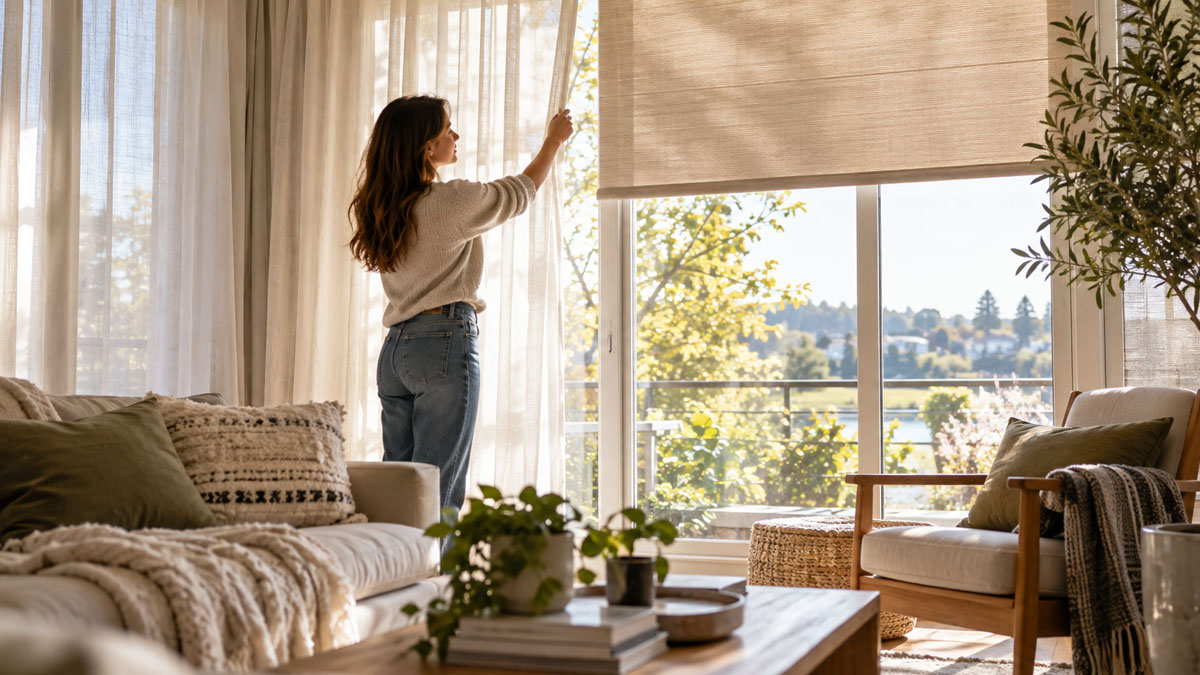
Good window coverings aren’t about choosing the prettiest fabric on the roll. They solve the tension between daylight, seclusion, heat and glare. Once you are clear about which one matters most in each room, the product choice becomes much simpler.
Start with the room, not the product
Pick the job before you pick the fabric. Every room asks for something different, and defining that job can save money and avoid rework.
A bedroom needs genuine darkness for sleep, while a street-facing living room needs daytime seclusion without requiring the lights to be switched on at noon. A home office needs glare control for screens. A west-facing family room needs better heat control in summer.
Write that priority down for each window, then match the covering to it.
This step prevents a common mistake. People fall for colour and pattern first, bring home a pretty sheer for a bedroom and then find they cannot sleep past sunrise. Others fit a heavy blockout in a dark hallway and lose the only useful daylight they had.
The priorities vary between homes. Properties near busy streets often need privacy most, while those with large areas of western glass need relief from the afternoon sun. The right answer depends on the outlook and the way each room is used, so start there.
Know the four types that actually matter
Once you know the job, fabric choice gets easier. Most coverings fall into four groups. When you understand what each group does well, you can match the fabric to the room without getting lost in colour charts and brand names.
Sheer fabrics scatter light
Sheers don’t block views, but they do soften them. A sheer curtain takes the edge off bright daylight and helps the room feel less exposed during the day. You can still see shapes outside, and daylight continues to fill the space. There is a clear trade-off: after dark, with the lights on, sheers won’t provide privacy. They need a second layer at night.
Light-filtering fabrics hit the middle
Light-filtering fabrics offer the middle ground that many living rooms need. They diffuse harsh sun so you don’t have to squint at the table, while still allowing enough light through to keep the room bright. They also provide daytime privacy from the street. Choose this option when you want an outlook and soft daylight without the intensity of direct sun. It won’t provide the full darkness needed for sleep.
Blockout fabrics stop light
Blockout means darkness rather than dimness. A good blockout roller or curtain stops outside light when it is closed and fitted well, which is what bedrooms need. It also suits media rooms used for daytime viewing. The same fabric provides privacy at night because light cannot pass either way. The cost is daylight. A closed blockout makes a room dark at midday, so pair it with a sheer if you also want softer light during the day.
Thermal fabrics slow heat
Thermal coverings work like a blanket at the glass. Cellular or honeycomb blinds trap air inside pockets, and that trapped air slows heat moving in or out. Foam-backed rollers do a similar job with a coated backing. Use them where the temperature near the windows swings from hot to cold. They don’t adjust like slats, but they help keep the room temperature steadier throughout the day.
Layering brings these groups together. A blockout roller behind a sheer curtain is a common pairing: use the sheer by day for soft light, then close the blockout at night for sleep and seclusion. This gives the window two practical settings without requiring products to be swapped.
Let orientation decide how hard the covering must work
Sun doesn’t hit every side of a home in the same way. Track its path and you will make a better choice.
East-facing glass gets sharp morning sun. It can wake children early and create glare across breakfast tables. Light-filtering fabric or tilted slats can control it while keeping the daylight useful.
West-facing glass takes the brunt of the afternoon heat. Summer sun can push warmth deep into living rooms and bedrooms, so these windows generally need stronger fabric and a tighter fit. Blockout or thermal-backed blinds can help most here.
South-facing windows in Sydney generally receive less direct sun, while north-facing glazing can receive substantial sun depending on the season and any external shading. Windows with limited direct sun rarely need heavy blockout purely for heat control. Privacy and soft daylight are usually the main priorities.
Western glazing is usually the first area to address.
If the budget is tight, focus spending on western glass and low eastern windows that catch long periods of morning sun, while keeping shaded windows simpler. Stand in each room in the morning and again in the late afternoon to see where glare lands and heat builds. Take those notes when you shop so you can explain your needs clearly and avoid buying more than the room requires.
Plan for night privacy, heat and UV
A daylight solution can fail at night. With lamps on, glass becomes reflective from inside but exposed from outside. Neighbours may not be able to see through sheers during the day, yet they can often see straight in after dark. If a room faces a street or another home, include a covering for night use. Light-filtering or blockout fabric restores seclusion when it matters.
Heat is another cost that can be easy to overlook. Windows transfer heat in both directions. During summer, they allow warmth to build up inside; in cooler months, indoor heat escapes through the glass. Heat gain and loss through windows accounts for 25%-30% of residential heating and cooling energy use (U.S. Department of Energy). Fabric choice therefore affects running costs as well as the room’s appearance.
Honeycomb blinds address this through their structure. Each cell holds still air, which transfers heat slowly and helps the room stay closer to the thermostat setting for longer.
Sun exposure also wears out interiors. Flooring, rugs, upholstery and artwork fade over time, while strong sunlight can bleach timber tones and dull fabric colour. Coverings with a high UV block rating help shield these surfaces and extend the usable life of floors and lounge suites. They won’t prevent all fading, but they can slow it considerably.
What to fit where: a room-by-room framework
With those principles in place, matching coverings to rooms becomes more straightforward. Use the notes you made about outlook and sun, then apply this framework as a starting specification that can be adjusted for budget and taste. If measuring and fitting seem risky, blinds sydney specialists can specify, measure, deliver and install the coverings instead of treating the work as a DIY job.
Bedroom
Bedrooms need darkness first because streetlights and early sun can interrupt sleep even through closed eyes. Fit blockout rollers or curtains with side channels or generous overlap, then add a sheer in front if you want soft daylight during the day. Keep the controls simple and quiet. Cordless operation works well because there is nothing to rattle or become tangled in the dark. If you share the room with a shift worker, blockout is essential. Reliable darkness and quiet operation matter more than pattern.
Living areas
Living rooms change throughout the day. In the morning they benefit from openness, while midday may require less glare. During the afternoon, heat control becomes important, followed by seclusion in the evening.
Static sheers cannot handle every change on their own. Adjustable coverings are particularly useful in living rooms because venetian blinds let you tilt the slats to direct light upwards or close off the view. Vertical blinds perform a similar job on wide sliding doors. Dual rollers provide a sheer setting and a blockout setting on one bracket. Choose one of these options when the room is used throughout the day. Comparing sheer and blockout fabrics side by side can also make the difference between their light levels easier to judge.
Home office
Home offices depend on comfortable screen use. Direct sun on a monitor causes eye strain and can wash out video calls. Light-filtering rollers reduce the intensity while keeping the room bright enough for work. Venetians provide finer control because the slats can be angled to direct light away from the desk. Where possible, place the desk side-on to the glass. Close the blind behind you during video meetings so your face isn’t left in shadow. The aim is steady, even light that does not change dramatically whenever clouds pass.
Bathroom and kitchen
Bathrooms and kitchens require privacy as well as resistance to moisture and mess. Frosted glass alone may not feel private at night, so use moisture-tolerant blinds that wipe clean and resist mould growth in steamy conditions. Faux timber venetians or PVC rollers are usually better suited to these rooms than untreated fabric. Keep the mechanisms simple. Steam and cooking residue build up quickly, making it important to choose a finish you will actually clean. Privacy still matters, but washability determines whether the covering continues to look good next year.
Make operation safe and simple to use daily
Some windows are difficult to reach, including tall voids, stairwells, skylights and glazing above doors. A pole may work for a while, but inconvenient controls often stop being used. Motorisation removes that difficulty by allowing a remote or wall switch to move the blind. Timers can also close coverings on western glass before the hottest part of the day, without anyone needing to climb or pull at cords.
There is a safety benefit as well. Cordless blinds have no loops that can catch, which matters in children’s rooms and play areas. Cordless or motorised controls are sensible in any home with young children or pets because they simplify daily use and remove a clear hazard.
Choose controls that will actually be used. If adjusting a blind requires two hands and a stool, it is likely to remain in one position. Connect its use to routines you already follow, such as closing western blinds before the afternoon heat builds. Consistent habits are often more useful than complicated settings.
Get tricky windows right and keep fabric in shape
Unusual window shapes need suitable hardware. Sliding doors require tracks that stack clear of the doorway, and vertical blinds or dual-track rollers allow people to walk through without ducking. Skylights need blinds that hold securely on a slope or flat roof plane. Internal shades reduce glare, while external shades intercept heat earlier. French doors need slim blinds that fit inside the frame so the handles can still turn. Narrow sidelights need slim side channels to limit light entering through gaps.
Fabric care determines how long coverings continue to look good. Bathrooms need mould-resistant coatings and regular airing, while dusty rooms benefit from wipeable slats or rollers that can be vacuumed. Sun-heavy windows need fade-resistant yarns and lighter colours that make bleaching less obvious. Ask what cleaning each fabric requires before buying it. If the upkeep sounds like a chore that will be skipped, choose the tougher finish. Good fabric with basic care will outlast cheap fabric left damp, although the difference becomes clear after a few summers rather than a few weeks.
Choose for the room first and then consider the sun it receives. Layer coverings when one fabric cannot handle both day and night requirements, and keep the controls safe and simple enough for daily use. The room will feel more comfortable when daylight, heat and seclusion are properly balanced.



