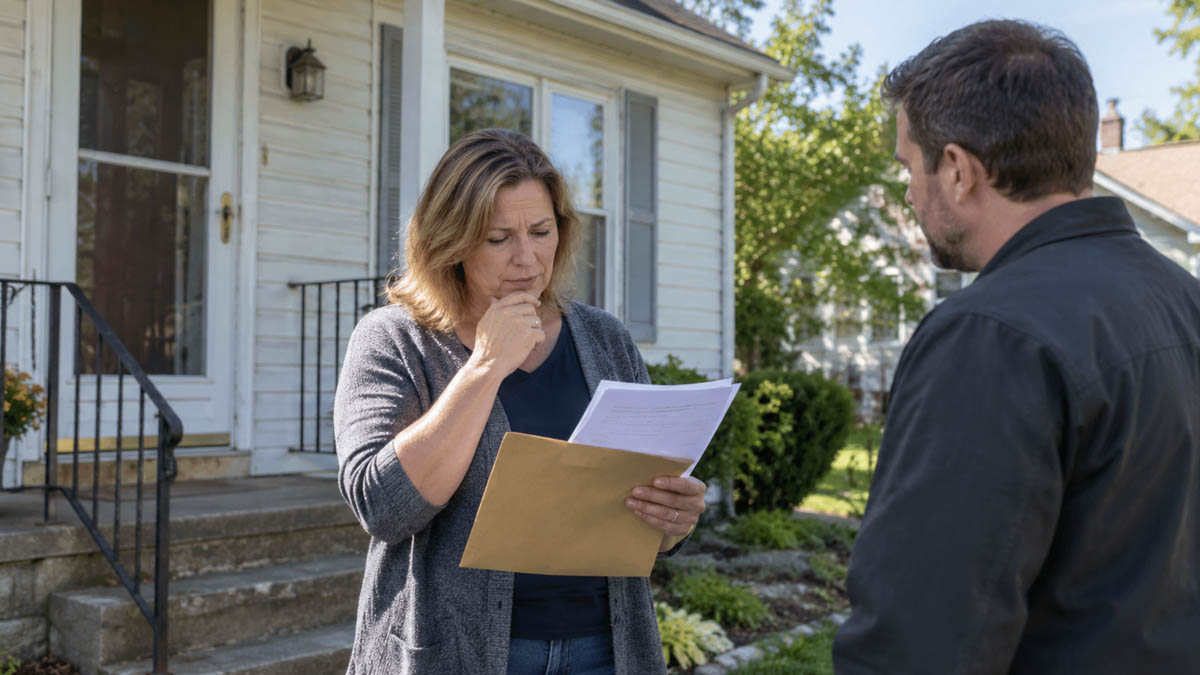
Four months. That is how long the average Ohio listing sits on the market once you count the repair negotiation, the appraisal gap, and the buyer who walks three days before closing. I have watched sellers in Grove City and Newark pull their homes off the market twice in a single year, convinced that the next offer would be the good one. It usually is not, and the reason has nothing to do with their house.
As-is sales changed that math for a lot of people. You skip the punch list, the showings, and the agent who tells you to repaint the kitchen before anyone will look at it. But the cash route comes with its own set of traps, and most sellers only discover them after they have already signed something. Here is what you need to know before you accept a number.
What “As-Is” Actually Means in an Ohio Sale
As-is is not a magic phrase. It is a contract term that shifts repair responsibility away from you and onto the buyer. In a traditional listing, a buyer’s inspection almost always turns into a second negotiation. They find a cracked foundation, you knock $8,000 off the price, and the closing gets pushed back two weeks while you argue about it.
An as-is sale removes that second round. The buyer looks at the property, prices in the condition, and closes on what they see. No repair credits, no re-trade after inspection, no contractor walking through your kitchen during dinner. For anyone selling a house with a failed furnace, a leaking roof, or forty years of accumulated stuff in the basement, that single change is worth real money in stress alone.
Here is where sellers get confused. As-is does not mean you can hide a known defect. Ohio operates under a doctrine that requires sellers to disclose material problems they know about, and you can read the actual disclosure framework through the Legal Information Institute. If your basement floods every spring and you know it, saying nothing does not protect you. It creates liability that can follow you after closing.
My take: as-is is a speed tool, not a liability shield. Use it to skip repairs, never to skip honesty.
Who Actually Buys Houses for Cash
Not everyone waving a cash offer is running the same playbook. You are typically looking at three types of buyers, and they behave very differently.
- Local investors who plan to renovate and resell or rent. They know your neighborhood block by block and usually close with their own funds.
- National wholesalers who assign your contract to someone else for a fee. The face you meet is often not the person who ends up owning the house.
- iBuying platforms that use an algorithm to price your home and charge a service fee on top of it. Fast, but rarely the highest number.
The difference matters because a wholesaler’s offer is only as solid as their buyer list. If they cannot find an end buyer, your closing date moves. A local investor with their own capital does not have that problem. If you want a clean answer, ask one direct question: are you buying this with your own money, or are you assigning it? The pause before the answer tells you plenty.
How to Judge a Cash Offer Without Getting Burned
A big number on a piece of paper is meaningless until you subtract the fees attached to it. This is the part I would push hardest on if I were sitting at your kitchen table.
Run every offer through these four checks, in this order:
- Net, not gross. Ask for the final number that lands in your account. Subtract commissions, closing costs, repair credits, and any “service fee.”
- Proof of funds. A real buyer can produce a bank statement or a lender letter. Ask for it before you sign anything.
- Closing timeline in writing. Vague promises about a fast close mean nothing. Get a date and a penalty if they miss it.
- Exit terms. If you need to stay a few weeks after closing, get that in the contract. Some buyers allow it, some charge rent.
I would also compare the cash number against what a listed sale would realistically net you, repairs included. Cash offers typically land below retail, and that gap is your convenience fee. Sometimes it is worth paying. Sometimes it is not, and knowing which one you are looking at is the entire decision.
Where Sellers Get Stuck: The Paperwork Nobody Explains
The contract itself is where most problems hide. Cash purchase agreements can run twenty pages, and the language is not written for you. Watch for these items specifically.
An inspection period that lets the buyer walk for any reason after locking you into a two-month timeline. A clause that lets the buyer assign the contract without your approval. An escape hatch tied to title issues that you could have fixed for a few hundred dollars. None of these are unusual, and none of them are automatically bad. What matters is that you see them before your signature is on the page.
Federal rules also apply here. Deceptive practices in real estate transactions, including misrepresenting what a buyer will pay, fall under the Federal Trade Commission. If someone pressures you to sign the same day, or refuses to let you take the contract to an attorney, that is your signal to walk. A legitimate buyer will wait a day. A bad one will not.
I have a simple rule for this. If the person on the other side of the table gets annoyed when you ask questions, the questions were worth asking.
When a Cash Sale Makes Sense, and When It Does Not
Cash offers solve specific problems. They are close to a miracle when you are facing a foreclosure deadline, managing an inherited property from another state, dealing with a house that needs more work than you can fund, or trying to relocate for a job next month. In those situations, speed is the whole point and the discount is a fair trade.
They make less sense when your home is in decent shape, you have six months of patience, and the local market is moving. In that scenario, listing will usually net you more, even after commissions and repairs. I would not take a cash offer in that position, and neither should you.
The honest middle ground is this. Get a cash number anyway, even if you plan to list. It costs you nothing, it gives you a floor to negotiate against, and it tells you what the fast option is actually worth in your specific zip code. Sellers who skip that step are negotiating blind.
One more thing worth knowing about how these transactions are structured. Federal law requires that most sellers receive a settlement statement itemizing every fee before closing, per HUD. If nobody hands you that document, ask for it. You are entitled to see where the money goes.
Plenty of homeowners in Columbus, Reynoldsburg, and Delaware have used the cash route well. They went in with a number in mind, they read the contract, and they used the speed to solve a real problem. Others took the first offer they heard because it came with a handshake and no paperwork, and they left money on the table.
Which one are you going to be? If you are weighing a fast sale against a listed one, start by comparing real numbers instead of promises. Plenty of homeowners start that search by talking with experienced Ohio Cash Home Buyers who work the local market daily, and there is no cost to finding out what your house would bring.