Commercial outdoor spaces are often reviewed when they are empty.
A courtyard looks spacious on a plane. An entrance plaza appears orderly before opening hours. A patio seems comfortable during a morning site visit, and a walkway feels wide enough when nobody is carrying packages, waiting for a ride, or moving around other people.
Then 3 p.m. arrives.
The sun has shifted. Pavement has been exposed for hours. Delivery traffic overlaps with customers. Employees take breaks outside. Shadows fall in different places, and the route that looked generous in the morning suddenly feels crowded.
That difficult hour can reveal more about an outdoor design than the easiest conditions ever will.
Find the Hour When the Space Works Hardest
Not every property has its most demanding period at 3 p.m.
A restaurant patio may be tested during the evening. An office courtyard could be busiest at lunch. A retail entrance may experience its greatest pressure during weekend shopping hours.
The idea is to identify the period when several demands overlap.
Look for a combination of:
- Heavy foot traffic
- Strong sun or glare
- Deliveries
- Employee breaks
- Customer waiting
- Peak parking activity
- Outdoor dining
- Carts or equipment
- People entering and leaving simultaneously
Designing around that period creates a more realistic picture of what the space needs.
Watch Where People Actually Stop
Plans show where people are supposed to move.
Real users show where they actually stop.
Someone waiting for a ride may stand beside the entrance rather than in the designated seating area. Customers may gather beneath the only available shade. Employees may choose a low wall as an informal seat because the planned benches are too exposed to afternoon sun.
These habits reveal whether the design supports real behavior.
Spend time observing the site before changing it.
Where do people naturally pause? Where do they avoid standing? Which path becomes crowded even though another route appears wider on paper?
Those observations can guide better decisions than assumptions about how the outdoor space should function.
Shade Should Follow Occupancy
A decorative tree at the edge of a property may look attractive without making the places people occupy more comfortable.
Shade needs to be considered according to time and location.
A seating area shaded at 9 a.m. may sit in direct sun by mid-afternoon. A building overhang may protect an entrance during one season and leave it exposed during another.
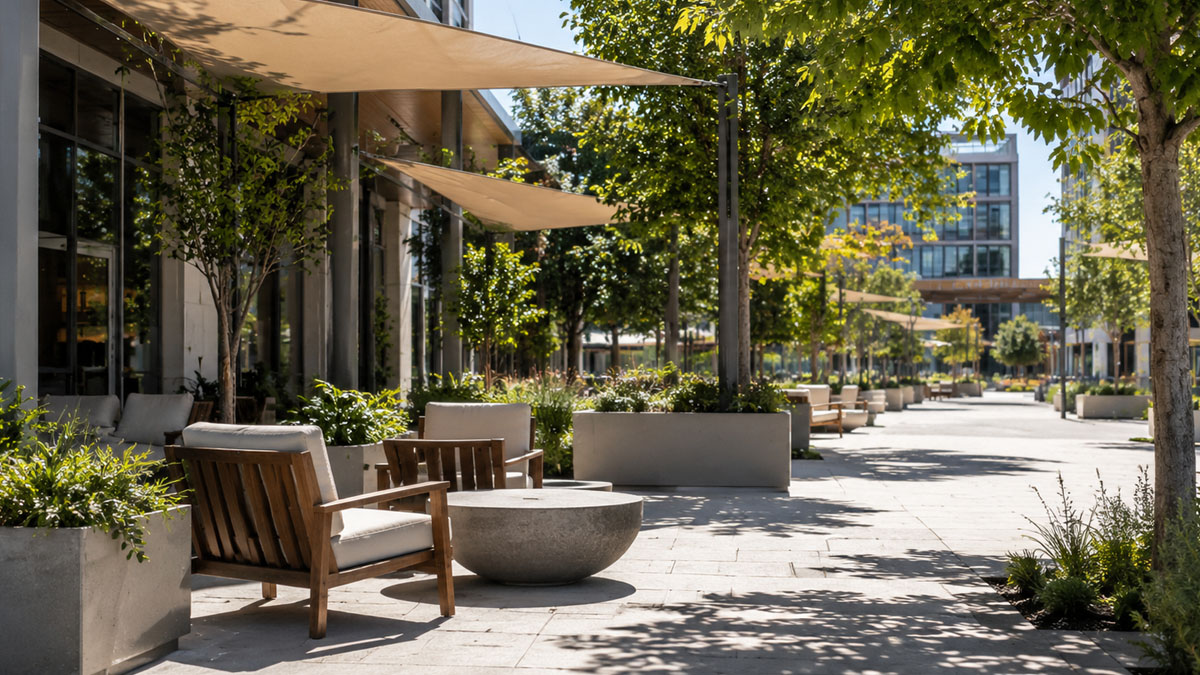
Businesses planning landscaping services can consider planting, structures, seating, patios, and circulation according to where people actually spend time during the property’s busiest periods rather than treating shade as a decorative feature placed wherever open space remains.
The most useful shade is usually where people would choose to stay even without it.
Large Hard Surfaces Change How the Space Feels
A broad plaza or concrete patio can look clean and organized, but its experience changes through the day.
Sun exposure, surrounding walls, reflected light, and the absence of overhead cover may make an open area feel very different in the afternoon than it did in the morning.
This does not mean hard surfaces are inherently uncomfortable.
It means large paved areas need context.
Trees, structures, planting, seating position, and building orientation can all influence how the space feels during peak use.
Material color and finish may also affect visual glare, so samples should be considered in outdoor light rather than only indoors.
Doorways Need More Space Than the Door Itself
Commercial entrances create temporary crowds.
One person stops to hold the door. Another waits for someone inside. A delivery driver arrives with a cart. Customers step aside to check a phone or find keys.
The area immediately outside the entrance therefore needs more than a clear path through the doorway.
Observe how people spread around it.
If seating, planters, signs, or other features occupy that informal waiting space, movement may become awkward during busy periods.
The goal is not to leave every entrance surrounded by empty pavement. It is to recognize that the door creates a small activity zone beyond its physical width.
Delivery Traffic Deserves Its Own Route
Service movement often happens at the same time customers are using the property.
Boxes, carts, maintenance equipment, waste collection, and supplier vehicles may all need access.
If those routes cross a primary customer walkway, the conflict may appear only during particular hours.
Map service movement separately from public movement.
Then look for the overlap.
A minor adjustment to a pathway, loading point, gate, or planting bed can sometimes create clearer separation without redesigning the entire property.
The strongest commercial outdoor spaces make necessary service activity possible without allowing it to dominate the customer experience.
Concrete Should Be Planned Around Actual Workload
Not every paved section experiences the same level of use.
A quiet employee walkway, busy storefront entrance, delivery approach, and vehicle-loading area place different demands on their surfaces.
At this stage, a commercial Concrete Contractor can evaluate slab layout, transitions, high-traffic areas, joints, access points, and other concrete details according to how different parts of the property are actually used rather than treating every paved area as equivalent.
The same principle applies to future maintenance.
The areas carrying the greatest workload deserve particular attention during routine property reviews.
Accessibility Transitions Need to Work During Crowded Conditions
A route can technically remain open and still become difficult to use when people gather around it.
Ramps, curb transitions, entrances, and accessible pathways should not depend on nearby areas staying empty.
Furniture, planters, signs, and waiting customers can narrow practical circulation even when the constructed route itself has not changed.
Review the space during peak activity.
Can people move through without weaving around temporary obstacles? Does outdoor seating spill into a main path? Are service activities occupying the same transition?
Designing for the busiest period helps keep intended routes functioning when they are needed most.
Test the Property After Rain Too
The hardest hour may arrive after a storm rather than during bright sun.
Water can reveal low spots, splash zones, muddy shortcuts, and places where people avoid the intended route.
Watch whether pedestrians walk around puddles and create unofficial paths through planting.
Notice whether runoff carries soil or mulch onto paved areas.
These observations can influence both landscape and hardscape decisions.
A space that works perfectly when dry may need small changes to remain comfortable and orderly in wet conditions.
Nighttime Can Create a Different Pressure Point
Some commercial properties become busiest after sunset.
Restaurants, entertainment venues, hospitality properties, and certain retail locations may experience their most demanding conditions at night.
The stress test changes.
Daytime shade becomes less important while lighting, visibility, wayfinding, and the relationship between pedestrians and vehicles become more noticeable.
A good outdoor design should therefore be tested during the period that matches actual business use rather than according to a generic daytime checklist.
Design for the Difficult Hour
Commercial outdoor spaces should not be judged only when they are empty, freshly cleaned, and photographed under comfortable conditions.
The more revealing test is the hour when the property is asking the most from the design.
Observe where people stop, how shade moves, where service traffic crosses customer routes, which surfaces carry the heaviest use, and how entrances behave when several activities happen at once.
Then repeat the test after rain or after dark if those conditions matter to the property.
A space designed around its hardest hour usually performs better during all the easier ones.