When I bought my 2021 Chevrolet Silverado 1500 LT Crew Cab 4WD, running boards were nowhere near my list of priorities. I remember walking the dealer lot, checking out different trims, and when the salesman pointed out a set on a higher trim model, I just shrugged. I’m 36, in decent shape, and getting in and out of a truck cab never struck me as a problem worth solving. If anything, I filed running boards under “looks nice, not necessary” — something guys added to make their truck look more aggressive on the road, not something that actually changed how you used the vehicle day to day.
Three years and a lot of family road trips later, I finally installed a set. This is the story of how my thinking changed, what I actually looked for when I started shopping, and what running boards have — and haven’t — done for my truck.
I Didn’t Think I Needed Them
For the first year or so of ownership, I stand by my original assessment. I’m the primary driver, I climb in and out of the Silverado dozens of times a week for my commute, and it never bothered me. The step-in height on a Crew Cab 4WD is noticeably higher than a car, but I adjusted to it almost immediately.
What I didn’t fully account for was that I’m not the only one using this truck.
Where the Problem Actually Showed Up
My wife and I have an 8-year-old, and between school drop-offs, weekend camping trips, and fishing runs, that truck gets used by the whole family constantly. My wife is average height, and while she never complained outright, I started noticing small things — she’d grab the door frame and kind of hop up, especially if she had a coffee in one hand and a bag in the other. Our son had it worse. At his height, getting into the back seat of a Crew Cab meant either a boost from one of us or an awkward scramble up using the seat and door handle as leverage.
It became more obvious on camping and fishing trips, when everybody’s getting in and out repeatedly with gear, coolers, tackle boxes, and camp chairs in hand. That’s when a two-second climb into the cab starts to feel like friction instead of a non-issue. I noticed it, then noticed myself noticing it, and eventually admitted that this wasn’t a cosmetic problem — it was a practical one that just didn’t affect me directly.
A Lesson From a Previous Mistake
Before I get into how I picked running boards, I want to mention something that shaped how I shop for truck accessories now. A while back, I bought an aftermarket accessory that was advertised as fitting “Silverado 1500,” full stop. No mention of cab configuration, no year range specifics that I bothered to read closely. I assumed since I owned a Silverado 1500, it would fit.
It didn’t. Turned out the product was designed for a Double Cab, not a Crew Cab, and the mounting points were completely different from what my truck needed. I ended up eating the return shipping cost and losing a couple of weeks waiting on a replacement. Lesson learned the hard way: “Silverado 1500” isn’t a complete fitment description. You need the cab configuration, the year, and sometimes the trim, because GM has changed body structure and mounting points across model years and configurations more than people realize.
That mistake is why, when I started looking at running boards, I went in with a much more careful eye toward fitment.
What I Actually Looked For
Once I decided running boards made sense for my family, I didn’t just search “running boards for trucks” and grab the first result. Here’s what mattered to me, in roughly the order I prioritized it:
Exact vehicle fitment. After my earlier mistake, this was non-negotiable. I needed something confirmed for a Crew Cab specifically, not a generic “fits Silverado 1500” listing. I wanted the year range and cab configuration spelled out clearly.
Stepping space for both rows. This was the whole point of the upgrade, so I paid attention to how much usable step length was available for both front and rear doors, not just a token step near the front.
Step width. A narrow step doesn’t do much for a kid or an adult trying to plant a foot securely, especially with hands full of gear. I wanted something wide enough to actually stand on comfortably, not just brush a foot against.
Surface design and traction. North Carolina isn’t the snowiest state, but we get plenty of rain, and camping and fishing trips mean wet, muddy boots climbing in and out. A slick step would be worse than no step at all from a safety standpoint.
Ground clearance. I didn’t want to trade convenience for scraping something every time I went down a gravel road or a mildly rutted camping site. This mattered more to me than most cosmetic factors.
Installation requirements. As someone who does occasional DIY work on the truck, I wanted something I could bolt on myself without drilling into the frame or needing specialty tools, if possible.
How I actually use the truck. Daily commuting, family trips, camping, fishing, and the occasional hardware store run. That’s a mix of on-road and light off-road use, so I needed something durable enough for that without being overkill.
What I Found
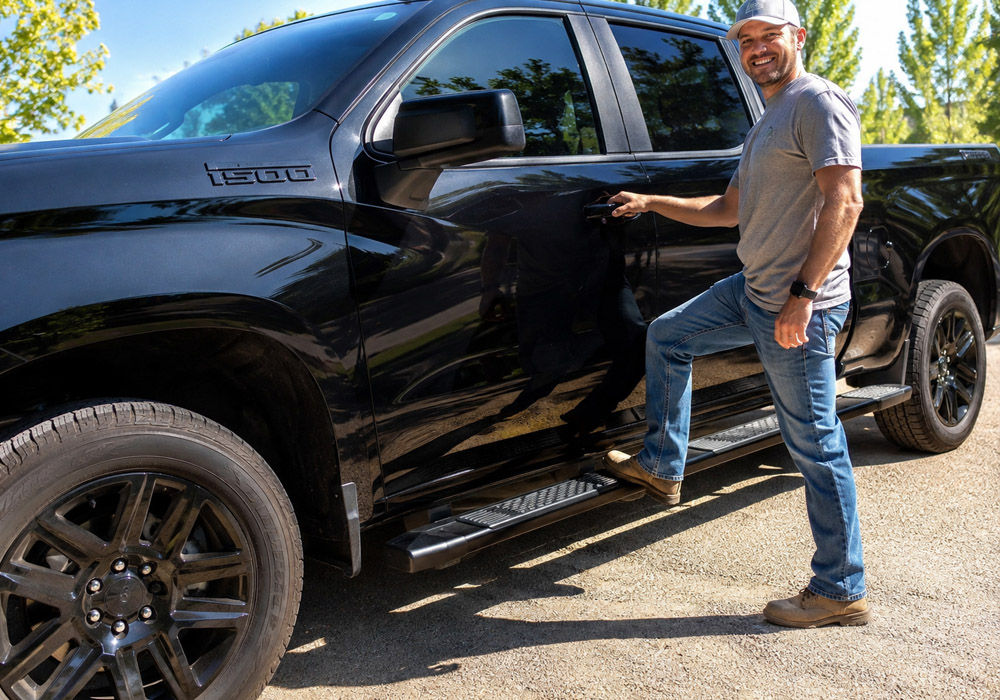
During my research, I came across a set of running boards from Joytutus listed as compatible with 2019–2026 Chevrolet Silverado 1500 Crew Cab models. Given my history with fitment mistakes, I didn’t take that listing at face value — I cross-checked it against my exact truck: a 2021 Silverado 1500 LT Crew Cab 4WD. The year range and cab configuration lined up, which was the first real green light.
Beyond fitment, the step width and surface design looked like they’d address the actual problem I was trying to solve — enough room for my wife and son to plant a foot securely, with a textured surface for grip rather than a smooth painted panel. I ended up going with that set of running boards for my Silverado 1500 after comparing it against a couple of other options that either didn’t specify Crew Cab fitment clearly or had noticeably narrower step surfaces in the photos and spec sheets.
I want to be clear I’m not presenting this as some definitive verdict on the brand — it’s just what fit my specific truck, my budget, and what I was trying to solve.
Installation
I did the install myself on a Saturday afternoon. It wasn’t a five-minute job, but it also wasn’t a full-day project. The mounting brackets used existing points on the frame, so there was no drilling involved, which mattered to me since I didn’t want to compromise the truck’s undercarriage or void anything related to rust protection. Having a second set of hands helped with lining up the brackets, but it’s realistically a one-person job if you’re patient about it.
What Actually Changed
I’m not going to tell you running boards transformed my truck ownership experience, because that would be overselling it. What I can say honestly is this: my wife stopped doing the little hop-and-grab motion getting into the passenger seat, and my son can now get into the back seat on his own most of the time, without needing a boost. On camping and fishing trips, when we’re loading and unloading the truck repeatedly with gear in hand, having a stable step point has made those trips feel less like a minor obstacle course.
For me personally, since I never had trouble getting in and out, the difference is negligible day to day. This upgrade was really about the rest of my family, not me — and I think that’s an important distinction for anyone considering Silverado running boards. If you’re single, or the only one who regularly rides in your truck, and you don’t struggle with the step-in height, this might not move the needle much for you.
The Trade-Offs Nobody Really Talks About
Running boards aren’t a purely upside decision, and I think it’s worth being straight about that.
Dirt and mud buildup is real. Living where we do, with regular rain and dirt roads on the way to camping spots, the boards collect grime fast. They need regular hosing down or wiping, especially if you don’t want that dirt transferring onto pant legs and shoes when people step on them.
Cleaning is another maintenance item. It’s not a big deal, but it’s one more surface to think about when washing the truck, and if you let mud dry on them, it takes more scrubbing than a quick rinse.
Ground clearance is a legitimate consideration. Running boards sit lower than the frame rails by design, so if you do any real off-roading — not just gravel campground roads, but genuine rock crawling or deep rutted trails — they can be more susceptible to scraping or catching on obstacles. For my use case, mild dirt roads and campsite access, this hasn’t been an issue, but it’s worth thinking about if your truck sees rougher terrain.
They’re simply not necessary for everyone. If you don’t have passengers who struggle with step-in height, or if you’re primarily concerned with off-road capability over convenience, running boards might just be added weight and another surface to maintain without solving a real problem for you.
Where I Landed
Looking back at my own decision-making process, I don’t think I was wrong to skip running boards initially — for how I used the truck at the time, they genuinely weren’t necessary. What changed wasn’t the truck; it was how our family used it. More passengers, more gear, more repeated trips in and out of the cab during camping and fishing outings shifted the calculus.
If you’re on the fence, I’d encourage you to think less about how the truck looks with them and more about who actually rides in it and how. That’s really what decided it for me. And if you do go shopping, learn from my earlier mistake — double-check the exact model year and cab configuration before you buy anything, whether it’s running boards or any other Chevrolet Silverado accessories. It’ll save you the return shipping and the headache.