That first crack of hail against a metal roof is a sound you never forget. You stand inside, coffee in hand, listening to what sounds like someone throwing marbles at your house, and you wonder: is this the storm that finally does it?
Here’s the honest answer: stone-coated steel handles hail better than almost any other roofing material, but it is not invincible. I have crawled across enough rooftops to know exactly what you’re about to face. This guide walks you through what to check, in what order, and what actually matters when you’re standing on the ground staring up at a roof that just took a beating.
What Hail Actually Does to Stone-Coated Steel
Stone-coated steel is a different animal than your neighbor’s asphalt shingles. The base is a steel panel, usually 26 or 28 gauge, coated with an acrylic layer and then embedded with stone granules that mimic the look of tile or shake. That construction gives it real advantages.
According to the National Oceanic and Atmospheric Administration, hail causes billions in property damage every year across the United States, and Texas consistently ranks near the top of the list for large hail events. The NOAA story on Texas hail damage (2024) notes that the state has recorded some of the costliest hailstorms in the nation’s history.
But here’s the thing about stone-coated steel specifically: the steel core doesn’t crack, doesn’t split, and doesn’t tear. What hail damages is the coating. When a stone-coated steel roof fails after hail, it fails in one of three ways:
- Granule loss: The stone chips get knocked loose, leaving bare spots on the panel.
- Coating fracture: The acrylic layer cracks or crazes, creating hairline fissures that can let moisture in over time.
- Denting: Large hail can leave visible dents, especially at the panel edges or around fasteners.
Notice what’s missing from that list: leaks. A stone-coated steel roof rarely leaks immediately after hail. The problems show up months or years later, when those hairline fractures expand through freeze-thaw cycles. So your inspection isn’t about finding today’s leak. It’s about finding the damage that will become a leak.
When You Can Safely Get On the Roof
Before you even think about ladders, you need to handle the safety side. The storm isn’t done just because the sun came out. Here’s my rule: wait at least 24 hours after the last hail stone falls, then walk the perimeter of your house and look for downed power lines, broken tree limbs, or wet spots on the ground near the foundation.
If the roof is still wet, you wait. Wet metal with stone granules is slicker than you’d expect, and one misstep on a two-story pitch is a hospital visit, not a roof repair. Dry conditions only, and always with a partner on the ground who can spot you and call for help if something goes wrong.
Also, warm weather matters. Inspecting when the coating is warm and flexible is easier on the material. A cold February morning after a freak hailstorm means the coating is brittle, and you could cause more damage just by walking on it.
The Ground Inspection You Should Do First
You’d be surprised how much you can diagnose without ever leaving the yard. Grab a pair of binoculars and walk a full circle around the house, stopping every ten feet or so to scan different sections of the roof.
You’re looking for the obvious signs: missing panels, lifted edges, or spots where the stone coating looks lighter than the surrounding area. That color shift is your first clue to granule loss. The granules are what give the roof its color, so a bare patch reads as a slightly different shade, especially when the sun hits it at an angle.
Next, check the ground. Look at your gutters, your downspouts, and the soil around the foundation. A scattering of stone granules in the gutter or on the ground near the downspout means the coating is shedding. A small amount after a big storm is normal. If you’re seeing a consistent trail of granules pouring out of the downspout, that’s a problem worth documenting.
While you’re on the ground, check the flashing. These are the metal transition pieces around your chimney, skylights, and roof valleys, and they take a beating in hail storms.
The NOAA National Centers for Environmental Information billion-dollar disaster data (2025) shows that severe storm events, including hail events, have grown in frequency and cost over the last decade, which means more homes are dealing with exactly this kind of inspection after every spring storm season.
On the Roof: The Systematic Walk Pattern
Now for the part that actually matters. Once you’re up there, do not wander around randomly. I’ve seen homeowners “inspect” a roof by walking to the ridge, looking at the valley, and climbing back down. That catches maybe a third of the damage.
Use what I call the strip method. Divide the roof into vertical strips, roughly three feet wide, from the eave to the ridge. Work your way across the roof one strip at a time, left to right. This guarantees you physically cover every panel, and it takes maybe twenty minutes on a typical 2,000 square foot home.
As you work each strip, you’re looking for three specific things:
- Impact marks: Dents that look like someone pressed a golf ball into the panel. Small dents are cosmetic. Deep dents, where the metal has clearly deformed, need attention.
- Granule displacement: Areas where the stone coating has been knocked away, leaving a smooth, darker patch. Run your hand over it. If the granules come off on your fingers easily, the coating is compromised.
- Coating cracks: Hairline fissures radiating outward from impact points. These are hard to see from the ground, which is exactly why you’re up here.
Pay extra attention to the panel seams and the fastener lines. Hail tends to strike the exposed edges hardest, and this is also where the coating layer is thinnest. Take photos of everything, even the spots that look fine. You’ll want the documentation if you file a claim.
The Stone Coating Test
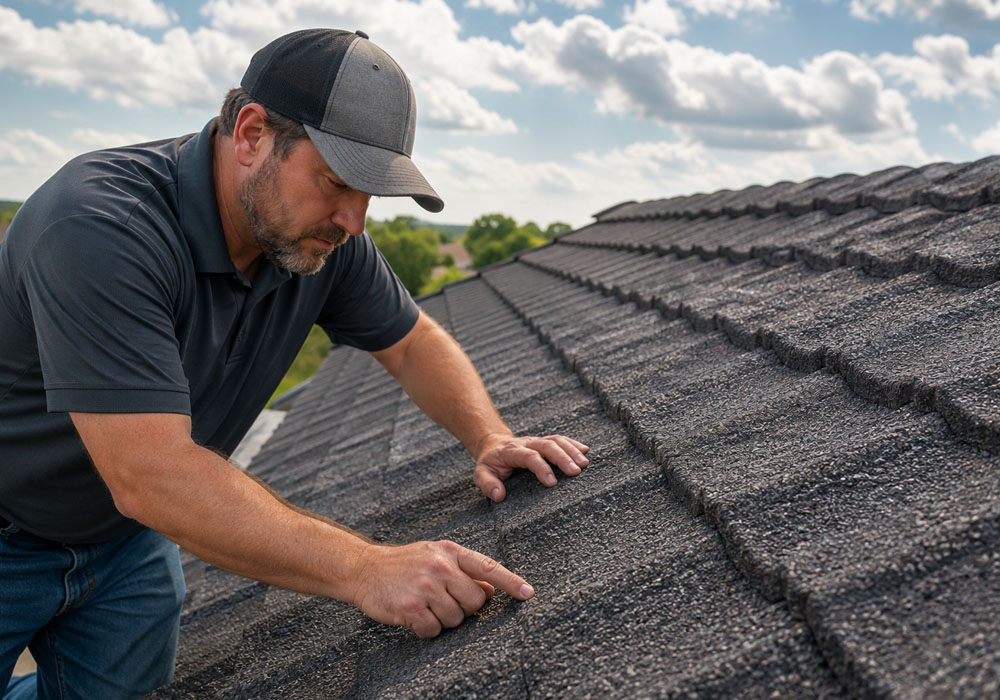
Here’s a hands-on test that tells you a lot about whether your coating is still doing its job. Find a spot that took a direct hail hit and gently press your thumb into the center of the impact mark and then pull away. If the coating feels soft, spongy, or flakes off under light pressure, the impact compromises the layer.
Then do the fingernail test. Scratch lightly at the edge of any bare spot with your fingernail. On a healthy roof, the coating is hard and the granules are firmly embedded. If you’re able to scrape off additional granules or if your fingernail leaves a visible groove, the coating has lost its integrity in that area.
This matters because the coating is the roof’s first line of defense. The Insurance Institute for Business & Home Safety research on hail damage (2023) found that roofing material performance under hail varies widely, and that the condition of the protective coating is one of the strongest predictors of whether a roof survives a hailstorm without leaking. A roof with compromised coating is a roof that’s going to leak, eventually, even if no water comes through today.
Documenting Damage for Your Insurance Claim
If you find damage, your next step is documentation. The insurance company is going to ask for proof, and your photos are your evidence. Here’s what to capture:
- Wide shots of the full roof from each side of the house.
- Close-ups of every dent, bare patch, and crack you found, with a coin or ruler for scale in each photo.
- Photos of the granules in your gutters and on the ground.
- A note on each photo of which side of the roof and approximately where on the roof face it was taken.
Call your insurance company before you schedule any repairs. Most policies cover hail damage, but they want to send their own adjuster out first. If you’ve already hired someone and started repairs, the adjuster can’t see the original damage, and that can complicate your claim.
One more piece of practical advice: don’t sign anything with a roofing contractor until you’ve had the insurance adjuster out. A good contractor will tell you the same thing. They want the adjuster to see the damage, too.
When to Call a Professional vs. When to DIY
Here’s where I draw the line. You can absolutely handle the inspection yourself for small hail events, pea-sized or marble-sized stone. You know your roof, you know your house, and you’re saving a service call.
But if you’re dealing with golf ball sized hail or larger, or if you found any of the following, it’s time to call in someone who does this every day:
- Visible dents deeper than a quarter of an inch.
- Bare patches wider than the palm of your hand.
- Coating cracks that you can see without a magnifying glass.
- Any damage on a roof that’s older than 15 years.
The reason is simple: a professional has the training to spot damage you’ll miss, and they have the tools to test panel integrity properly. Plus, if there’s a warranty on your roof, it might require professional assessment and repair to stay valid. And if you do need repairs, you want a contractor who works with stone-coated steel every week, not someone who installs asphalt and “can probably handle it.”
If you’re in the Kentucky area and need a second opinion after a storm, you can look up qualified metal roofing installation contractors in Lexington who offer free inspections and can assess whether your coating damage is cosmetic or structural.
The Bottom Line on Your Post-Hail Check
Your stone-coated steel roof is tougher than most, but every hailstorm is a roll of the dice. Granule loss, coating cracks, and deep dents are the damage patterns to watch for, and the earlier you catch them, the cheaper the fix.
Do the ground inspection first, then the strip method walk, then the coating test. Document everything. And don’t skip the professional assessment just because the roof isn’t leaking yet. The roof that leaks after the next storm is the one that had coating damage after this one.
So what’s sitting on your roof right now? A few cosmetic dings, or the beginning of a real problem? The only way to know is to get up there and look.