Key Legal Obligations in a QLD Contract of Sale
Buying or selling property in Queensland is one of life’s most significant financial decisions. At the heart of every transaction lies the Contract of Sale. This crucial legal document outlines the terms and conditions for transferring property ownership. Understanding its intricacies is not just important—ensure a smooth, compliant, and successful outcome for both buyers and sellers.
Queensland’s property laws are unique, with specific standard contracts and evolving regulations. From the mandatory cooling-off period to the new Seller Disclosure Scheme, which commenced in August 2025, there’s a lot to navigate. For many, partnering with expert local agents and legal professionals provides invaluable support.
In this comprehensive guide, we will break down the Queensland Contract of Sale. We’ll explore its key components, recent updates, and the legal obligations for all parties. Our aim is to equip you with the knowledge needed to approach your next property transaction with confidence.
Role of an Expert Real Estate Agency in Contract Preparation
The journey of a property sale often begins with a real estate agent, point out Blue Chip Property Managers experts. Their responsibilities extend far beyond simply finding a buyer; they play a pivotal role in initiating and managing the Contract of Sale process. Typically, a real estate agent will prepare the initial draft of the contract, filling in the essential details such as the property address, purchase price, deposit amount, and proposed settlement date. They act as the primary liaison between the buyer and seller, facilitating negotiations and ensuring all agreed-upon terms are accurately reflected in the document.
However, it’s crucial to understand that while agents can draft the initial contract, their role is primarily facilitative. For comprehensive legal protection and advice, the guidance of a solicitor or conveyancer is indispensable. A solicitor’s role involves a thorough pre-contract review, where they scrutinise every clause, identify potential risks, and ensure the contract aligns with our client’s best interests. This includes drafting any necessary special conditions that deviate from the standard terms. Conveyancers also provide expert guidance throughout the transaction, focusing on the legal transfer of property and ensuring all statutory requirements are met. We strongly advise that any alterations or additions to the standard contract, particularly special conditions, are prepared or reviewed by a legal professional to avoid ambiguities or unintended consequences. This collaborative approach, combining the agent’s market expertise with legal precision, forms the bedrock of a secure property transaction.
REIQ and QLS Standard Residential Property Contracts
In Queensland, the vast majority of residential and commercial property sales utilise the standard contracts jointly published by the Real Estate Institute of Queensland (REIQ) and the Queensland Law Society (QLS). These contracts are meticulously drafted to comply with Queensland property law and are regularly updated to reflect legislative changes, such as those introduced by the Property Law Act 2023. The most recent iteration, the 1st edition from August 2025, incorporates significant updates, particularly concerning the new seller disclosure scheme and electronic conveyancing mandates.
These standard forms are essentially legal templates designed to provide a fair and balanced framework for property transactions. They are, however, only accessible to QLS full members under strict licensing terms, ensuring their professional and compliant use. While the standard terms cover many common scenarios, every property transaction has unique aspects. This is where special conditions become vital. Special conditions are clauses added to the standard contract to address specific requirements or circumstances of a particular sale, such as finance approval, building and pest inspections, or the sale of an existing property. It is paramount that these special conditions are drafted by a legal practitioner to ensure they are legally sound, enforceable, and do not inadvertently contradict other parts of the contract. Altering the core standard terms directly is highly discouraged; instead, any modifications should always be introduced as clearly defined special conditions.
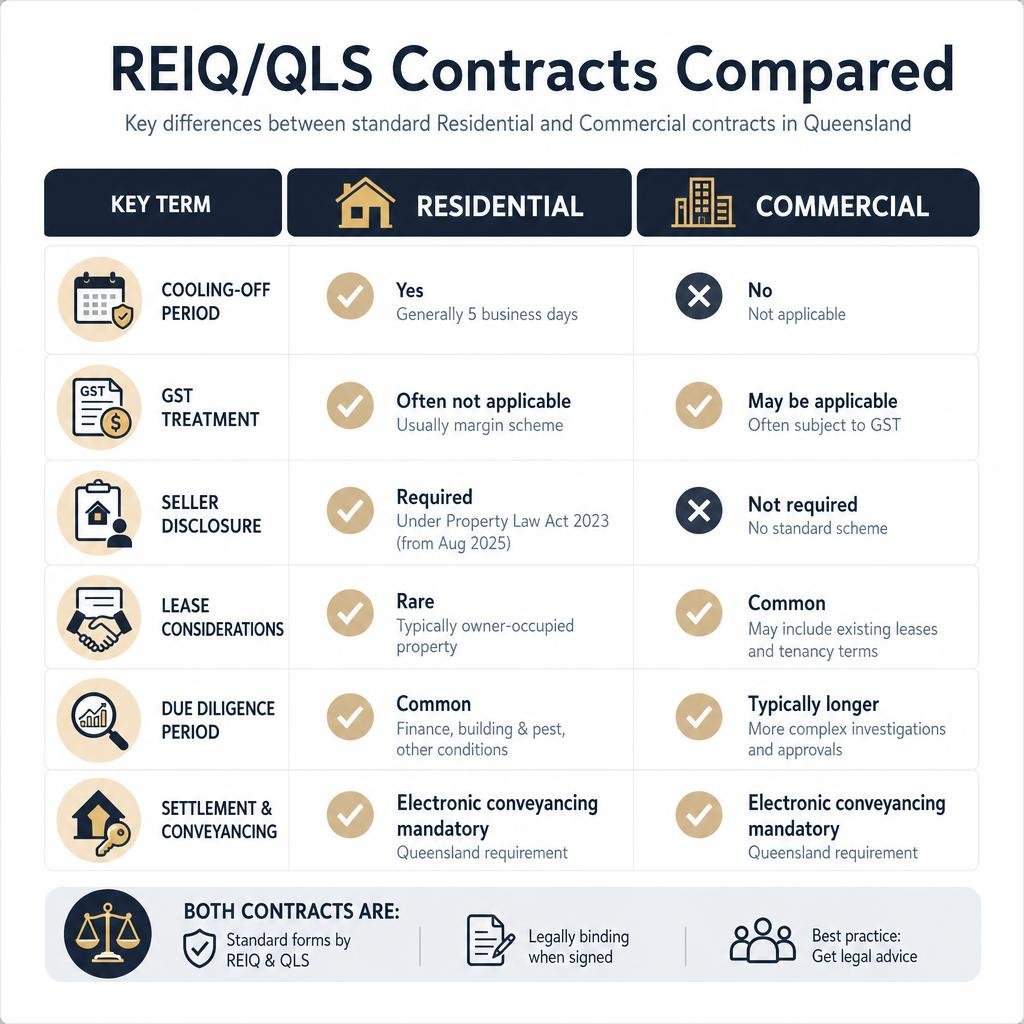
We can illustrate the distinctions between residential and commercial contracts with a conceptual comparison:
This table would typically highlight differences in areas such as cooling-off periods (generally applicable to residential, not commercial), GST treatment, specific disclosure requirements, and the complexity of lease arrangements.
New Seller Disclosure Scheme Under Property Law Act 2023
A significant development in Queensland property law is the new Seller Disclosure Scheme, which commenced on 1 August 2025, under the Property Law Act 2023 (PLA 2023). This scheme introduces mandatory disclosure requirements for sellers of residential property, aiming to provide buyers with greater transparency and protection. Under this scheme, sellers must provide a comprehensive Form 2 Seller Disclosure Statement, along with prescribed certificates, to the buyer before the contract is signed.
The Form 2 must contain all material facts about the property. This includes details about any encumbrances, easements, or restrictions affecting the land, as well as specific certificates such as body corporate certificates (for strata-titled properties), pool safety certificates (if applicable), and information regarding smoke alarms. The onus is on the seller to ensure these disclosures are accurate and complete.
The implications of non-compliance are substantial. If the seller fails to provide the required disclosure documents before the buyer signs the contract, or if the documents contain inaccuracies or omissions that constitute a material misrepresentation, the buyer may have the right to terminate the contract. This termination right can extend up to the settlement date, provided the buyer can prove the information was material, unknown at the time of signing, and would have prevented them from entering the contract had they known. This new scheme underscores the critical importance of meticulous preparation and legal advice for sellers to avoid potential disputes and contract terminations.
Cooling-Off Periods, Deposits, and Common Conditions
The Queensland Contract of Sale includes several protective mechanisms for buyers, most notably the statutory 5-business-day cooling-off period for residential properties. This period commences on the day the buyer receives a copy of the signed contract. It allows buyers an opportunity to conduct final due diligence, obtain legal advice, or simply reconsider their purchase without significant penalty. Should a buyer choose to terminate the contract during this cooling-off period, a termination penalty of 0.25% of the purchase price applies, with the remainder of any deposit paid being refunded. This cooling-off period does not apply to properties purchased at auction.
Deposits are a fundamental component of the contract, typically amounting to 10% of the purchase price, though this can be negotiated. The deposit is usually paid in two parts: an initial deposit upon signing the offer, and the balance of the deposit within a few days of the contract date. These funds are held in a trust account, usually by the real estate agent or solicitor, and are released at settlement or according to the contract’s termination clauses.
Beyond the cooling-off period, residential contracts often include common conditions that protect buyers, such as:
- Finance Approval:This clause makes the contract conditional upon the buyer obtaining satisfactory finance by a specified date. Buyers are generally required to take reasonable steps to secure finance.
- Building and Pest Inspections:This condition allows the buyer to arrange independent inspections of the property. If the reports reveal significant issues, the buyer may have grounds to negotiate repairs, a price reduction, or terminate the contract, provided they act reasonably.
- Pool Safety:If the property has a pool, the contract will stipulate requirements for a valid pool safety certificate by settlement.
These conditions provide crucial safeguards, and understanding their implications is vital for both parties.
How an Expert Real Estate Agency Manages Tax Withholding and Settlement
The process of settlement marks the official transfer of property ownership and involves a complex series of financial adjustments and document exchanges. An expert real estate agency, working in conjunction with legal professionals, plays a crucial role in ensuring a seamless settlement.
One key area is managing tax withholding obligations. This includes Goods and Services Tax (GST) withholding, which applies to certain new residential properties or commercial properties, and Capital Gains Tax (CGT) withholding for foreign residents. The contract will specify if the buyer is required to withhold a portion of the purchase price and remit it directly to the Australian Taxation Office (ATO). Navigating these obligations correctly is essential to avoid penalties for both buyers and sellers.
Modern property settlements in Queensland predominantly occur through electronic settlement platforms, known as Electronic Lodgement Network Operators (ELNOs), such as PEXA. This e-conveyancing system streamlines the process, allowing for the electronic lodgement of transfer documents and the immediate disbursement of funds.
At settlement, various outgoings are adjusted between the buyer and seller. These typically include council rates, water rates, and body corporate levies (for strata properties). The adjustments ensure that each party pays their fair share of these expenses based on the settlement date. Furthermore, if the property is tenanted, rent adjustments are also calculated. In the event of unforeseen circumstances, known as “Delay Events” (e.g., natural disasters, major system outages), the contract typically includes provisions that allow for an extension of the settlement date, preventing default due to factors beyond either party’s control. A skilled real estate agency will meticulously coordinate these elements, ensuring all financial obligations are met and documents are correctly exchanged, leading to a successful transfer of title.
Essential Criteria for Selecting Brisbane Real Estate Agents
Steps to Ensure Compliance and Smooth Settlement
Ensuring compliance and a smooth settlement requires a proactive approach from both buyers and sellers, supported by their chosen professionals. For sellers, providing accurate seller warranties is paramount. These are guarantees about the property’s condition, title, and absence of undisclosed encumbrances (such as unregistered easements or covenants). The contract will detail these warranties, and any breach can have significant legal repercussions.
Navigating potential defaults is another critical aspect. If either the buyer or seller fails to meet their contractual obligations by the due date, they may be considered in default. For instance, a buyer failing to settle on time or a seller failing to provide vacant possession could trigger default clauses. The contract outlines the rights and remedies for the non-defaulting party, which can include the right to terminate the contract, claim damages, or charge default interest for delayed settlement. Default interest rates are typically specified in the contract and can accrue daily until the default is remedied.
The role of an expert real estate agency extends to guiding clients through these potential pitfalls. They facilitate communication, help resolve issues before they escalate into disputes, and ensure all necessary documentation is prepared and lodged correctly. This includes verifying that the title is free from unexpected encumbrances and that all conditions precedent to settlement (like finance approval or satisfactory inspections) have been met.
A successful property transaction culminates in the handover of keys and the formal transfer of ownership. This moment is the result of careful planning, diligent execution, and expert guidance throughout the entire process.
By understanding the intricacies of the Queensland Contract of Sale and partnering with experienced professionals, both buyers and sellers can navigate the property market with confidence, achieving their desired outcomes efficiently and compliantly.
Conclusion
The Queensland Contract of Sale is a complex yet foundational document in any property transaction. From the standard REIQ/QLS forms to the critical new Seller Disclosure Scheme and the nuances of e-conveyancing, understanding its provisions is key to a successful experience. We’ve explored the roles of real estate agents, solicitors, and conveyancers, highlighting how their expertise ensures compliance and protects your interests. Whether you’re buying or selling, being informed about cooling-off periods, deposit handling, common conditions, and tax obligations empowers you to make sound decisions. By engaging knowledgeable professionals and understanding your legal obligations, you can navigate the dynamic Queensland property market with confidence, leading to a smooth and secure settlement.