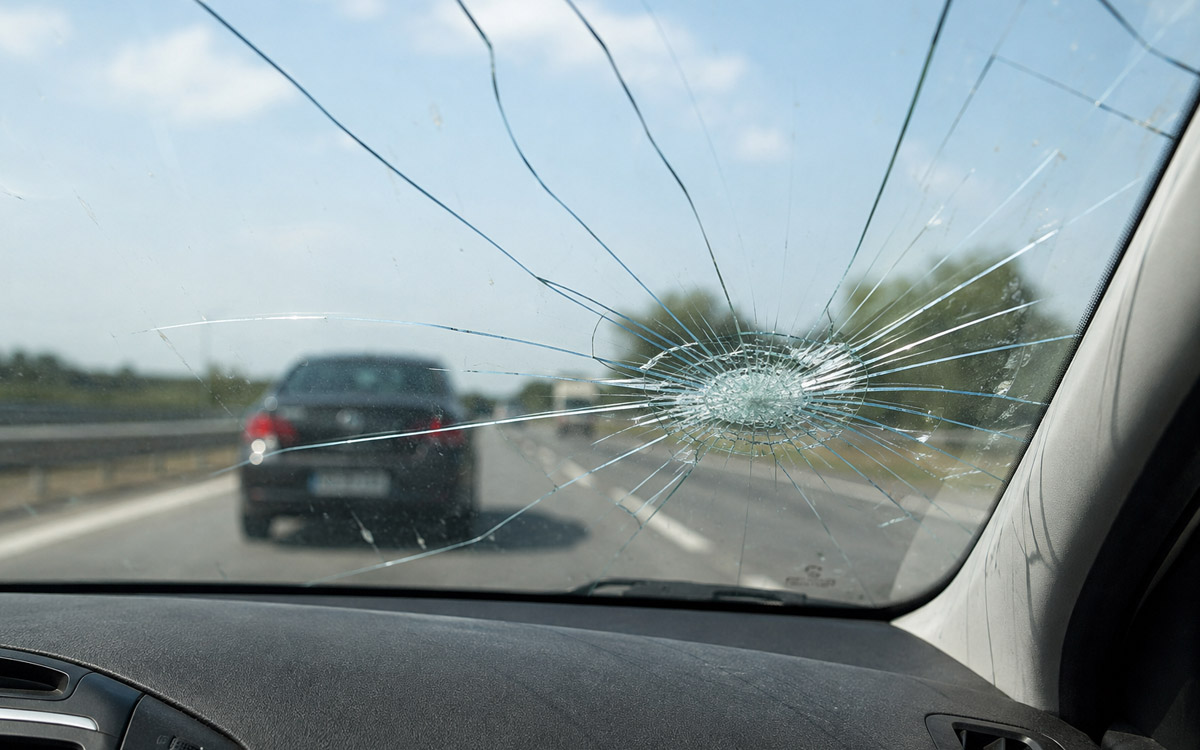
For most drivers, a chip or crack in the windshield is a purely cosmetic issue – something that’s annoying and they’d like to get rid of, but nothing to get too worked up about. This is far from optimal – in both the functional and safety sense. Something that allows air and noise through the windshield surely can’t be good news for the driver and passenger.
The Glass That Holds Your Car Together
A windshield is secured directly to the frame of a car with urethane adhesive which makes it a stress-bearing part of the chassis rather than a panel you can take out with no consequences. The body shell in a monocoque vehicle – almost all passenger cars – is dependent on the windshield to keep its rigidity.
The stats here aren’t just idle boasting. The front windscreen gives roughly 45% of the vehicle’s frontal structural strength in a crash, and it’s responsible for around 60% of the vehicle’s roof crush resistance in a rollover (NHTSA). That’s key. When a car flips, the windshield is one of the biggest things stopping the roof from squashing the occupants. A weakened windscreen means a compressed survival space.
The glass itself is laminated – two layers of glass stuck together with a PVB inter-layer. This inter-layer is what stops a broken windshield from shattering and throwing shards into the cabin. But this is only effective if the glass on both sides is intact, as the PVB loses its power when one of the surface panes is breached.
How A Small Chip Becomes A Serious Problem
If you know what causes crack propagation, you can also prevent its occurrence. Many times, the reason for the same is temperature. In winters, when you switch on your rear defogger or in summers when you park your car in direct sunlight, your car’s glass tends to expand and contract. A pre-existing chip will result in a stress zone in the glass and that’s where the crack starts to develop. The crack does not spread gradually over time; it becomes bigger when the temperature changes even by a small amount.
Besides temperature, you also have to consider road vibrations. Potholes, speed breakers, and bad roads will cause your windshield to flex and this also makes the existing chip expand. This continuous expansion can cause the crack to get bigger. A second impact, no matter how minor it is, can also damage the windshield. For example, if there is a stone chip close to the existing crack, the second one can start spreading soon. Then comes the glass matrix damage. The structure around the chip becomes weak in an invisible radius. This makes the impact zone larger than the actual impact.
The Repair Window Closes Fast
Timing plays a big role in cost and options here. A chip smaller than roughly the size of a 10p coin is often repairable through resin injection – a technician simply fills the break with transparent resin that restores the glass’s strength and blocks the spread of the break. The process is quick, relatively low cost, and frequently insured with no charge to you.
Once the break size has passed that point – or it is right on the edge of the windscreen where the liquid resin would leak out – the repair option is ruled out and the only solution left is a Windscreen replacement. This is a much bigger job with different insurance coverage issues. The longer a motorist goes without making the repair, the more likely a small, inexpensive fix is no longer possible.
What A Weakened Screen Means In A Crash
The passenger airbag in most vehicles doesn’t deploy directly at the occupant. It deploys toward the windscreen and uses the glass as a backstop – the screen redirects the airbag back toward the passenger. A windscreen that’s been weakened by a propagated crack, or that has started to separate from the urethane bond around its edges can deflect or fail during deployment. Instead of the airbag cushioning the passenger, it can redirect downward or to the side.
Moisture ingress makes this worse. Water works into a chip or crack and attacks both the PVB interlayer and the adhesive bond at the screen’s edge. UV exposure degrades the interlayer further over time. Neither process is visible from the driver’s seat, but both weaken the screen’s ability to function as a safety system.
Modern Sensors Make This More Complicated
A lot of cars now contain a camera or sensor fitted up near the top of the windscreen – systems that take care of lane departure warnings, automatic emergency braking, and adaptive cruise control. ADAS technology needs a clean, undamaged optical path to work correctly. A chip or crack close to the camera’s viewing field can distort sensor readings, potentially causing the safety systems to operate unpredictably while failing to send any alert on the dashboard.
And once that windscreen is eventually replaced, those sensors need to be recalibrated. But putting off the repair won’t prevent this process – it’ll just mean the sensors are operating with compromised input in the meantime.
Roadworthiness And The MOT
Any damage in the driver’s main line of vision, and any damage larger than 10mm across the rest of the screen will cause an MOT test failure. This aside, a vehicle with a chipped windscreen involved in a collision may find its insurance company casting a beady eye over any claims – especially if the chip had plenty of time to turn into a full-on crack which in turn led to the crash.
A chip caught early costs very little to fix. Left until it spreads, it costs significantly more – and in the worst case, it affects the outcome of the accident you were counting on the safety systems to prevent.