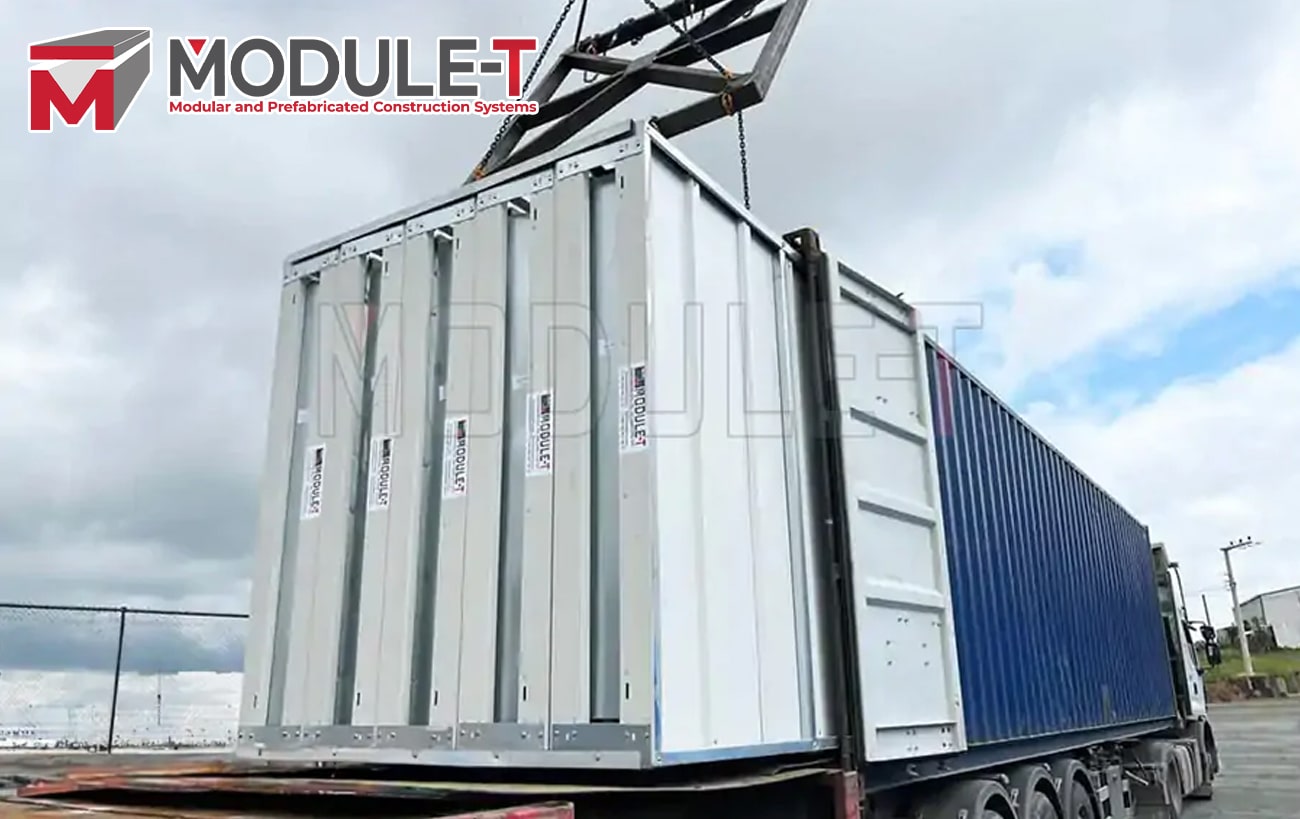
Construction and infrastructure projects often require operational spaces to be delivered before the main site reaches full capacity. Offices, storage areas, technical rooms and other support facilities need to be available quickly, especially on projects located far from established urban centers. 20 ft flat pack containers provide a practical format for these requirements because manufacturing, transportation, and on-site assembly can be planned as parts of the same project process.
How 20 ft Flat Pack Containers Support International Project Logistics
Construction and infrastructure projects often require operational spaces to be delivered before the main site reaches full capacity. Offices, storage areas, technical rooms and other support facilities need to be available quickly, especially on projects located far from established urban centers. 20 ft flat pack containers provide a practical format for these requirements because manufacturing, transportation, and on-site assembly can be planned as parts of the same project process.
Their standard dimensions support production consistency, while the modular structure allows individual units to be used separately or combined within larger site layouts. For contractors managing complex project sites, this creates a more structured alternative to building every operational space directly on location.
Why the 20 ft Format Works for Project Sites
A 20 ft unit offers enough internal area for common operational functions while remaining manageable from a transportation and installation perspective.
Module-T’s standard 20 ft flat pack model provides approximately 14.4 m² of usable area with external dimensions of 600 × 240 cm. Insulated sandwich panel options can also be selected according to project requirements.
The format can be used for compact offices, storage areas and other site functions. Where a larger facility is required, several units can be planned together within the same modular layout.
This makes the system particularly useful for projects where space requirements may develop in phases rather than being delivered as one large permanent structure from the beginning.
Flat Pack Design Simplifies Transport Planning
Transportation is one of the main factors that shapes modular building projects.
Fully assembled volumetric units can create logistical limitations when projects are located far from production centres or when access to the destination is restricted. Flat pack systems approach this issue by preparing structural and building components in a compact configuration before final assembly.
This can improve the use of transport capacity and make delivery planning easier for projects involving several units.
The benefit becomes more noticeable on larger sites. Instead of treating each building as a separate shipment, production, packaging, delivery and installation can be coordinated within a single project schedule.
This approach also reduces the need to make logistics decisions only after production has been completed. Transport requirements can be considered from the engineering stage onward.
Manufacturing Capability Matters in Larger Projects
A modular unit is only one part of the wider project delivery process.
When several buildings are required, consistency becomes more important. Structural systems, wall panels, insulation, doors, windows, and internal specifications need to follow the same technical framework across all units.
Module-T manufactures modular building systems in Turkey for projects in different international markets. Its manufacturer-led approach covers structural components and building elements, while its experience in large-scale overseas projects supports coordinated production, logistics and installation planning.
This becomes especially relevant when a project requires several types of supporting facilities within the same site. Offices, accommodation buildings, sanitary units, locker rooms, canteens and storage areas may all need to be produced within a coordinated programme.
For this type of requirement, production capacity alone is not sufficient. Engineering, manufacturing sequence and delivery planning also need to work together.
Standard Dimensions Still Allow Project-Specific Planning
Standardization is one of the main advantages of modular production, but project requirements are rarely identical.
A 20 ft unit may need a different internal arrangement depending on whether it will be used as an office, storage area, or another operational space. Climate conditions and local project specifications can also affect insulation, electrical systems, heating, cooling, and internal finishes.
These requirements are most efficiently managed before manufacturing begins.
For manufacturers working across different markets, the objective is to retain the efficiency of standardized production while adapting the unit to the technical and functional needs of the destination.
This is particularly important in multi-unit projects. A well-defined specification helps maintain consistency throughout production and reduces unnecessary variation between units.
From Single Units to Larger Facilities
The 20 ft format can support both small and larger site requirements.
A single unit may be sufficient for a compact operational function, while several units can be configured together when additional space is required. This gives project planners flexibility when the number of personnel or site functions changes during different phases of the project.
The same approach can also support future relocation or reconfiguration when project requirements change.
Rather than planning one fixed building for the entire project lifecycle, modular layouts can be developed around the actual operational needs of each phase.
Production and Logistics Need to Be Planned Together
The value of a flat pack system does not come only from the physical unit itself. The wider advantage lies in how engineering, production, transport, and installation are coordinated.
For 20 ft flat pack containers, compact transportation and controlled manufacturing can support more predictable project planning, especially when multiple buildings need to be delivered to the same location.
This places greater importance on the manufacturer’s role. Companies with experience in large-scale international projects are better positioned to manage repeated production requirements, destination-specific adaptations, and coordinated delivery schedules.
For contractors and project owners, the key decision is therefore not simply which unit size to select. It is whether the chosen manufacturer can manage the complete process from production planning through to delivery and site implementation.