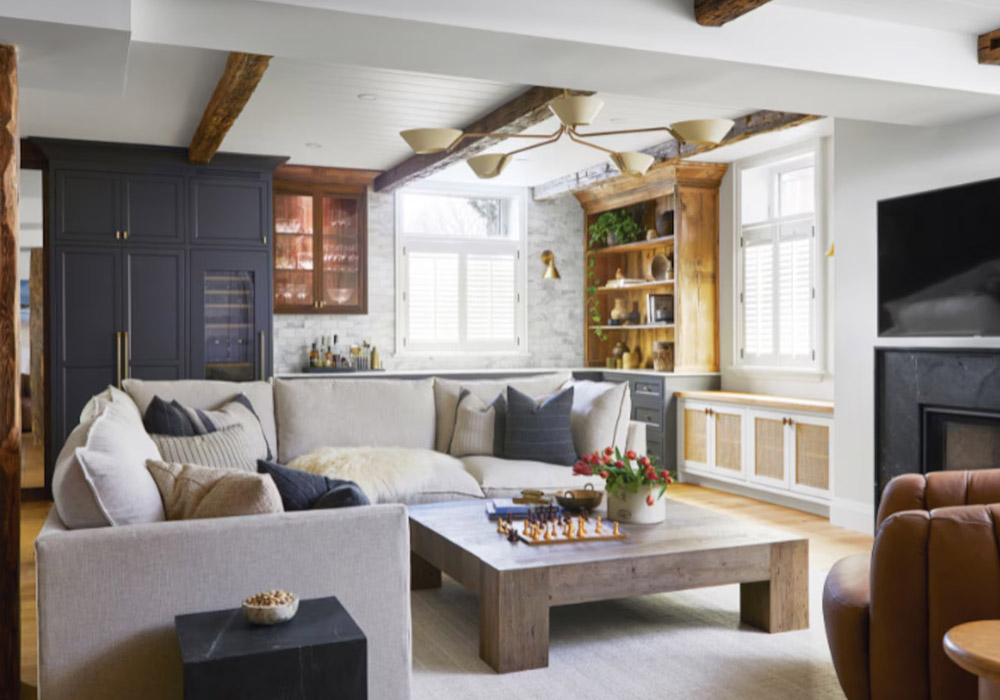
The issue with most dark rooms is not a lack of light. It’s that the light in the room cannot get to the areas it needs to reach (i.e. the walls, the ceiling, and the adjoining room). Throwing more light at the room does not fix the problem; if each light is not able to effectively illumine an adequate portion of the room, the result will always be the same – dark corners, dark edges, and a dark adjacent room beyond the door.
Start With The Ceiling, Not The Walls
If you have a room with good windows, but it still feels dark, first, check the ceiling. High ceilings can render windows almost useless by letting all the light rise and stay far above the areas that people live and work in. Dark or strongly textured ceiling finishes can absorb and scatter that precious light, too. A skylight is a direct way to yank light down into the center of your room, often doing the work that multiple tall windows couldn’t in any case.
If your room has a wasted ceiling but you’re short of wall space (for shelves, say) or stuck on the dark side of the block’s similarly tall neighbor, a skylight might get you all the sunlight you need. That sunlight will also move if you have actual mirrors (rather than the structural variety) in the room to bounce it around.
Fix The Hallway That’s Always Dark
Hallways are difficult to light because, well, they rarely have any walls, let alone exterior walls. This is where clerestory windows shine. Clerestories are those high, narrow windows set near the roofline, above normal sightlines. They allow light into a room without using up precious wall space. Plus, they don’t create a privacy concern like pumping light in through street-facing or bedroom windows does. A hallway with clerestory glazing along one side can open from a lightless tunnel you pass through to an actual room.
Solve The Basement Or Ground-Floor Shadow Problem
There’s no amount of paint, however scrupulous the hue-selection process, that can correct a room you just want to leave the moment you enter it. If you’re dealing with a basement room or even a ground-floor room that’s partially below grade (i.e. lower than the sightline of nearby windows), a light well is the most surefire solution. A light well is essentially a shallow shaft that’s been cut into the ground directly outside the room’s foundation, often outfitted with angled, reflective walls that capture daylight and focus it downward through a window that wouldn’t attract any light at all. It’s a bigger lift than almost anything else we’re talking about here, and it almost always requires a permit, but a light well is the singular architectural solution to this failure mode.
Add A Light-Capturing Buffer Room
A solarium or sunroom is a different animal than the solutions above because it’s an addition, not a modification. Think of it as a giant bay window that sends its beams of light deep into your home’s interior during more hours of the day because the windows can turn more of the sun’s face to your room. Meanwhile, the greenhouse effect will warm the air in the solarium itself. Add energy-efficient double glazing to that – or better yet, low-emittance (low-E) glass that’s coated to prevent UV rays from warming up your home, yet remain open to visible light – and that home heating bill will shrink noticeably. Of course, the cost will climb along with your dreams if you’re not careful. So, before you make a decision about a solarium versus a simple window upgrade, it helps to explore light-filled home ideas to see how a solarium shapes up against other daylighting additions in cost and payoff.
Let Light Travel Between Rooms
Often, it’s not that there’s no light in the house. It’s that one room gets all the light while another room inches away remains shadowed. Interior glass walls and sliding glass partitions allow the light that does exist to penetrate from one room to another. This is especially effective in older homes with a series of small, boxy rooms that weren’t initially intended to be open-plan. You don’t need to knock a wall down to give the impression of a connected room; you just need to allow the light to cross the divide.
Push Light Deeper Into The Room
Windows provide natural light, but often the light from a south-facing window doesn’t reach very far into a room. A light shelf can be constructed with very minimal alteration to the room; it’s essentially a horizontal panel above eye level that is angled to bounce the light up towards the ceiling and into the room. This reduces the need for artificial light sources.
Why This Matters Beyond Aesthetics
It’s not just about aesthetics. The U.S. Department of Energy states that daylighting can reduce lighting energy consumption by 50-80%. This transforms these elements from a mere expense to a cost-effective improvement. When coupled with the research on biophilic design that proves people simply feel better in daylight-connected spaces, the arguments for structural solutions just keep adding up the longer you tolerate a dark room.
Solar orientation matters where these features are concerned, too. Before you get too far into designing a light well or planning the size of a skylight, it’s certainly worth taking a compass to the room to verify that the sun’s even a potential light source. Building codes on skylights, light wells, and even structural glazing will determine what can happen with which piece of property, so it’s worth a call to the permitting office before you accidentally punch a hole in a roof or foundation wall.
None of these six features works as a solitary element, either. A skylight can raise the height of light within a potentially oppressive room, but it’s still the responsibility of the floor and walls to reflect and carry that light elsewhere. A light well may be an ideal solution for the deepest-buried basement, but your electricians are still going to need to fill in after the daylight hours. Treat these as a system, not a shopping list, and the dark room you’ve been living with becomes the brightest one in the house.