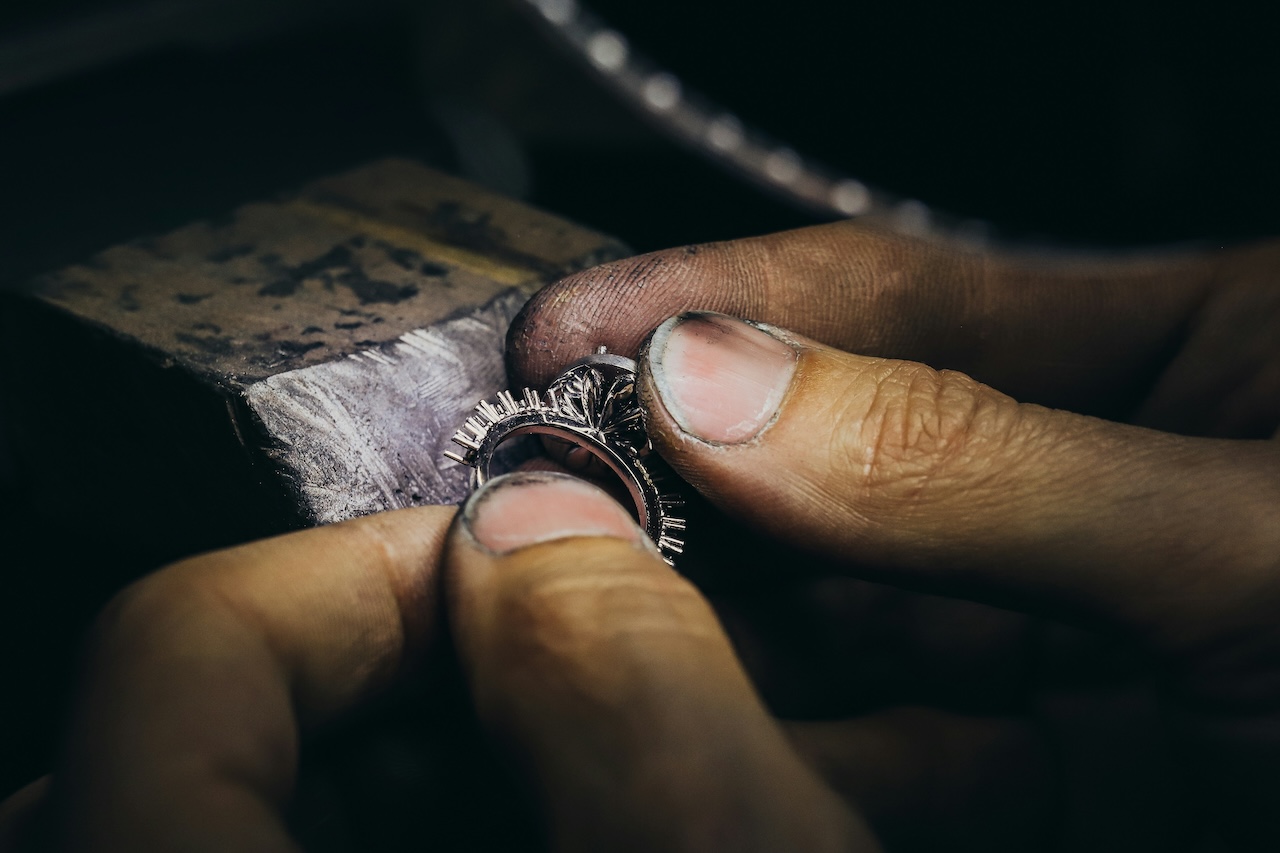
Screens now mediate most of what professionals do. Reports are written on them, meetings held through them, products designed and delivered via them. For a growing number of people who entered the workforce with those tools as a given, the accumulated weight of a keyboard-bound career has produced a counter-impulse. They want work where the output is physical, the mistakes visible, and the skill accumulates in the hands.
How the pull toward physical craft is reshaping career choices, and why the workbench has become a point of departure for professionals leaving screen-bound work
Jewelry making has emerged as one of the clearest expressions of this pull. It is not a hobby trend. It is showing up in career pivots and in enrollment patterns at craft schools. Professionals in their thirties and forties describe a persistent sense that the tools they work with have no texture, no resistance, no permanence. The shift raises questions about what people actually want from work, and why some crafts retain a pull that no amount of software sophistication seems to diminish.
The quiet move away from work that lives entirely on a screen
The frustration with screen-bound work is not primarily about fatigue. It has more to do with feedback loops. When someone completes a UX prototype, the outcome is inherently provisional: it can be revised indefinitely, and the relationship between effort and result is mediated by layers of abstraction.
Craft work behaves differently. A piece of metal either holds its shape or it does not. Solder either flows cleanly or it does not. That directness turns out to satisfy something that abstract work consistently leaves unmet.
Researchers studying occupational meaning have noted that tactile feedback, the sense that one’s actions produce a visible change in a physical object, correlates with stronger reported engagement. People who work with their hands in precision crafts build an archive of acquired judgment. They learn to read the behavior of a material, to adjust pressure in real time, to recognize when a piece is ready. That knowledge is embodied and cumulative in a way that spreadsheet proficiency generally is not.
What draws digital professionals to jewelry making
What makes jewelry making particularly attractive to people transitioning from screen-based careers is the combination of intellectual rigor and physical specificity. The craft requires genuine problem-solving. A maker must design a setting that holds a stone securely without obscuring it, understand how precious metals behave under heat, and calculate proportions at a scale of millimeters.
That skill is built through the hands-on practice offered at a jewelry making academy in Rome, the Accademia delle Arti Orafe, where master craftspeople work with students individually. Its professional training treats jewelry craft as a technical discipline. The craftsmanship it develops becomes artisan knowledge that transfers across a career.
The appeal is partly economic. High jewelry and precision metalwork occupy a segment of the luxury sector where skilled human production has not been automated out. Luxury brands continue to rely on trained specialists for handcrafted pieces, and employability in that sector depends on manual precision that cannot be acquired casually. For someone retooling a career, that market reality provides a concrete answer to where the skill leads.
There is also something more durable at work. Digital expertise depreciates quickly. Platforms change, languages evolve, tools become obsolete.
The core skills of jewelry making have changed far less over the past century than virtually any skill in technology. Reading metal, working stone, constructing a piece from raw material to finished object: that knowledge does not depreciate on a software cycle. It draws people who have already lived through one or two rounds of digital obsolescence.
Why structured training beats self-teaching in jewelry making
This is not a craft that yields to self-teaching in any efficient way. Much of what a skilled maker knows cannot be written down or conveyed through video. It lives in the adjustment of grip, the reading of heat color, the judgment built from making the same mistake many times. Only then does a maker learn to catch it at an earlier stage. That kind of knowledge transfers through direct transmission, from someone who has it to someone who is acquiring it, over time and under correction.
UNESCO recognizes traditional craftsmanship as intangible cultural heritage, stressing that what must be preserved is the knowledge and skill of the maker, transmitted through apprenticeship rather than the finished objects. The learning cannot be separated from the relationship between teacher and learner. It cannot be compressed without loss.
Structured programs taught by working professionals preserve that transmission path. They create conditions under which a student can fail productively, receive specific correction, and build judgment in real time. For someone whose professional feedback has been largely mediated by software or organizational hierarchy, this mode of learning can be genuinely disorienting at first. It is also considerably more effective at producing durable competence than working alone from filmed demonstrations.
What the return to hand skills signals about the next decade of work
The movement toward craft is not a rejection of professional life. The people drawn to jewelry making are not walking away from ambition or intellectual seriousness. They are redirecting those qualities toward work with a different relationship to permanence and the kind of visible mastery that accumulates over years rather than sprinting through product cycles.
As more cognitive tasks are absorbed by automated systems, the work that remains distinctively human tends to involve physical judgment, cultural knowledge, and the slow accumulation of skilled perception. Precision craft, including jewelry making, sits squarely in that category. The hands of a trained maker represent an investment that does not depreciate the way a software certification does.
What is already clear is that the appeal of the craft is no longer confined to those who grew up around it. The skills it builds are increasingly legible as professional assets, and the people pursuing them are choosing with open eyes.